

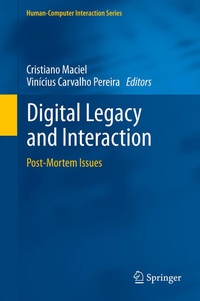
Digital Legacy and Interaction
Description

The views of leading researchers on the emerging topic of post-mortem digital legacy and posthumous interaction are explored in this book which combines the technical, cultural and legal aspects associated with this new branch of HCI.
The technical aspects of emerging technologies, both for the web and mobile platforms, are analysed and useful information is provided for system development, requirements engineering, and data management and storage. The authors address the cultural aspects of virtual identity, ethical problems, cross-culture differences regarding memories and death, bereavement, taboos and beliefs, and the visual/verbal representations of death. The legal aspects covered include regulation, property, privacy and conflicts between international and local jurisdictions.
The coverage of Digital Legacy and Interaction: Post-Mortem Issues is relevant to the development of systems that consider the influence of death, bereavement and mortality on Human Computer Interaction. The interdisciplinary approach that guides this book is intended to foster enriching and innovative discussions amongst HCI scholars and professionals.
Cristiano Maciel and Vinícius Carvalho Pereira are researchers at LAVI (Laboratory of Interactive Virtual Environments) and professors at UFMT (Federal University of Mato Grosso, Brazil).
Reviews / Votes
From the book reviews:
"It is inherently interesting to read the reflections and research of ten scholars who address these emerging issues. Any reader will enjoy stretching her thinking while reading this collection. . The book addresses a number of interesting questions. . No special technical skills are required to profitably read and enjoy thinking about our digital life after death." (Brad Reid, Computing Reviews, April, 2014)
More details
Other editions
Additional editions
Content
Preface.- The Fate of Digital Legacy in Software Engineers' View: Technical and Cultural Aspects.- Living with the Dead: Emergent Post-Mortem Digital Curation and Creation Practices.- The Persistence of Memory Online: Digital Memorials, Fantasy, and Grief as Entertainment.- The Internet Generation and the Posthumous Interaction.- Narrating the Digital: The Evolving Memento Mori.- Tombstone Technology: Deathscapes in Asia, the U.K. and the U.S..- "What Happens to my Facebook Profile when I Die?": Legal Issues Around Transmission of Digital Assets on Death.
