

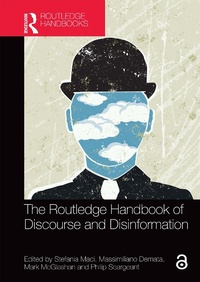
The Routledge Handbook of Discourse and Disinformation
1st Edition
Published on 30. November 2023
454 pages
978-1-000-99011-9 (ISBN)
Description

This handbook offers a comprehensive overview of research into discourses of disinformation, misinformation, post-truth, alternative facts, hate speech, conspiracy theories, and "fake news".
Divided into two sections, it provides a detailed look at the methodological challenges and approaches for studying disinformation, along with a wide range of case studies covering everything from climate change denial to COVID-19 conspiracies. The studies address how discourses of disinformation are constructed and developed, what rhetorical and persuasive strategies they employ, how disinformation can be discerned from real news, and what steps we might take in order to create a more trustworthy news environment.
Authored by leading experts from around the world, and showcasing the most up-to-date methodological approaches to the topic, the volume makes a significant contribution to current linguistic research on politics, and is an essential guide to the discourses of disinformation for advanced students and researchers of English language studies, linguistics, and media and communication studies.
Divided into two sections, it provides a detailed look at the methodological challenges and approaches for studying disinformation, along with a wide range of case studies covering everything from climate change denial to COVID-19 conspiracies. The studies address how discourses of disinformation are constructed and developed, what rhetorical and persuasive strategies they employ, how disinformation can be discerned from real news, and what steps we might take in order to create a more trustworthy news environment.
Authored by leading experts from around the world, and showcasing the most up-to-date methodological approaches to the topic, the volume makes a significant contribution to current linguistic research on politics, and is an essential guide to the discourses of disinformation for advanced students and researchers of English language studies, linguistics, and media and communication studies.
More details
Series
Edition
1. Auflage
Language
English
Place of publication
London
United Kingdom
Publishing group
Taylor & Francis Ltd
Target group
College/higher education
Illustrations
40 Tables, black and white; 28 Line drawings, black and white; 11 Halftones, black and white; 39 Illustrations, black and white
ISBN-13
978-1-000-99011-9 (9781000990119)
Copyright in bibliographic data and cover images is held by Nielsen Book Services Limited or by the publishers or by their respective licensors: all rights reserved.
Schweitzer Classification
Other editions
Additional editions
Stefania M. Maci | Massimiliano Demata | Mark McGlashan
The Routledge Handbook of Discourse and Disinformation
Book
approx. 12/2025
1st Edition
Routledge
€76.50
Not yet published
Stefania M. Maci | Massimiliano Demata | Mark McGlashan
The Routledge Handbook of Discourse and Disinformation
Book
11/2023
1st Edition
Routledge
€290.80
Shipment within 10-20 days
Persons
Stefania M. Maci is Full Professor of English Language at the University of Bergamo, where she is the coordinator of the MA in Digital Humanities and Director of the Research Centre on Specialised Language. Her research is focussed on the study of the English language in academic and professional contexts.
Massimiliano Demata is Associate Professor of English Linguistics at the University of Turin. He has published monographs, papers, and book chapters on British and US political discourse, nationalism and discourse, populism, computer-mediated communication, and climate change refugees.
Mark McGlashan is Senior Lecturer in English Language at the Birmingham Institute of Media and English, Birmingham City University. Mark's research interests predominantly centre on the synthesis and application of methods from corpus linguistics and (critical) discourse studies to study a wide range of social issues, and his recent work has focussed on relationships between language and abuse. Mark is co-editor (with Professor John Mercer) of Toxic Masculinity: Men, Meaning and Digital Media (Routledge, 2023).
Philip Seargeant is Senior Lecturer in Applied Linguistics at the Open University, where he teaches and researches language and communication with a political focus on political discourse. His recent books include The Art of Political Storytelling, Political Activism in the Linguistic Landscape, and Crisis Leadership: Boris Johnson and Political Persuasion during the Covid Pandemic.
Massimiliano Demata is Associate Professor of English Linguistics at the University of Turin. He has published monographs, papers, and book chapters on British and US political discourse, nationalism and discourse, populism, computer-mediated communication, and climate change refugees.
Mark McGlashan is Senior Lecturer in English Language at the Birmingham Institute of Media and English, Birmingham City University. Mark's research interests predominantly centre on the synthesis and application of methods from corpus linguistics and (critical) discourse studies to study a wide range of social issues, and his recent work has focussed on relationships between language and abuse. Mark is co-editor (with Professor John Mercer) of Toxic Masculinity: Men, Meaning and Digital Media (Routledge, 2023).
Philip Seargeant is Senior Lecturer in Applied Linguistics at the Open University, where he teaches and researches language and communication with a political focus on political discourse. His recent books include The Art of Political Storytelling, Political Activism in the Linguistic Landscape, and Crisis Leadership: Boris Johnson and Political Persuasion during the Covid Pandemic.
Content
1. The Various Dimensions of Disinformation: An Introduction
Part I: Genres and methodologies
2. The Expression of Bias in (Online) Newspaper Headlines
3. Critical Discourse Analysis Approaches to Investigating Fake News and Disinformation
4. Introducing Digital Source Criticism: A Method for Tackling Fake News and Disinformation
5. A Model for Understanding and Assessing Semi-Fake Scientific News Reporting
6. Misinformation Detection in News Text: Automatic Methods and Data Limitations
7. Fakespeak in 280 Characters: Exploring the Language of Disinformation on Twitter through a Comparative Corpus-based Approach
8. Debunking Fake News through the Multimodal Composition of Internet Memes
9. "It's never about #ProLife, it's about punishment, hate, and religious repression." Polarising Discourses and Disinformation in the Abortion Debate on Twitter
10. Investigating the Language of Fake News across Cultures
Part II: Case studies
A. Politics
11. Disinformation and Immigration Discourses
12. Brexit and Disinformation
13. New Dogs, Old Tricks. A Corpus-Assisted Study of the 'Art' of Delegitimisation in Modern Spoken Political Discourse
14. The Military's Approach to the Information Environment
15. Attitudes about Propaganda and Disinformation: Identifying Discursive Personae in YouTube Comment Sections
16. Citizens' Perspectives on the News Media and Democracy: a Citizens' Panel Case Study from Wales
B. Society
17. (Dis)information and Ethical Guidelines: A Critical Discourse Analysis of News Reporting on Violence against Women
18. Online Gendered and Sexualised Disinformation against Women in Politics
19. The Rainbow Conspiracy: A Corpus-Based Social Media Analysis of Anti-LGBTIQ+ Rhetoric in Digital Landscapes
20. The Discourses of Climate Change Denialism across Conspiracy and Pseudoscience Websites
21. Reframing of Fake in Art Discourse
C. Medical discourses
22. Exploring Health-related Misinformation, Disinformation and "Fake News"
23. The COVID-19 Infodemic on Twitter: Dialogic Contraction within the Echo Chambers
24. COVID-19 Parody Fake Voice Messages on WhatsApp
25. The Impact of Covid-19 Reports on Multicultural Young People's Social and Psychological Well-Being: Novel Experiential Metaphors in an ELF-Mediated Debate on Fake News
26. Mapping Polylogical Discourse to Understand (Dis)Information Negotiation: The Case of the UK Events Research Programme
Index
Part I: Genres and methodologies
2. The Expression of Bias in (Online) Newspaper Headlines
3. Critical Discourse Analysis Approaches to Investigating Fake News and Disinformation
4. Introducing Digital Source Criticism: A Method for Tackling Fake News and Disinformation
5. A Model for Understanding and Assessing Semi-Fake Scientific News Reporting
6. Misinformation Detection in News Text: Automatic Methods and Data Limitations
7. Fakespeak in 280 Characters: Exploring the Language of Disinformation on Twitter through a Comparative Corpus-based Approach
8. Debunking Fake News through the Multimodal Composition of Internet Memes
9. "It's never about #ProLife, it's about punishment, hate, and religious repression." Polarising Discourses and Disinformation in the Abortion Debate on Twitter
10. Investigating the Language of Fake News across Cultures
Part II: Case studies
A. Politics
11. Disinformation and Immigration Discourses
12. Brexit and Disinformation
13. New Dogs, Old Tricks. A Corpus-Assisted Study of the 'Art' of Delegitimisation in Modern Spoken Political Discourse
14. The Military's Approach to the Information Environment
15. Attitudes about Propaganda and Disinformation: Identifying Discursive Personae in YouTube Comment Sections
16. Citizens' Perspectives on the News Media and Democracy: a Citizens' Panel Case Study from Wales
B. Society
17. (Dis)information and Ethical Guidelines: A Critical Discourse Analysis of News Reporting on Violence against Women
18. Online Gendered and Sexualised Disinformation against Women in Politics
19. The Rainbow Conspiracy: A Corpus-Based Social Media Analysis of Anti-LGBTIQ+ Rhetoric in Digital Landscapes
20. The Discourses of Climate Change Denialism across Conspiracy and Pseudoscience Websites
21. Reframing of Fake in Art Discourse
C. Medical discourses
22. Exploring Health-related Misinformation, Disinformation and "Fake News"
23. The COVID-19 Infodemic on Twitter: Dialogic Contraction within the Echo Chambers
24. COVID-19 Parody Fake Voice Messages on WhatsApp
25. The Impact of Covid-19 Reports on Multicultural Young People's Social and Psychological Well-Being: Novel Experiential Metaphors in an ELF-Mediated Debate on Fake News
26. Mapping Polylogical Discourse to Understand (Dis)Information Negotiation: The Case of the UK Events Research Programme
Index
