

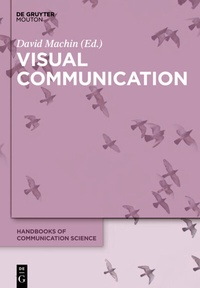
Visual Communication
Description

The primary goal of the volume on "Visual Communication" is to provide a collection of high quality, accessible papers that offer an overview of the different academic approaches to Visual Communication, the different theoretical perspectives on which they are based, the methods of analysis used and the different media and genre that have come under analysis. There is no such existing volume that draws together this range of closely related material generally found in much less related areas of research, including semiotics, art history, design, and new media theory. The volume has a total of 34 individual chapters that are organized into two sections: theories and methods, and areas of visual analysis. The chapters are all written by quality theorists and researchers, with a view that the research should be accessible to non-specialists in their own field while at the same time maintaining a high quality of work. The volume contains an introduction, which plots and locates the different approaches contained in it within broader developments and history of approaches to visual communication across different disciplines as each has attempted to define its terrain sometimes through unique concepts and methods sometimes through those borrowed and modified from others.
More details
Other editions
Additional editions
Person
Content
2 - Part I [Seite 13]
2.1 - Introduction [Seite 15]
3 - Part II [Seite 33]
3.1 - 1 The cognitive semiotics of the picture sign [Seite 35]
3.2 - 2 Relevance Theory as model for analysing visual and multimodal communication [Seite 63]
3.3 - 3 Military hardware as affective objects: Towards a social semiotics of militainment television [Seite 83]
3.4 - 4 Foucauldian discourse analysis: Photography and the social construction of immigration in the Greek national press [Seite 103]
3.5 - 5 Linguistic fetish: The sociolinguistics of visual multilingualism [Seite 147]
3.6 - 6 Sex and Race go Pop [Seite 165]
3.7 - 7 The visual semiotics of Tarot images: A sociocultural perspective [Seite 185]
3.8 - 8 Colour language hierarchy [Seite 207]
3.9 - 9 Applying psychological theory to typography: is how we perceive letterforms special? [Seite 227]
3.10 - 10 Toys or the rhetoric of children's goods [Seite 255]
3.11 - 11 Visual Aspects of British Tabloid Newspapers: 'Image Crowding Out Rational Analysis'? [Seite 273]
3.12 - 12 British press photographs and the misrepresentation of the 2011 'uprising' in Libya: A Content Analysis [Seite 293]
3.13 - 13 Looking for what counts in film analysis: A programme of empirical research [Seite 313]
3.14 - 14 In the eye of the beholder: Visual communication from a recipient perspective [Seite 343]
3.15 - 15 Questioning bohemian myth in Weimar Berlin: Reinterpreting Jeanne Mammen and the artist function through her illustrations Der Maler und sein Modell 'The Painter and his Model' (1927) [Seite 369]
3.16 - 16 A multimodal lens on the school classroom [Seite 399]
3.17 - 17 Celebrating and critiquing "past" and "present"? The intersection between nostalgia and public service discourses in BBC1's Ashes to Ashes [Seite 417]
4 - Part III [Seite 439]
4.1 - 18 Ally Sloper, Victorian comic book hero: interpreting a comedy type [Seite 441]
4.2 - 19 Visual Communication in the Theatre [Seite 457]
4.3 - 20 Analysing impossible pictures: Computer generated imagery in science documentary and factual entertainment television [Seite 475]
4.4 - 21 Reading the Fenian photographs: A historically and culturally located study [Seite 495]
4.5 - 22 Interpretation, representation and methodology: Issues in computer game analysis [Seite 513]
4.6 - 23 The art of voice: The voice of art - understanding children's graphicnarrative- enactive communication [Seite 529]
4.7 - 24 The political values embedded in a child's toy: The case of "Girl Power" in the Brazilian doll Susi [Seite 551]
4.8 - 25 The role of images in social media analytics: A multimodal digital humanities approach [Seite 577]
4.9 - 26 From static to dynamic: The changing experience of fashion imagery [Seite 601]
4.10 - 27 The de-humanization of Palestinians in Israeli school books: a multimodal analysis of layout, intertextuality and reading paths [Seite 615]
4.11 - 28 Visual communication in tourism research: Seoul destination image [Seite 637]
4.12 - 29 Thinking visuals: What the challenges of architectural representation can tell us about visual communication [Seite 657]
4.13 - 30 Visual communication in animals: Applying a Portmannian and Uexküllian biosemiotic approach [Seite 671]
4.14 - 31 The importance of Murals during the Troubles: Analyzing the republican use of wall paintings in Northern Ireland [Seite 689]
4.15 - 32 Transforming art and visual anthropology: Imitation, innovation and inspiration in two Japanese art museums [Seite 709]
4.16 - 33 Emotion ekphrasis: representation of emotions in children's picturebooks [Seite 723]
4.17 - 34 ' The Ocular Proof ?': Television news and the pursuit of reality [Seite 741]
5 - Biographical sketches [Seite 757]
6 - Index [Seite 767]
