

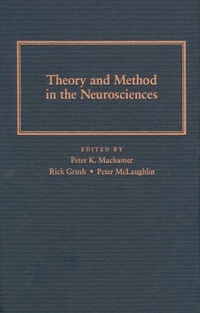
Theory and Method In The Neurosciences
Published on 15. March 2017
309 pages
978-0-8229-7057-6 (ISBN)
Description

Theory and Method in the Neurosciences surveys the nature and structure of theories in contemporary neuroscience, exploring many of its methodological techniques and problems. The essays in this volume from the Pittsburgh -Konstanz series explore basic questions about how to relate theories of neuroscience and cognition, the multilevel character of such theories, and their experimental bases. Philosophers and scientists (and some who are both) examine the topics of explanation and mechanisms, simulation and computation, imaging and animal models that raise questions about the forefront of research in cognitive neuroscience. Their work will stimulate new thinking in anyone interested in the mind or brain and in recent theories of their connections.
More details
Other editions
Additional editions
Peter Machamer | Rick Grush | Peter McLaughlin
Theory and Method In The Neurosciences
Book
03/2001
University of Pittsburgh Press
€75.65
Article exhausted; check different version
Persons
Peter Machamer (Editor)
Peter Machamer was professor of history and philosophy of science at the University of Pittsburgh. He was also coeditor, with Gereon Wolters, of Thinking about Causes: From Greek Philosophy to Modern Physics and Science, Values, and Objectivity, among other books.
Rick Grush (Editor)
Rick Grush (Ph.D. 1995, U.C. San Diego) is assistant professor of philosophy and associate director of the University of Pittsburgh Center for the History and Philosophy of Science.
Peter McLaughlin (Editor)
Peter McLaughlin (Ph.D. 1986, Berlin) has been with the philosophy department at the University of Konstanz since 1989. His publications include Kants Kritik der teleologischen Urteilskraft; Exploring the Limits of Pre-classical Mechanics; and What Functions Explain.
Peter Machamer was professor of history and philosophy of science at the University of Pittsburgh. He was also coeditor, with Gereon Wolters, of Thinking about Causes: From Greek Philosophy to Modern Physics and Science, Values, and Objectivity, among other books.
Rick Grush (Editor)
Rick Grush (Ph.D. 1995, U.C. San Diego) is assistant professor of philosophy and associate director of the University of Pittsburgh Center for the History and Philosophy of Science.
Peter McLaughlin (Editor)
Peter McLaughlin (Ph.D. 1986, Berlin) has been with the philosophy department at the University of Konstanz since 1989. His publications include Kants Kritik der teleologischen Urteilskraft; Exploring the Limits of Pre-classical Mechanics; and What Functions Explain.
Content
- Intro
- Contents
- Introduction
- 1. The Origin and Development of the Neurosciences
- 2. Theory Structure in the Neurosciences
- 3. On the Nature of Explanation in the Neurosciences
- 4. Mechanisms, Coherence, and the Place of Psychology: Commentary on Revonsuo
- 5. Cognitive Neuroscience:Relating Neural Mechanisms and Cognition
- 6. Discovering Mechanisms in Neurobiology: The Case of Spatial Memory
- 7. The Explanatory Power and Limits of Simulation Models in the Neurosciences
- 8. The Semantic Challenge to Computational Neuroscience
- 9. Functional Imaging Evidence: Some Epistemic Hot Spots
- 10. Extrapolation from Animal Models:Social Life, Sex, and Super Models
- 11. Under the Lamppost:Commentary on Schaffner
- 12. Consciousness: A Neurological Perspective
- Index
