

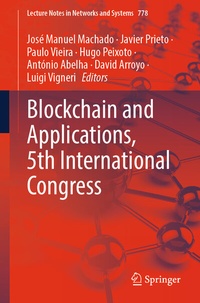
Blockchain and Applications, 5th International Congress
Description

This book constitutes the refereed proceedings of the 5th International Congress on Blockchain and Applications 2023, BLOCKCHAIN'23, held in Guimarães, Portugal, in July 2023. Among the scientific community, blockchain and artificial intelligence are a promising combination that will transform the production and manufacturing industry, media, finance, insurance, e-government, etc. Nevertheless, there is no consensus with schemes or best practices that would specify how blockchain and artificial intelligence should be used together.
The full papers presented in the main track were carefully reviewed. They contain the latest advances on blockchain and artificial intelligence and on their application domains, exploring innovative ideas, guidelines, theories, models, technologies, and tools and identifying critical issues and challenges that researchers and practitioners must deal with in the future research. The authors would like to thank all the contributing authors, the members of the Program Committees, the sponsors, and the Organizing Committee of the University of Minho and the University of Salamanca for their hard and highly valuable work.
More details
Other editions
Additional editions
Content
- Intro
- Preface
- Organization
- Contents
- Main Track
- Implementation and Evaluation of Blockchain-Based Applications in SMEs' Supply Chains: Proof-of-Origin and Process Automation
- 1 Introduction
- 2 State of the Art
- 3 Use Cases
- 3.1 Proof of Origin
- 3.2 Process Automation
- 4 Technical Implementation
- 4.1 Proof of Origin
- 4.2 Process Automation
- 5 Evaluation
- 5.1 Evaluation Strategy
- 5.2 Results
- 6 Conclusion and Future Work
- References
- Report on Decentralized Identity Models and Study on Main Privacy Concerns
- 1 Introduction
- 2 Privacy Matters Regarding Blockchain
- 3 Verifiable Credentials
- 3.1 Privacy Regarding Verifiable Credentials
- 4 SoulBound Tokens
- 4.1 Privacy Regarding SoulBound Tokens
- 5 Conclusions
- References
- Blockchain-Based Decentralized Autonomous Organizations (DAOs) for Democratization in the Environmental, Social, and Governance (ESG) Rating Process
- 1 Introduction
- 2 Literature Review
- 2.1 ESG Ratings
- 2.2 Decentralized Autonomous Organization (DAO)
- 2.3 Related Works
- 3 Research Method
- 3.1 Observation Stage
- 3.2 Theory Building Stage
- 4 Discussion
- 4.1 Blockchain Technology in ESG Rating Process
- 4.2 The Proposed Architecture of Blockchain-Based ESG Rating System
- 5 Conclusion
- References
- FeDis: Federated Learning Framework Supported by Distributed Ledger
- 1 Introduction
- 2 Related Works
- 3 Proposed FeDis Framework
- 4 Implementation of FeDis Framework
- 5 Case Study and Results
- 6 Conclusion
- References
- Enhancing Privacy Protection in Intelligent Surveillance: Video Blockchain Solutions
- 1 Introduction
- 2 Background and Related Work
- 3 Our Proposed Solutions
- 3.1 The Best Cryptographic Functions to Implement a Video Blockchain
- 3.2 Solution for Privacy Preserving Over the Blockchain
- 4 Result Analysis and Discussion
- 5 Conclusion and Future Work
- References
- Energizing Blockchain: Legal Gaps and Power Plays in the Energy Sector's Digital Transformation
- 1 Blockchain Used Cases in the Energy Sector
- 1.1 Key Issues of Adopting Blockchains Technology in the Energy Sector
- 1.2 Lack of Proper Regulatory Framework - Peer to Peer Energy Trading
- 2 Conclusion
- References
- Student Certificate Sharing System Using Blockchain and NFTs
- 1 Introduction
- 2 Background
- 3 Related Works
- 4 Solution Framework and Discussions
- 4.1 Schema
- 4.2 Performance Evaluation
- 5 Conclusion
- References
- Transparency Disclosure for End Consumers in Private Food Supply Chains - A Systematic Literature Review
- 1 Introduction
- 2 Related Work
- 3 Research Question and Methodology
- 4 Discussion of Identified Paper
- 5 Conclusion
- References
- Repositioning Blockchain Technology in the Maritime Industry for Increased Accountability
- 1 Introduction
- 2 Research Rationale
- 3 An Introduction to Blockchain
- 4 Background Work
- 4.1 What Are DID?
- 4.2 A Challenge Statement
- 4.3 A Solution Strategy
- 4.4 Conceptualization
- 5 Proof of Concept: An Architectural Proposition
- 5.1 An Entry
- 5.2 Workflow
- 6 Discussion and Future Work
- References
- IPFS and Hyperledger Fabric: Integrity of Data in Healthcare
- 1 Introduction
- 2 Materials and Methods
- 2.1 Decentralized Distributed File System
- 2.2 Analysis of a Permissioned Blockchain Framework for Enterprise Applications
- 2.3 Related Works
- 3 Architecture
- 3.1 Basic Explanation
- 3.2 Node Composition
- 3.3 Global Representation
- 4 Discussion
- 5 Conclusion and Future Works
- References
- Advancing the Environmental, Social, and Governance (ESG) with Blockchain: A PRISMA Review
- 1 Introduction
- 2 Literature Review
- 2.1 Environmental, Social, and Governance (ESG)
- 2.2 Blockchain
- 2.3 Blockchain in the ESG Mechanism
- 3 Research Method
- 3.1 Stage 1 (Planning Stage)
- 3.2 Stage 2 (Conducting the review Stage)
- 3.3 Stage 3 (Reporting Stage)
- 4 Discussion
- 4.1 General Description
- 4.2 How can Blockchain be Applied Throughout ESG Reporting and Assessment?
- 4.3 What are the Opportunities and Challenges in Implementing Blockchain in ESG Initiatives?
- 4.4 What are the New Concepts, Perceptions, and Approaches that Can Lead to a Research Agenda for Blockchain Implementation in ESG?
- 5 Conclusion
- References
- Industry 4.0 Business-Oriented Blockchain Design Decision Tree
- 1 Introduction
- 2 Related Work
- 3 Industry 4.0 Business Requirements
- 4 Proposed Decision Tree
- 5 Example Use Case: Product Manufacturing Traceability
- 6 Conclusions and Future Work
- References
- Performance Evaluation of Quantum-Resistant Cryptography on a Blockchain
- 1 Introduction
- 2 State of the Art
- 3 Architecture
- 4 Implementation
- 5 Evaluation
- 5.1 Evaluation Strategy
- 5.2 Evaluation Results
- 6 Conclusion
- References
- An Investigation of Scalability for Blockchain-Based E-Voting Applications
- 1 Introduction
- 2 Background and Concepts
- 2.1 Blockchain and Solana
- 2.2 Technical Concepts
- 3 Solana-Based E-Voting Implementation
- 3.1 E-Voting System Model
- 3.2 Architecture
- 3.3 Evaluation Setup
- 4 Scalability Evaluation
- 4.1 Cost
- 4.2 Throughput
- 4.3 Finality Delay
- 5 Related Work
- 6 Discussion
- 7 Conclusion
- References
- Data Analysis and Core Findings of Pakistan's National Population Census for a Blockchain-Based Solution
- 1 Introduction
- 2 Previous Work
- 3 Related Work
- 4 Methodology
- 5 Structured Interview Questionnaire and Pre-Fieldwork
- 6 Data Collection and Data Analysis
- 6.1 Participant Demographics
- 6.2 The Existing Population Census System
- 6.3 The Population Missed During the Enumeration Process
- 6.4 Blockchain Awareness
- 6.5 Requirements of a New Solution
- 7 Core Findings
- 8 Blockchain-Based National Census Solution Outlook
- 9 Conclusion
- References
- Severity Analysis of Web3 Security Vulnerabilities Based on Publicly Bug Reports
- 1 Introduction
- 2 Web3 Insecurity
- 3 Methodology
- 4 Results and Discussion
- 5 Conclusions
- References
- Virtuous Data Monetisation Cycle: A Hybrid Consensus Substrate Automotive Consortium Blockchain Solution
- 1 Introduction
- 1.1 Blockchain Framework by Design: Substrate
- 2 State of Art
- 3 Data Monetisation Use Case
- 4 Data Monetization Solution Workflow
- 5 Functional Evaluation
- 6 Experimental Evaluation
- 6.1 Hybrid Consensus Analysis
- 7 Conclusion
- References
- Blockchain and Sustainability in the Public Sector: A Risk Management Perspective
- 1 Introduction
- 2 Background and Related Works
- 3 Methods
- 4 Addressing Risk Management
- 4.1 Risk Identification
- 4.2 Risk Treatment
- 4.3 Monitoring
- 5 Discussion and Conclusion
- References
- Blockchain-Based Federated Learning: Incentivizing Data Sharing and Penalizing Dishonest Behavior
- 1 Introduction
- 2 Background and Related Works
- 3 System Model
- 3.1 Data Trust, Access Control and Incentive Method
- 3.2 IPFS Storage
- 3.3 Confidentiality and Privacy
- 3.4 Decentralized Network Architecture
- 3.5 Aggregation/Averaging Method
- 4 Experimental Results and Discussions
- 4.1 Performance Analysis
- 4.2 Accuracy (Workers vs Epochs) Analysis
- 5 Conclusion
- References
- An Introduction to Arbitrary Message Passing
- 1 Introduction
- 2 The AMP Problem
- 3 An Analytical Framework
- 3.1 Extensibility
- 4 Conclusion
- References
- A Survey of Decentralized Storage and Decentralized Database in Blockchain-Based Proposed Systems: Potentials and Limitations
- 1 Introduction
- 2 Overview of Blockchain
- 3 Research Methodology
- 4 Blockchain and Distributed Storage
- 5 Blockchain and Database
- 5.1 Blockchain Refined with Database Features
- 5.2 Database Refined with Blockchain Features
- 6 Discussion
- 7 Conclusion
- References
- A Blockchain-Based Framework Solution to Enhance the Remote Assessment Process in HEIs
- 1 Introduction
- 2 State of the Art
- 3 Prototype Development Approach
- 3.1 The Prototype Implementation
- 4 Results and Discussion
- 4.1 Testing Experiment
- 4.2 Discussion
- 5 Conclusion
- References
- Detecting Fraudulent Wallets in Ethereum Blockchain Combining Supervised and Unsupervised Techniques - Using Autoencoders and XGboost
- 1 Introduction
- 2 Related Work
- 3 Methodology
- 4 Experimental Results
- 5 Conclusions
- References
- TariScript: Bringing Dynamic Scripting to Mimblewimble
- 1 Introduction
- 1.1 Mimblewimble
- 1.2 Tari
- 2 TariScript
- 2.1 Preventing Cut-Through with the Script Offset
- 3 Implications and Trade-Offs
- 3.1 Script Lock Key Generation
- 3.2 Blockchain Size
- 3.3 Chain Analysis
- 3.4 Horizon Attacks
- 4 Examples
- 4.1 Standard Mimblewimble Transactions
- 4.2 Unilateral Payments
- 4.3 TariScript Script - A Concrete Implementation
- 5 Conclusion
- References
- Smart Contract Analyzer. A Tool for Detecting Fraudulent Token Contracts
- 1 Introduction
- 2 Background: Blockchain and Digital Assets
- 3 Problem Definition: Digital Crypto Asset Trapdoor
- 4 Related Works Studies
- 5 The Proposed Solution for Detecting Fraudulent Token Contract
- 5.1 Proof of Concept Implementation
- 5.2 Initial Results
- 6 Conclusion and Future Works
- References
- Blockchain Context Canvas: A Tool to Align Developers and Stakeholders
- 1 Introduction
- 2 Theoretical Reference
- 2.1 The Challenge in Analyzing Blockchain Solutions
- 3 Method
- 4 Blockchain Context Canvas Proposal
- 5 Case Study
- 6 Expert Assessment
- 7 Final Considerations
- References
- A Feature Model of Consensus Algorithms in Distributed Ledger Technology
- 1 Introduction
- 2 Research Approach
- 3 Feature Model
- 4 Discussion
- 5 Conclusion
- References
- How Decentralized Autonomous Organizations are Affecting Real Estate
- 1 Introduction
- 2 Methodology
- 3 Blockchain
- 3.1 Non Fungible Tokens (NFTs)
- 3.2 Decentralized Finance (DeFi)
- 3.3 Decentralized Autonomous Organization (DAO)
- 3.4 NFTsxDefi
- 3.5 NFTs and Real Estate
- 4 Real Estate DAO
- 4.1 Access
- 4.2 Vote
- 4.3 Pool
- 4.4 Tiers and Benefits
- 4.5 SWOT Analysis
- 5 Conclusion
- References
- A Thematic Analysis to Determine the Future Design of Mobile Cryptocurrency Wallet
- 1 Introduction
- 2 Background and Related Works
- 2.1 Crypto Wallet Definition
- 2.2 Related Works in User Experience (UX) in Crypto Wallet
- 3 Methodology
- 3.1 Data Collection
- 3.2 Data Selection
- 3.3 Data Analysis
- 4 Result
- 4.1 Thematic Analysis Result
- 4.2 Mandatory Features Recommended for Future Design
- 5 Conclusion
- References
- Blockchain Technology as a Means to Achieve Prior Transparency in Arbitration Processes. A Social Challenge
- 1 The Need for Transparency
- 2 Arbitration Systems
- 2.1 Arbitration and Transparency
- 2.2 The Case of Arbitration in the Spanish Energy Market
- 3 Blockchain, Transparency and Arbitration
- 4 Technical Framework
- 5 Conclusions
- References
- Probabilistic Optimization of Optimistic Finality for the Waterfall Consensus Protocol
- 1 Introduction
- 2 Literature Overview
- 3 General Platform Design
- 4 Probabilistic Slot Optimization
- 4.1 Slot Supporting Threshold
- 4.2 Simulating and Probabilistic Optimization
- 5 Non-Relayed Transactions
- 6 Conclusion
- References
- The Role of Blockchain Technology in Ensuring Security and Immutability of Open Data in Healthcare
- 1 Introduction
- 2 What is OpenEHR?
- 3 Blockchain
- 4 Blockchain in the Healthcare Sector
- 5 Why OpenEHR with Blockchain in Healthcare?
- 6 Architecture
- 7 Results and Discussion
- 7.1 Insertion of Data into the Blockchain with 20000 Records, Scenario 1 and Scenario 2
- 7.2 Additional Test for Scenario 2
- 8 Discussion and Conclusion
- References
- Managing Write Access Without Token Fees in Leaderless DAG-Based Ledgers
- 1 Introduction
- 2 System Model
- 3 Credit-Based Access Control
- 4 Simulations
- 4.1 Simulation Setup
- 4.2 Single-Node Simulator
- 4.3 Multi-node Simulator
- 5 Conclusion
- References
- BFT Testing Framework for Flow Blockchain
- 1 Introduction
- 2 Related Works
- 3 BFTune BFT Testing Framework
- 3.1 Overview
- 3.2 Architecture
- 3.3 Sample BFT Testing Scenarios
- 4 Experimental Results
- 5 Conclusion
- References
- Implementing a Blockchain-Powered Metadata Catalog in Data Mesh Architecture
- 1 Introduction
- 2 Challenges of Data Governance in Data Mesh
- 3 Introducing Blockchain-Powered Metadata Catalog
- 3.1 Metadata Catalog Types
- 3.2 Using Hyperledger Fabric for Metadata Management
- 4 Metadata Catalog Model and Implementation
- 4.1 Ledger Asset Structure
- 4.2 Chaincode Operations and Catalog Architecture
- 4.3 Use-Cases for Distributed Metadata Catalog in Data Mesh
- 5 Contribution Discussion
- 5.1 Model Pros and Cons
- 5.2 Potential Model Improvements
- 6 Conclusions and Further Research
- A Metadata Catalog Assets
- References
- Workshop on Beyond the Promises of Web3.0: Foundations and Challenges of Trust Decentralization (WEB3-TRUST)
- Workshop on Beyond the Promises of Web3.0: Foundations and Challenges of Trust Decentralization (WEB3-TRUST)
- Workshop Organization
- Organizing Committee
- Program Committee
- Decentralized Oracle Networks (DONs) Provision for DAML Smart Contracts
- 1 Background and Related Work
- 2 Decentralized Oracles for DAML
- 3 Components of DAML-DONs System Architecture
- 3.1 Broker Contract
- 3.2 Service Registry Contract
- 3.3 Ranking Engine
- 3.4 DAML-DON Web Service
- 3.5 Interactive User Interface
- 4 Experimental Evaluation and Results
- 4.1 Experimental Environment
- 4.2 Case Study and Results
- 5 Conclusion
- References
- Analyzing the Effectiveness of Native Token Airdrop Campaigns in NFT Marketplaces
- 1 Introduction
- 2 Dynamics of Token Airdrops
- 3 Related Work
- 4 Dataset
- 5 Case Studies
- 6 Results
- 7 Discussion and Future Research
- 8 Conclusions
- References
- A Novel DID Method Leveraging the IOTA Tangle and Its Integration into OpenSSL
- 1 Introduction
- 2 A DID Method for the IOTA Tangle
- 2.1 Working Principles
- 2.2 Implementation of the OTT Method Functions
- 3 Experimental Setup and Results
- 4 Future Perspectives
- 5 Conclusions and Future Works
- References
- Beyond the Chain: Workshop on DAG-Based Distributed Ledger Technologies (DAG-DLT)
- Beyond the Chain: Workshop on DAG-based Distributed Ledger Technologies (DAG-DLT)
- Workshop Organization
- Organizing Committee
- Program Committee
- An Attack Resilient Policy on the Tip Pool for a DAG-Based Distributed Ledger
- 1 Introduction
- 2 Related Work
- 3 System Model
- 3.1 PCT Condition
- 4 Simulations
- 4.1 A1: Single Spamming Attacker
- 4.2 A2: Single Multi-rate Attacker
- 4.3 A3: Benchmark Experiment (Multi-rate Attacker, No PCT)
- 5 Conclusions and Future Work
- References
- Welcome to the Tangle: An Empirical Analysis of IOTA Ledger in the Chrysalis Stage
- 1 Introduction
- 2 Data Description
- 2.1 Data Collection Workflow
- 2.2 Extract Conflicting and Indexation Messages
- 3 Message Characteristics
- 3.1 Transactions
- 3.2 Milestones
- 3.3 Indexations
- 4 Tangle Graph Characteristics
- 4.1 Tangle Network Construction
- 4.2 Network Features
- 5 Conclusion
- References
- Performance Analysis of the IOTA Chrysalis on Heterogeneous Devices
- 1 Introduction
- 1.1 Contributions
- 2 Related Work
- 2.1 IOTA Chrysalis
- 3 System Architecture
- 3.1 Implementation Details and Procedures
- 4 Experimental Results
- 4.1 Measuring Overhead of Data Creation
- 4.2 Overhead of Data Transmission on the IOTA Chrysalis Tangle
- 5 Conclusion and Future Work
- References
- Enhancing Social Compliance with an IOTA Tangle-Enabled Smart Mask System
- 1 Background
- 2 Architecture and Compliance Model
- 2.1 Compliance Algorithm
- 3 Mask Design
- 4 Experimental Set-Up
- 5 Conclusion
- References
- Topology and the Tangle: How the Underlying Network Topology Influences the Confirmation of Blocks in IOTA
- 1 Introduction
- 2 The IOTA System
- 3 The Model
- 3.1 Simulation
- 4 Results
- 4.1 Approval Weight Trajectories
- 4.2 Approval Weight Gain and Different Topologies
- 5 Conclusion
- References
- FPCS: Solving n-Spends on a UTXO-Based DLT
- 1 Introduction
- 2 Description of the Protocol
- 2.1 Notations
- 2.2 Protocol
- 3 Results
- 4 Conclusion and Future Work
- References
- Bridging Protocols in DAG-Based DLTs: Facilitating Interaction Between IOTA and Other DLT Networks
- 1 Introduction
- 2 Study of Protocol Characteristics to Ensure Interoperability
- 2.1 Security and Realibility
- 2.2 Communication Efficiency
- 3 Discussion
- 4 Conclusion and Future Lines of Work
- References
- Workshop on Building the Potential of Blockchain in Farming (FARMS4CLIMATE)
- Workshop on Building the Potential of Blockchain in Farming (FARMS4CLIMATE)
- Workshop Organization
- Organizing Committee
- Program Committee
- Development of an Open Source IoT-Blockchain Platform for Traceability of Fresh Products from Farm to Fork
- 1 Introduction
- 2 Background
- 2.1 Blockchain for Food Traceability
- 3 Development
- 3.1 Requirements Definition
- 3.2 Design and Development of the Data Model for Food Traceability
- 3.3 Web App Development
- 3.4 Development of the Connection with the Blockchain
- 3.5 Development and Interconnection of the Hardware Data Acquisition Module
- 4 Evaluation
- 4.1 Chaincode Validation
- 4.2 Requirements Fulfilment Checking
- 5 Conclusions and Future Lines
- References
- Blockchain-Based Platforms for Carbon Offsetting: A Survey of Existing Approaches and Their Potential to Promote Carbon Farming for Smallholders
- 1 Introduction
- 2 Literature Review
- 2.1 Overview of Carbon Offset Market and Its Challenges
- 2.2 Blockchain Technology and Its Potential in Addressing Carbon Offset Market Challenges
- 2.3 Existing Blockchain-Based Platforms for Carbon Offsetting
- 3 Results and Discussion
- 4 Conclusion and Future Directions
- References
- Doctoral Consortium
- Blockchain Oracles for Asset Ownership Verification and Trust Establishment in the Metaverse
- 1 Problem Statement and Motivation
- 2 Research Objectives and Questions
- 3 Methodology and Design
- 4 Research Plan
- 5 Preliminary Results and Conclusion
- References
- A Digital Health Passport Based on Hyperledger Fabric Blockchain: Use Case in Morocco
- 1 Introduction
- 2 Related Works
- 3 Current System Challenges in Morocco
- 4 System Model Based on Hyperledger Fabric Overview
- 5 Proposed System: Blockchain-Based Digital Health Passport
- 6 Conclusion
- References
- Creating a Blockchain-Based Insurance Platform with Marlowe
- 1 Introduction
- 1.1 Background and Motivation
- 2 Related Works
- 3 Methodology
- 4 Implementation
- 5 Evaluation and Discussion
- 6 Contribution and Conclusion
- References
- The Use of Blockchain Technology in the Educational Field in Bahrain
- 1 Introduction
- 2 Overview of Blockchain Technology:
- 3 Applications of Blockchain Technology in Education
- 4 Benefits and Advantages of Blockchain in Education
- 5 Challenges and Limitations
- 6 Case Studies and Initiatives
- 7 Conclusion
- References
- Business Processes and Patterns of Blockchain Technology
- 1 Introduction
- 2 Theoretical Background
- 2.1 Business Process
- 2.2 Blockchain Technology and Smart Contract
- 3 Objectives
- 3.1 The Use of Model to Program M2P in Business Process Improvement and Optimization
- 3.2 The Implementation of Blockchain Smart Contract After applying the Improvement Algorithm
- 3.3 Results
- 4 Conclusion and Future Direction of the Research
- References
- A Modelling Approach for a High Utility Decentralized Autonomous Organization Development
- 1 Problem Statement
- 2 Related Works
- 3 Hypothesis and Proposal
- 4 Evaluation Plan
- 5 Conclusive Remarks
- References
- Towards an Enterprise Blockchain Interoperability Framework: A Case of the Banking Sector
- 1 Introduction
- 1.1 Problem Statement
- 1.2 Research Objectives
- 2 Related Works
- 3 Methodology
- 4 Preliminary Results
- 5 Conclusion and Way Forward
- References
- Author Index
