

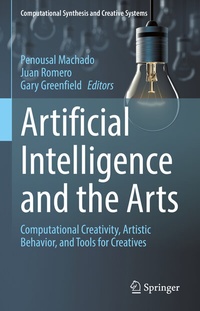
Artificial Intelligence and the Arts
Computational Creativity, Artistic Behavior, and Tools for Creatives
1st Edition
Published on 13. October 2021
XIV, 381 pages
978-3-030-59475-6 (ISBN)
Description

Emotions, creativity, aesthetics, artistic behavior, divergent thoughts, and curiosity are both fundamental to the human experience and instrumental in the development of human-centered artificial intelligence systems that can relate, communicate, and understand human motivations, desires, and needs. In this book the editors put forward two core propositions: creative artistic behavior is one of the key challenges of artificial intelligence research, and computer-assisted creativity and human-centered artificial intelligence systems are the driving forces for research in this area.
The invited chapters examine computational creativity and more specifically systems that exhibit artistic behavior or can improve humans' creative and artistic abilities. The authors synthesize and reflect on current trends, identify core challenges and opportunities, and present novel contributions and applications in domains such as the visual arts, music, 3D environments, and games.
The book will be valuable for researchers, creatives, and others engaged with the relationship between artificial intelligence and the arts.
The invited chapters examine computational creativity and more specifically systems that exhibit artistic behavior or can improve humans' creative and artistic abilities. The authors synthesize and reflect on current trends, identify core challenges and opportunities, and present novel contributions and applications in domains such as the visual arts, music, 3D environments, and games.
The book will be valuable for researchers, creatives, and others engaged with the relationship between artificial intelligence and the arts.
More details
Series
Language
English
Place of publication
Cham
Switzerland
Publishing group
Springer International Publishing
Target group
Professional and scholarly
Illustrations
XIV, 381 p. 81 illus., 72 illus. in color.
File size
24,20 MB
ISBN-13
978-3-030-59475-6 (9783030594756)
DOI
10.1007/978-3-030-59475-6
Schweitzer Classification
Other editions
Additional editions
Penousal Machado | Juan Romero | Gary Greenfield
Artificial Intelligence and the Arts
Computational Creativity, Artistic Behavior, and Tools for Creatives
Book
10/2021
Springer
€213.99
Shipment within 7-9 days
Persons
Penousal Machado
is an Associate Professor at the Dept. of Informatics of the University of Coimbra in Portugal and scientific director of its Computational Design and Visualization Lab. His research interests include Computational Creativity, Evolutionary Computation, Artificial Intelligence, and Information Visualization. He has chaired related scientific events, including the Intl. Conf. on Computational Creativity (ICCC), the Intl. Conf. on Parallel Problem-Solving from Nature (PPSN), and EvoStar, the European Conf. on Bio-inspired Computing, and he is a member of related steering committees and editorial boards. Among his recognitions is the EvoStar Award for Outstanding Contribution to Evolutionary Computation in Europe. He has given invited keynotes on Evolutionary Computation, Visualization, and Art, his work was featured in the journal Leonardo and Wired magazine, and he has presented in venues such as the National Museum of Contemporary Art in Lisbon and the Museum ofModern Art (MoMA) in New York.
Juan Romero is a professor in the Dept. of Computer Science and Information Technologies at the University of A Coruña. His research interests include Artificial Intelligence, Evolutionary Computation, Computational Creativity, Evolutionary Art, and Evolutionary Music. He has chaired related scientific events, including the EvoStar Applications of Evolutionary Computation conference and the Intl. Conf. on Artificial Intelligence in Music, Sound, Art and Design, he cofounded the European Network of Research that led to the latter event. He has guest edited special issues such as Neural Networks in Art, Sound and Design for the Neural Computing journal (Springer), Complex Systems in Aesthetics and Art for the Complexity journal (Hindawi), and Genetic Algorithms on Visual Art and Music for the journal Leonardo (MIT Press). He coedited the book "The Art of Artificial Evolution: A Handbook on Evolutionary Art and Music" with Penousal Machado in 2008. He's a cofounder and Chief Innovation Officer of the company PhotoIlike.com.
Gary Greenfield is Professor Emeritus of Mathematics & Computer Science at the University of Richmond. He has chaired related scientific events, including the EvoStar Applications of Evoutionary Computation conference, and he is the Founding Editor of the Journal of Mathematics and the Arts (Taylor & Francis). His computer-generated artworks arise from visualizations of mathematical, physical, or biological processes, focusing the viewer's attention on the complexity and intricacy underlying such processes, most recently he has been exploring the tension that develops when generating minimalist art using complex processes.
Juan Romero is a professor in the Dept. of Computer Science and Information Technologies at the University of A Coruña. His research interests include Artificial Intelligence, Evolutionary Computation, Computational Creativity, Evolutionary Art, and Evolutionary Music. He has chaired related scientific events, including the EvoStar Applications of Evolutionary Computation conference and the Intl. Conf. on Artificial Intelligence in Music, Sound, Art and Design, he cofounded the European Network of Research that led to the latter event. He has guest edited special issues such as Neural Networks in Art, Sound and Design for the Neural Computing journal (Springer), Complex Systems in Aesthetics and Art for the Complexity journal (Hindawi), and Genetic Algorithms on Visual Art and Music for the journal Leonardo (MIT Press). He coedited the book "The Art of Artificial Evolution: A Handbook on Evolutionary Art and Music" with Penousal Machado in 2008. He's a cofounder and Chief Innovation Officer of the company PhotoIlike.com.
Gary Greenfield is Professor Emeritus of Mathematics & Computer Science at the University of Richmond. He has chaired related scientific events, including the EvoStar Applications of Evoutionary Computation conference, and he is the Founding Editor of the Journal of Mathematics and the Arts (Taylor & Francis). His computer-generated artworks arise from visualizations of mathematical, physical, or biological processes, focusing the viewer's attention on the complexity and intricacy underlying such processes, most recently he has been exploring the tension that develops when generating minimalist art using complex processes.
Content
Part I, Visual Arts.- Artificial Life and Artifcial Intelligence Advances in the Visual Arts.- Aesthetics, Artificial Intelligence, and Search-Based Art.- Applicability of Convolutional Neural Network Artistic Style Transfer Algorithms.- Part II, Music.- Artificial Musical Intelligence: Computational Creativity in a Closed Cognitive World.- Evolutionary Music, Deep Learning and Conceptual Blending: Enhancing User Involvement in Generative Music Systems.- Representation Learning for the Arts: A Case Study Using Variational Autoencoders for Drum Loops.- Part III, 3D.- Case Studies in Computer Graphics and AI.- Setting the Stage for 3D Compositing with Machine Learning.- Part IV, Other Art Forms.- Computational Models of Narrative Creativity.- Learning from Responses to Automated Videogame Design.- Artificial Intelligence for Designing Games.- Part V, Artistic Perspectives.- Bees Select Flowers, Humans Select Images: New Designs for Open-Ended Interactive Evolutionary Computation Inspiredby Pollination Ecology.- Breaking the Black Box: Procedural Reading, Creation of Meaning, and Closure in Computational Artworks.- Organism-Machine Hybrids.
