

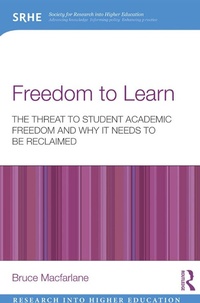
Freedom to Learn
The threat to student academic freedom and why it needs to be reclaimed
Published on 12. August 2016
156 pages
978-1-315-52944-8 (ISBN)
Description

The freedom of students to learn at university is being eroded by a performative culture that fails to respect their rights to engage and develop as autonomous adults. Instead, students are being restricted in how they learn, when they learn and what they learn by the so-called student engagement movement. Compulsory attendance registers, class contribution grading, group project work and reflective learning exercises based on expectations of self-disclosure and confession take little account of the rights of students or individual differences between them. This new hidden university curriculum is intolerant of students who may prefer to learn informally, are reticent, shy, or simply value their privacy. Three forms of student performativity have arisen - bodily, participative and emotional - which threaten the freedom to learn.
Key themes include:
A re-imagining of student academic freedom
The democratic student experience
Challenging assumptions of the student engagement movement
An examination of university policies and practices
Freedom to Learn offers a radically new perspective on academic freedom from a student rights standpoint. It analyzes the effects of performative expectations on students drawing on the distinction between negative and positive rights to re-frame student academic freedom. It argues that students need to be thought of as scholars with rights and that the phrase 'student-centred' learning needs to be reclaimed to reflect its original intention to allow students to develop as persons. Student rights - to non-indoctrination, reticence, in choosing how to learn, and in being treated like an adult - ought to be central to this process in fostering a democratic rather authoritarian culture of learning and teaching at university.
Written for an international readership, this book will be of great interest to anyone involved in higher education, policy and practice drawing on a wide range of historical and contemporary literature related to sociology, philosophy and higher education studies.
Key themes include:
A re-imagining of student academic freedom
The democratic student experience
Challenging assumptions of the student engagement movement
An examination of university policies and practices
Freedom to Learn offers a radically new perspective on academic freedom from a student rights standpoint. It analyzes the effects of performative expectations on students drawing on the distinction between negative and positive rights to re-frame student academic freedom. It argues that students need to be thought of as scholars with rights and that the phrase 'student-centred' learning needs to be reclaimed to reflect its original intention to allow students to develop as persons. Student rights - to non-indoctrination, reticence, in choosing how to learn, and in being treated like an adult - ought to be central to this process in fostering a democratic rather authoritarian culture of learning and teaching at university.
Written for an international readership, this book will be of great interest to anyone involved in higher education, policy and practice drawing on a wide range of historical and contemporary literature related to sociology, philosophy and higher education studies.
Reviews / Votes
"[T]his is a powerful book, for both the higher education theorist and the university practitioner. The ideas provide a refreshingly alternative perspective on some common and dominant concepts that have guided teaching and learning for the last 30 years or so...Macfarlane's book spoke to my feelings of unease about my practice and the difficulties of being a university teacher." - Higher Education"This is a brilliant and devastating book which, if listened to and acted on, presages profound changes in higher education, world-wide. Beautifully and engagingly written [...] Freedom to Learn presents an indictment of much contemporary thinking about 'engaging' students and their 'learning experiences' [...] This is a book that should become required reading not only for vice-chancellors, and all involved in 'improving' teaching and learning in universities, but for anyone with any responsibility towards shaping higher education." - Professor Emeritus Ronald Barnett, University College London Institute of Education (UK)
"Bruce Macfarlane writes about student rights and freedoms. He has produced a beautifully argued and accessible account that provides an alternative view to the ideological framing of student learning that has dominated higher education over the last 30 years. Anyone interested in student learning should read this book." - Professor Tony Harland, University of Otago (New Zealand)
"Macfarlane's critique of the bodily, participatory and emotional performativity increasingly expected of students is at least a significant corrective and may lead to a substantial rethinking of one of the major recent developments in higher education teaching-learning." - Professor Gavin Moodie, University of Toronto (Canada)
"A perceptive analysis of students' freedom to learn flexibly in an era of performativity. An incisive re-imagination of student academic freedom, interweaving conceptual thought and empirical data. Another tour-de-force from the prolific keyboard of Bruce Macfarlane." - Professor David Carless, University of Hong Kong (Hong Kong)
"This book presents a measured, insightful and comprehensively researched analysis of a topic that appears, either by design or default, to have been largely taboo to date. I found the book a great read, and strongly recommend it." - Professor Emeritus Royce Sadler, Griffith University (Australia)
More details
Series
Language
English
Place of publication
London
United Kingdom
Publishing group
Taylor & Francis Ltd
Target group
College/higher education
Professional and scholarly
Illustrations
2 s/w Tabellen
2 Tables, black and white
File size
0,94 MB
ISBN-13
978-1-315-52944-8 (9781315529448)
Copyright in bibliographic data and cover images is held by Nielsen Book Services Limited or by the publishers or by their respective licensors: all rights reserved.
Schweitzer Classification
Other editions
Additional editions
Bruce Macfarlane
Freedom to Learn
The threat to student academic freedom and why it needs to be reclaimed
Book
08/2016
1st Edition
Routledge
€184.80
Shipment within 15-20 days
Bruce Macfarlane
Freedom to Learn
The threat to student academic freedom and why it needs to be reclaimed
Book
08/2016
1st Edition
Routledge
€64.70
Shipment within 15-20 days
Person
Bruce Macfarlane is Professor of Higher Education at the University of Southampton, UK.
Content
1. The hidden curriculum 2. Student rights 3. A paradox 4. The performative turn 5. Participative performativity 6. Bodily performativity 7. Emotional performativity 8. Reclaiming student-centred
