

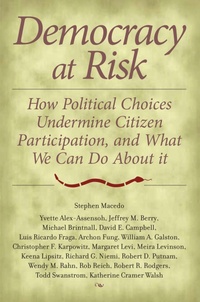
Democracy at Risk
How Political Choices Undermine Citizen Participation, and What We Can Do About it
1st Edition
Published on 25. May 2006
240 pages
978-0-8157-9786-9 (ISBN)
Description

Voter turnout was unusually high in the 2004 U.S. presidential election. At first glance, that level of participation¿largely spurred by war in Iraq and a burgeoning culture war at home¿might look like vindication of democracy. If the recent past is any indication, however, too many Americans will soon return to apathy and inactivity. Clearly, all is not well in our civic life. Citizens are participating in public affairs too infrequently, too unequally, and in too few venues to develop and sustain a robust democracy. This important new book explores the problem of America's decreasing involvement in its own affairs. D emocracy at Risk reveals the dangers of civic disengagement for the future of representative democracy. The authors, all eminent scholars, undertake three main tasks: documenting recent trends in civic engagement, exploring the influence that the design of political institutions and public policies have had on those trends, and recommending steps that will increase the amount and quality of civic engagement in America. The authors focus their attention on three key areas: the electoral process, including elections and the way people get involved; the impact of location, including demographic shifts and changing development patterns; and the critical role of nonprofit organizations and voluntary associations, including the philanthropy that help keep them going.
This important project, initially sponsored by the American Political Science Association, tests the proposition that social science has useful insights on the state of our democratic life. Most importantly, it charts a course for reinvigorating civic participation in the world's oldest democracy.
The authors: Stephen Macedo (Princeton University), Yvette Alex-Assensoh (Indiana University), Jeffrey M. Berry (Tufts), Michael Brintnall (American Political Science Association), David E. Campbell (Notre Dame), Luis Ricardo Fraga (Stanford), Archon Fung (Harvard), William
More details
Edition
1. Auflage
Language
English
Place of publication
DC
United States
ISBN-13
978-0-8157-9786-9 (9780815797869)
Copyright in bibliographic data and cover images is held by Nielsen Book Services Limited or by the publishers or by their respective licensors: all rights reserved.
Schweitzer Classification
Other editions
Additional editions
Book
08/2005
Brookings Institution
€73.18
Article exhausted; check different version
Person
Stephen Macedo is Laurence S. Rockefeller professor of politics and director of the University Center for Human Values at Princeton University.
Content
- Front Cover
- Front Flap
- Title Page
- Contents
- Preface
- Chapter 1. Toward a Political Science of Citizenship
- What Is Civic Engagement?
- What Dimensions of Civic Engagement Should We Care About?
- Can Civic Engagement Be Bad?
- Our Report and the American Political Science Association
- Roadmap to What Follows
- Conclusion
- Chapter 2. National Electoral Processes
- Basic Trends
- Diagnosing Our Civic Malaise
- Personal Factors
- Structural Factors
- Cultural Factors
- What Is to Be Done?
- Conclusion
- Chapter 3. The American Metropolis
- The Promise and Perils of Local Politics
- Changing Patterns of Metropolitan Life
- Place, Context, and Civic Activity
- Engagement with Electoral Politics
- Political Engagement between Elections
- Community Engagement through Nongovernmental Institutions and Groups
- What Is to Be Done?
- Conclusion
- Chapter 4. Associational Life and the Nonprofit and Philanthropic Sector
- Associations and Civic Engagement
- Two Positive Trends: Volunteering and Growth of the Nonprofit Sector
- How Policy Creates and Regulates Nonprofits
- Reshaping the Civic Context for Associations
- What Is to Be Done?
- Conclusion
- Chapter 5. Conclusion: Assessing Our Political Science of Citizenship
- America's Democratic Deficit
- Our Agenda for Reform
- Pitfalls of Our Political Science of Citizenship
- Conclusion
- Notes
- The Authors
- Index
- Back Flap
- Back Cover
