

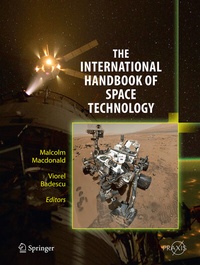
The International Handbook of Space Technology
Description

More details
Other editions
Additional editions
Persons
Malcolm Macdonald is Associate Director of the Advanced Space Concepts Laboratory within the Department of Mechanical and Aerospace Engineering at the University of Strathclyde. He studied for his PhD at the University of Glasgow from 2000-2002, prior to gaining a research assistant post until December 2004. From 2005-2008 he worked at SciSys UK Ltd. on a range of European Space Agency projects and missions, including ADM-Aeolus and LISA-Pathfinder, progressing to become a senior member of technical staff.
Malcolm has diverse research interests, with activities spanning space and aerospace technology, including mission and system design, astrodynamics, and swarm and disaggregated system engineering. He also has interests in technology foresight, horizon scanning and roadmapping, and is a fellow of the Royal Aeronautical Society.
Viorel Badescu is affiliated with the Candida Oancea Institute and a Professor in the Department of Engineering Thermodynamics at the Polytechnic University of Bucharest. His mainstream scientific contributions consist of about 250 papers and several books related to statistical physics, thermodynamics, the physics of semiconductors, the various aspects of terrestrial and space solar energy applications and other energy-related issues. Also, he has theorized on present-day Mars meteorology and Mars terraforming and on several macro-engineering projects. He has received four awards, including the Romanian Academy Prize for Physics in 1979. He is member of the Romanian Academy
Content
Introduction.- Applications of Space Technology.- Fundamentals of Space Exploration.- Fundamentals of Space Exploration.- Launch Systems.- Structure, Mechanisms and Deployables.- Power.- Propulsion.- Altitude Determination, Guidance and Navigation Control.- Thermal and Radiation.- Telemetry, Tracking and Command.- Command and Data Handling.- Spacecraft Computer Systems.- Software.- Biological Life Support.- Descent and Landing Systems.- Mission Operations.- Payload Design and Sizing.- Spacecraft Manufacturing, Testing & Reliability.- Cost.- Legal and Regulatory Requirements.- Project and Quality Management.- Mission and System Design.- Appendices.
