

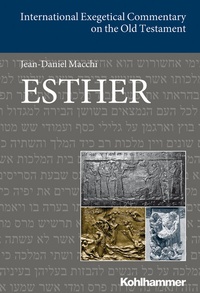
Esther
International Exegetical Commentary on the Old Testament (IECOT)
1st Edition
Published on 20. February 2019
361 pages
978-3-17-031027-8 (ISBN)
Description

The Book of Esther is one of the five Megillot. It tells the story of a Jewish girl in Persia, who becomes queen and saves her people from a genocide. The story of Esther forms the core of the Jewish festival of Purim. The commentary presents a literary analysis of the text, taking into account the inclusion and arrangement of different pericopes, and an analysis of the narration. Likewise, it will discuss the style, the syntax, and the vocabulary. The examination of the intellectual context of the book, biblical and extrabiblical textual traditions on which the book is based and with which it is in intertextual dialogue, leads to a discussion of the redactional process and the historical and social contexts in which the authors and redactors worked.
More details
Other editions
Additional editions
Book
02/2019
1st Edition
Kohlhammer
from
€109.00
Shipment within 5-7 days
Person
Prof. Dr. Jean-Daniel Macchi teaches Old Testament at the Faculty of Theology at the University of Geneva.
Content
- Cover
- Titlepage
- Impressum
- Content
- Editors' Foreword
- Author's Preface
- Introduction
- A. Textual Forms and Editorial Stages
- 1. Accounting for the Textual Diversity of Esther in this Commentary
- 2. The Textual Witnesses
- 2.1. The Hebrew Masoretic Text (MT)
- 2.2. Esther at Qumran?
- 2.3. The Majority Greek Text of the LXX
- 2.4. The Minority Greek Text, the Alpha Text (AT)
- 2.5. Flavius Josephus
- 2.6. The Old Latin (OL)
- 2.7. The Vulgate
- 2.8. Other Ancient Versions
- 3. The Work' Editorial Process
- 3.1. The Alpha Text (AT), a Late Revision Dependant upon the LXX and/or the MT
- 3.2. The Alpha Text Reflects a Pre-Masoretic Hebrew Proto-Esther
- 3.3. Narrative Source Divisions
- 3.4. The Additions in the LXX and the AT
- 3.5. The Place of the Old Latin
- 4. Synthesis and the Proposal Defended in the Present Commentary
- 4.1. From Proto-Esther to the Masoretic Text
- 4.1.1. Reconstructing Proto-Esther and Identifying the Proto-Masoretic Editorial Sections
- 4.1.2. Presentation of the Editorial Process of the Proto-Masoretic Hebrew Text of Esther in the Present Commentary
- 4.2. Emergence of the Two Primary Greek Witnesses (AT and LXX) and the Other Textual Witnesses of Esther
- 4.2.1. The AT and the LXX
- 4.2.2. The Other Textual Witnesses.
- 4.2.3. Schema of the History of the Texts of Esther
- B. Historical and Intellectual Context of the Book' Production
- 1. The Persian Era: The Setting of the Action
- 2. The Hellenistic Era: The Context of the Work' Production
- 2.1. Fictive Character of the Narrative
- 2.2. Different Textual Forms
- 2.3. Linguistic Arguments
- 2.4. Knowledge of Biblical Texts
- 2.5. Esther and Hellenistic Literature about Persia
- 2.5.1. Persian History and Its Sources
- 2.5.2. Links between Esther and Greek Literature
- 2.5.3. The Book of Esther, a Persica
- 2.6. Esther and Maccabean Conflicts
- 2.7. The Context of Proto-Esther' Production
- 2.7.1. Jewish Diasporas in the Hellenistic Era.
- 2.7.2. Synthesis
- 2.8. The Context of Production of the Proto-Masoretic Edition of Esther
- 2.8.1. Judea in the Maccabean and Hasmonean Eras
- 2.8.2. Synthesis
- 2.9. The Contexts of Production of the Additions and Other Textual Forms of the Work
- 3. Purim' Mysterious Origin
- C. Literary and Thematic Characteristics Developed in Esther' Masoretic Form
- 1. Organization of the Work
- 2. Novel-Like Characteristics
- 3. Language and Style
- 4. Allusions and References to Other Biblical Texts
- 4.1. Esther, Mordecai, and the Kings of Israel
- 4.2. The Joseph Story and the Book of Esther
- 4.3. Esther and Moses
- 4.4. Daniel
- 4.5. The Book of Esther and the Books of Maccabees and Judith
- 4.6. Conclusions
- 5. Themes
- 5.1. View of the Empire and Relationship with It
- 5.1.1 The Banquets
- 5.1.2. Law and Edicts
- 5.1.3. Non-Jewish Characters
- 5.2. Facing a Foreign Empire as a Jew
- 5.2.1. Being Jewish according to the Book of Esther
- 5.2.2. To Conceal or Reveal One' Identity
- 5.2.3. Mordecai: Refusing Norms Imposed by Imperial Power
- 5.2.4. Esther: Acting with Charm, Courage, and Cunning
- 5.2.5. The Use of Force by the Jews
- 5.3. God' Presence and Absence in the MT
- D. Literary and Thematic Characteristics of Other Textual Forms of Esther
- 1. Proto-Esther: Structure and Themes
- 2. The Greek Versions: Structure and Themes
- E. Perspectives on Space and Time
- 1. Spatial Organization of the Palace
- Schema of Palace Organization
- 2. The Chronological System in the Book of Esther
- 2.1. The Chronological System of the Masoretic Text
- 2.2. The Chronological System in the LXX
- 2.3. Diachronic Implications
- F. Canonization, Use, and Reception of the Work
- 1. An Anthoritative Book
- 1.1. Canonicity in Judaism
- 1.2. Canonicity in Christianity
- 2. A Book for the Festival of Purim
- 3. An Inspiring Book (Esther' Reception)
- 3.1. Esther in Judaism
- 3.2. Esther in Christianity
- G. How to Use This Commentary on Esther' Masoretic Form
- Chapter 1. The Fall of Queen Vashti
- Introduction
- The Banquets of the Persian King (1:1-9)
- Notes on Text and Translation
- Synchronic Analysis
- Vashti' Refusal (1:10-12)
- Notes on Text and Translation
- Synchronic Analysis
- The Consequences of Vashti' Refusal (1:13-22)
- Notes on Text and Translation
- Synchronic Analysis
- Diachronic Analysis
- Proto-Esther
- Proto-Masoretic Editing and the Emergence of the MT
- The Greek Translations and the Late Modifications of the MT
- Synthesis
- Chapter 2. Esther' Accession and Royal Installation
- Introduction
- Esther 2:1-18. Appointment of a New Queen
- Notes on Text and Translation
- Synchronic Analysis
- Esther 2:19-23. Events at the Court
- Translation
- Notes on Text and Translation
- Synchronic Analysis
- Diachronic Analysis
- Proto-Esther
- Proto-Masoretic Editing and the Emergence of the MT
- The Greek Translations and the Late Modifications of the MT
- Synthesis
- Chapter 3. Haman' Plot
- Notes on Text and Translation
- Synchronic Analysis
- Chapter 4. Mordecai Solicits Esther' Help
- Notes on Text and Translation
- Synchronic Analysis
- Chapter 5. Haman' Honors
- Introduction
- Esther' First Banquet (5:1-8)
- Notes on Text and Translation
- Synchronic Analysis
- Reasons for the Double Invitation to the Banquet
- Haman at Home with His Friends (5:9-14)
- Notes on Text and Translation
- Synchronic Analysis
- Diachronic Analysis
- Proto-Esther
- Proto-Masoretic Editing and the Emergence of the MT
- The Greek Translations and the Late Modifications of the MT
- Synthesis
- Chapter 6. Mordecai' Honors
- Introduction
- Haman Honors Mordecai (6:1-11)
- Notes on Text and Translation
- Synchronic Analysis
- Haman Returns Home (6:12-14)
- Notes on Text and Translation
- Synchronic Analysis
- Diachronic Analysis
- Proto-Esther
- Proto-Masoretic Editing and the Emergence of the MT
- The Greek Translations and the Late Modifications of the MT
- Synthesis
- Chapter 7. The Death of Haman
- Notes on Text and Translation
- Synchronic Analysis
- Chapters 8-10. Triumph, Massacre, and Festivities
- Introduction
- A Plot Difficult to Unravel (8:1-17)
- Notes on Text and Translation
- Synchronic Analysis
- The War (9:1-19)
- Notes on Text and Translation
- Synchronic Analysis
- The Letters Instituting the Festivals (9:20-32)
- Notes on Text and Translation
- Synchronic Analysis
- The King, Mordecai, the Jews, and the Empire (10:1-3)
- Notes on Text and Translation
- Synchronic Analysis
- Diachronic Analysis. Chapters 8-10
- Proto-Esther
- The Original Conclusion of Proto-Esther and Late Sections of the AT
- Proto-Masoretic Editing and the Emergence of the MT
- Proto-Masoretic Themes and Formulations
- Proto-Masoretic Editing of Chapter 8
- Proto-Masoretic Editing of 9:1-19
- Proto-Masoretic Editing of 9:20-28
- Editorial Process and Textual History of 9:29-32
- Proto-Masoretic Editing of 10:1-3
- The Greek Translations and the Late Modifications of the MT
- Corrections to the MT Subsequent to the Translation of the LXX
- The Outcome of the Greek Translations
- The Alpha Text
- The LXX
- Synthesis
- The Additions
- Addition A,1-11. Mordecai' Dream
- Addition A,12-17. The Eunuchs'First Plot
- Addition B,1-7. The Edict of Annihilation
- Addition C,1-30. Mordecai' and Esther' Prayers
- Addition D,1-16. Esther' Arrival before the King
- Addition E,1-24. The Counter-Edict
- Addition F,1-10. Interpretation of Mordecai' Dream
- Addition F,11. The Colophon
- Bibliography
- Esther Texts. Editions and Translations
- Hebrew
- Greek (LXX and AT)
- Old Latin (OL)
- Vulgate (Vulg.)
- Peshitta (Pesh. or Syr.)
- Patristic Literature
- Bible Translations
- Mesopotamian and Persian Literature
- Ancient Aramaic and Hebrew Sources
- Elephantine
- Megillat Ta'nit
- Targum Esther I and Targum Esther II (Tg. Esth. I and Tg. Esth. II)
- Midrash Rabbah (Mid. Rabbah) and Other Midrashic Texts
- Talmud (Babylonian (b.) and Jerusalem (y.))
- Greek and Roman Literature
- Encyclopedias, Dictionaries, Grammars
- Commentaries on the Book of Esther
- Articles and Monographs
- Indexes
- Plan of volumes
