

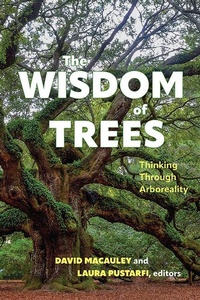
The Wisdom of Trees
Description

Pioneering essays that reveal the significance of new interdisciplinary understandings of trees and forests, especially in terms of their philosophical and ecological dimensions and their importance for addressing the climate emergency.
This is the first book to apply philosophical thinking to trees. Through a series of sixteen diverse essays by leading scholars and writers, along with an in-depth introduction to the key issues and ideas, it examines the new and emerging understanding of trees in science and society. Contributors show how these developments encourage a revisioning of philosophical thought and a more sustainable relationship with trees and forests-a reconceptualization with important ecological and social implications for responding to deforestation, the loss of biodiversity, and the climate emergency. The interdisciplinary contributions in this collection investigate the many interconnected dimensions of arboreality, focusing on subjects related to time, mind, truth, memory, being, beauty, goodness, silence, wisdom, personhood, and death. The volume engages in a conversation about why trees matter, how they can best be protected, our obligations to them, and even what or who they are. Most of the chapters are informed by natural history or ecological science and many share a particular emphasis on continental philosophy and the environmental humanities.
More details
Other editions
Additional editions
Persons
David Macauley is Academy Professor and Professor Emeritus of Philosophy and Environmental Studies at Penn State University. Laura Pustarfi is a Lecturer in Philosophy and Religion as well as Director of the Certificate Program at the Center for Psychedelic Therapies and Research at the California Institute of Integral Studies.
Content
- Intro
- Contents
- List of Illustrations
- Acknowledgments
- Foreword
- Introduction: The Wisdom of Trees
- Listening to Trees
- The Arboreal World
- Philosophy in the Forest
- Trees in Troubled Times
- Philosophical Branches
- Family Trees
- Planting the Future
- Notes
- Trees as Beings
- Interstice: Redwood
- 1 Arboreality: Trees as Ontologically Valuable Beings
- Thinking of Trees
- Arboreal Intelligence
- Arboreal Relationality
- Arboreal Agency
- Language, Personhood, and Consciousness
- Ontological Value
- Arboreal Ethics
- Conclusion
- Notes
- 2 In the Beginning She Was a Redwood: Rethinking Ontology through an Ecofeminist Materialism
- Encountering "Grandmother Tree"
- Rethinking Ontology as a Woman
- Toward an Ecofeminist Relational Ontology: Unpacking the Logic of Colonization
- Finding Mother Tree, Finding Mother God
- Conclusion
- Notes
- The Language of Trees
- Interstice: The Forest
- 3 Speaking Trees: The Language of Nature and Arboreal Communication
- Historical Background to the Language of Nature
- The Expressive Language of Trees
- Communication among Trees
- Notes
- 4 The Silence of Primeval Forests
- Modernity's Refusal of Silence and Darkness
- Luce Irigaray
- Redwood/Cedar-Hemlock Forests
- Notes
- Thinking (Like) Trees
- Interstice: Arborescence
- 5 Vegetal Imagination: Schelling and Whitehead as Exemplars of Marder's Plant-Thinking
- Notes
- Trees and Time
- Interstice: Rings
- 6 "Old Trees Hold Memory": Aboriginal Australian Perspectives on Memory, Trauma, and Witnessing in the Arboreal World
- Wisdom in the Absence of a Brain: Scientific Perspectives on Arboreal Memory
- Trees of Birth and Naming: Arboreal Memory in Aboriginal Australian Culture
- "Of Memory Deep Inside": Arboreal Memory and Embodiment in Aboriginal Poetry
- "It Is Still There: Our Story": Arboreal Memory and Transgenerational Trauma
- Conclusion: From Dendrophobia to Dendrophilia, Embracing New Memoryscapes
- Notes
- 7 Birth and Death in Trees
- Individual Life
- An Individual is Multitudes
- Born in Trees
- The Place and Ecology of Trees
- Interstice: Banyan
- 8 The Place of Trees: Taking Trees over the Edge
- Site, Space, and Place
- Taking Places, Giving Places (With Trees)
- The Edges of Trees in Place
- Arboreal Directionalities:A Living Infrastructure of the Place of Trees
- Notes
- 9 Organisms and Environments: What Alexander von Humboldt Learned from Trees
- The Physiognomy of Plants
- Plant Forms and Contexts
- The Clues of Trees
- Conclusion: Humboldt's Ecological Insight
- Notes
- Trees and Aesthetics
- Interstice: Cypress
- 10 Thirteen Ways of Looking at a Tree: Appreciating the Beauty of the Arboreal World
- Environmental Aesthetics
- Appreciating Trees
- 1. Form
- 2. Function and Evolution
- 3. Holism
- 4. Beautility
- 5. Suchness
- 6. Surface and Sensual Qualities
- 7. Ambience
- 8. Stories
- 9. Seasonality
- 10. Emotions
- 11. Moral Beauty
- 12. Sacredness
- 13. Imagination
- Conclusion
- Notes
- 11 Do Trees Sing?
- Notes
- Trees and Ethics
- Interstice: Apple
- 12 The Ponderosa Pines of Gold Creek: Discerning Arboreal Values for an All-Too-Human World
- On the Way to Trees
- What's in the Name?
- A Saying That Listens
- A Grove of Trees
- Burning Creation
- Notes
- 13 Wise Trees: Exemplars in the Arts of East Asia
- Wise Trees: What Can This Mean?
- Ways Trees Are Wise: Association
- Trees as an Embodiment and Manifestation of Wisdom in East Asia
- Problems with Wisdom in Trees
- The East Asian Context: Literati Culture and Landscape
- The Meaning and the Value of Wisdom
- Wisdom in Trees
- The Meaning of Wisdom in the East Asian Wisdom Traditions
- Wise Trees: Peach
- Wise Trees: Pines and Poetry
- Wise Trees: Bamboo and the Painting of Bamboo
- Painting Again
- Case Study: Dogen's Self-Portrait as a Plum Tree
- Conclusion
- Notes
- Legal and Political Trees
- Interstice: Eucalyptus
- 14 Philosophers with a Peculiarly Instructive Aversion toward Trees
- A Tree with Nothing to Teach
- An Absurd Tree
- Tiresome Trees
- Useless Trees
- Notes
- 15 Trees as Legal Persons
- Not Only People Are Persons: The Flexibility of Legal Fictions
- A Philosophical Turn toward Recognizing Trees as Persons
- How to Treat Trees as Legal Persons
- Conclusion
- Notes
- Afterword: The Sequoia Archipelago
- Suggestions for Further Reading
- Philosophy of Tree and Plant Life
- Tree and Plant Intelligence
- Arboreal Personhood
- Arboreal Ethics
- Trees and Aesthetics
- Trees and Plants in Literature
- Human Experience with Trees
- Trees, Forests, and Society
- Critical Views on Plant Studies
- Contributors
- Index
