

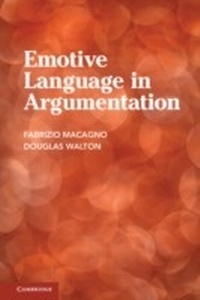
Emotive Language in Argumentation
1st Edition
Published on 30. November 2013
978-1-107-49684-2 (ISBN)
Description

This book analyzes the uses of emotive language and redefinitions from pragmatic, dialectical, epistemic and rhetorical perspectives, investigating the relationship between emotions, persuasion and meaning, and focusing on the implicit dimension of the use of a word and its dialectical effects. It offers a method for evaluating the persuasive and manipulative uses of emotive language in ordinary and political discourse. Through the analysis of political speeches (including President Obama's Nobel Peace Prize address) and legal arguments, the book offers a systematic study of emotive language in argumentation, rhetoric, communication, political science and public speaking.
Reviews / Votes
'Very often, words have emotive meanings and present certain values and assumptions as uncontroversial, thus functioning as persuasive (and potentially manipulative) instruments of everyday argumentation. However, an in-depth study of this important and potentially dangerous property of words is still lacking. Macagno and Walton fill this gap with their brilliant and exhaustive study of the relationship between words' meanings and emotions, values, definitions, presuppositions and dialogue commitments.' Manfred Kienpointner, University of Innsbruck 'Emotive language and definitions do not stand in opposition to reasoning; they are involved in virtually all cases of reasoning and argumentation about personal and public life. Macagno and Walton explain why this is so, provide a comprehensive account of how these tools are used, and offer guideposts for argument evaluation that take the role of language seriously.' David Zarefsky, Northwestern University 'Macagno and Walton demonstrate how words can be powerful in evoking emotions and how redefining them can be an act of persuasion. The book is a logico-pragmatic-rhetorical tour de force exploring how emotive meanings are intertwined with definitions, with the dynamics of presupposition, and with implicitness in argumentation. A journey well worth taking for argumentation scholars and linguists interested in evaluative language.' Andrea Rocci, University of Lugano 'This book's title understates its significance. The authors make a compelling case that all language in public argument is emotive language. Richard Weaver's metaphor that language is sermonic is surpassed with a detailed and systematic explanation of how the language of public argument is saturated with values and ideological preferences. Moreover, the authors demonstrate how the tools of logic can be used to understand and evaluate such emotive language. This book is a great leap forward for scholars of logic and argumentation.' Edward Schiappa, Massachusetts Institute of TechnologyMore details
Language
English
Place of publication
Cambridge
United Kingdom
Target group
Professional and scholarly
College/higher education
Illustrations
25 Tables, unspecified; 25 Plates, unspecified
File size
4,54 MB
ISBN-13
978-1-107-49684-2 (9781107496842)
Copyright in bibliographic data and cover images is held by Nielsen Book Services Limited or by the publishers or by their respective licensors: all rights reserved.
Schweitzer Classification
Other editions
Additional editions
Fabrizio Macagno | Douglas Walton
Emotive Language in Argumentation
Book
02/2014
Cambridge University Press
€105.10
Shipment within 15-20 days
Persons
Fabrizio Macagno is a postdoctoral researcher at the Universidade Nova de Lisboa, Portugal, where he teaches courses on argumentation theory and conducts research in the field of argumentation and communication. He is doing research in the field of argumentation and philosophy of language in cooperation with the University of Windsor, Ontario. His research interests are focused on the relationship between argumentation and semantics, which he investigates from epistemological, logical and linguistic perspectives. He co-authored Argumentation Schemes (Cambridge University Press, 2008). His articles have appeared in international peer reviewed journals such as Pragmatics and Cognition, the Journal of Pragmatics, Argumentation, Ratio Juris, Philosophy and Rhetoric, and Informal Logic. Douglas Walton is a Professor of Philosophy, Assumption Chair in Argumentation Studies and Distinguished Research Fellow of the Centre for Research in Reasoning, Argumentation and Rhetoric at the University of Windsor, Canada. His most recent book is Argumentation Schemes, coauthored with Chris Reed and Fabrizio Macagno (Cambridge University Press, 2008). Walton's work has been used to better prepare legal arguments and to help develop artificial intelligence. His books have been translated worldwide and he attracts students from many countries to study with him.
Content
1. When words are emotive; 2. The emotions in our words; 3. When words are reasoning; 4. The acts of defining; 5. What our words hide: presupposition and dark-side commitments; 6. Dialogues and commitments; 7. Metadialogues and redefinitions.
