

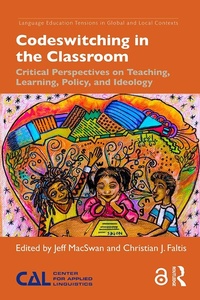
Codeswitching in the Classroom
Critical Perspectives on Teaching, Learning, Policy, and Ideology
1st Edition
Published on 16. October 2019
310 pages
978-1-315-40108-9 (ISBN)
Description

Bringing together sociolinguistic, linguistic, and educational perspectives, this cutting-edge overview of codeswitching examines language mixing in teaching and learning in bilingual classrooms. As interest in pedagogical applications of bilingual language mixing increases, so too does a need for a thorough discussion of the topic. This volume serves that need by providing an original and wide-ranging discussion of theoretical, pedagogical, and policy-related issues and obstacles in classroom settings-the pedagogical consequences of codeswitching for teaching and learning of language and content in one-way and two-way bilingual classrooms.
Part I provides an introduction to (socio)linguistic and pedagogical contributions to scholarship in the field, both historical and contemporary. Part II focuses on codeswitching in teaching and learning, and addresses a range of pedagogical challenges to language mixing in a variety of contexts, such as literacy and mathematics instruction. Part III looks at language ideology and language policy to explore how students navigate educational spaces and negotiate their identities in the face of competing language ideologies and assumptions. This volume breaks new ground and serves as an important contribution on codeswitching for scholars, researchers, and teacher educators of language education, multilingualism, and applied linguistics.
Part I provides an introduction to (socio)linguistic and pedagogical contributions to scholarship in the field, both historical and contemporary. Part II focuses on codeswitching in teaching and learning, and addresses a range of pedagogical challenges to language mixing in a variety of contexts, such as literacy and mathematics instruction. Part III looks at language ideology and language policy to explore how students navigate educational spaces and negotiate their identities in the face of competing language ideologies and assumptions. This volume breaks new ground and serves as an important contribution on codeswitching for scholars, researchers, and teacher educators of language education, multilingualism, and applied linguistics.
Reviews / Votes
"This is a fascinating volume that raises fundamental questions regarding the values and limits of theories and models of multilingual teaching and learning in institutionalized contexts. It brings the debates about theory, policy, practice and ideology together. The impact of the studies in this volume will be felt for a very long time to come."Li Wei, Chair of Applied Linguistics, University College London (UCL), UK.
"Decades of (socio)linguistic research on language mixing has made two things abundantly clear: it is ubiquitous in bilingual communities and it is highly structured. As such, eliminating it is neither feasible nor desirable. The editors of this indispensable volume are to be congratulated for hammering these facts home to the educational community. May their and their contributors' sage observations lead teachers to recognize and capitalize on the stunning resources bilingual kids bring to school rather than treating them as a liability."
Shana Poplack, Distinguished University Professor and Canada Research Chair in Linguistics, and Director, Sociolinguistics Laboratory, University of Ottawa, Canada.
More details
Series
Edition
1. Auflage
Language
English
Place of publication
London
United Kingdom
Publishing group
Taylor & Francis Ltd
Target group
College/higher education
Product notice
Reflowable
Illustrations
10 Tables, black and white; 15 Line drawings, black and white; 1 Halftones, black and white; 16 Illustrations, black and white
File size
1,67 MB
ISBN-13
978-1-315-40108-9 (9781315401089)
Copyright in bibliographic data and cover images is held by Nielsen Book Services Limited or by the publishers or by their respective licensors: all rights reserved.
Schweitzer Classification
Other editions
Additional editions
Jeff MacSwan | Christian J. Faltis
Codeswitching in the Classroom
Critical Perspectives on Teaching, Learning, Policy, and Ideology
Book
11/2019
1st Edition
Routledge
€69.80
Shipment within 10-20 days
Jeff MacSwan | Christian J. Faltis
Codeswitching in the Classroom
Critical Perspectives on Teaching, Learning, Policy, and Ideology
Book
11/2019
1st Edition
Routledge
€206.90
Shipment within 10-20 days
Persons
Jeff MacSwan is Professor of Applied Linguistics and Language Education at the University of Maryland, USA.
Christian J. Faltis is Professor of Teaching and Learning at the Ohio State University, USA.
Christian J. Faltis is Professor of Teaching and Learning at the Ohio State University, USA.
Content
Preface
Jeff MacSwan, University of Maryland; Christian J. Faltis, Ohio State University
Part I. Theory and Context
Sociolinguistic and Linguistic Foundations of Codeswitching Research
Jeff MacSwan, University of Maryland
Pedagogical Codeswitching and Translanguaging in Bilingual Schooling Contexts: Critical Practices for Bilingual Teacher Education
Christian J. Faltis, Ohio State University
Part II. Teaching and Learning
Exploring the Pedagogical Potential of Translanguaging in Peer Reading Interaction
Johanna Tigert, University of Massachusetts Lowell; James Groff, Melinda Martin-Beltran, Megan Madigan Peercy, University of Maryland; Rebecca Silverman, Stanford University
Codeswitching and mathematics learners: How hybrid language practices provide resources for student participation in mathematical practices
Judit Moschkovich, University of California, Santa Cruz
Sandwiching, Polylanguaging, Translanguaging, and Codeswitching: Challenging Monolingual Dogma in Institutionalized Language Teaching
Guadalupe Valdes, Stanford University
Effects of Home Codeswitching Practices on Bilingual Language Acquisition
Jeff MacSwan, University of Maryland; Natalia Guzman, University of Maryland; Kara McAlister, Arizona State University; and Margaret Marcus, University of Maryland
Young Emergent Bilinguals' Languaging Practices in Story Retelling
Mileidis Gort, CU Boulder
Part III. Policy and Ideology
?Que quieren de mi? Examining elementary school teachers' belief systems about language use in the classroom
Susan Hopewell, Lucinda Soltero-Gonzalez, Kathy Escamilla, Jody Slavick
Translanguaging in the Classroom: Implications for Effective Pedagogy for Bilingual Youth in Texas
Kathryn Henderson, University of Texas at San Antonio; and Peter Sayer, Ohio State University
Chicanx and Latinx Students' Linguistic Repertoires: Moving Beyond Essentialist and Prescriptivist Perspectives
Ramon A. Martinez, Stanford University; Danny C. Martinez, University of California, Davis
"You're not a Spanish-speaker!" - "We are all bilingual." The purple kids on being and becoming bilingual in a dual language kindergarten classroom
Deborah Palmer, University of Colorado, Boulder
Afterword: On Contested Theories and the Value and Limitations of Pure Critique
Terrance G. Wiley, Arizona State University
Jeff MacSwan, University of Maryland; Christian J. Faltis, Ohio State University
Part I. Theory and Context
Sociolinguistic and Linguistic Foundations of Codeswitching Research
Jeff MacSwan, University of Maryland
Pedagogical Codeswitching and Translanguaging in Bilingual Schooling Contexts: Critical Practices for Bilingual Teacher Education
Christian J. Faltis, Ohio State University
Part II. Teaching and Learning
Exploring the Pedagogical Potential of Translanguaging in Peer Reading Interaction
Johanna Tigert, University of Massachusetts Lowell; James Groff, Melinda Martin-Beltran, Megan Madigan Peercy, University of Maryland; Rebecca Silverman, Stanford University
Codeswitching and mathematics learners: How hybrid language practices provide resources for student participation in mathematical practices
Judit Moschkovich, University of California, Santa Cruz
Sandwiching, Polylanguaging, Translanguaging, and Codeswitching: Challenging Monolingual Dogma in Institutionalized Language Teaching
Guadalupe Valdes, Stanford University
Effects of Home Codeswitching Practices on Bilingual Language Acquisition
Jeff MacSwan, University of Maryland; Natalia Guzman, University of Maryland; Kara McAlister, Arizona State University; and Margaret Marcus, University of Maryland
Young Emergent Bilinguals' Languaging Practices in Story Retelling
Mileidis Gort, CU Boulder
Part III. Policy and Ideology
?Que quieren de mi? Examining elementary school teachers' belief systems about language use in the classroom
Susan Hopewell, Lucinda Soltero-Gonzalez, Kathy Escamilla, Jody Slavick
Translanguaging in the Classroom: Implications for Effective Pedagogy for Bilingual Youth in Texas
Kathryn Henderson, University of Texas at San Antonio; and Peter Sayer, Ohio State University
Chicanx and Latinx Students' Linguistic Repertoires: Moving Beyond Essentialist and Prescriptivist Perspectives
Ramon A. Martinez, Stanford University; Danny C. Martinez, University of California, Davis
"You're not a Spanish-speaker!" - "We are all bilingual." The purple kids on being and becoming bilingual in a dual language kindergarten classroom
Deborah Palmer, University of Colorado, Boulder
Afterword: On Contested Theories and the Value and Limitations of Pure Critique
Terrance G. Wiley, Arizona State University
