

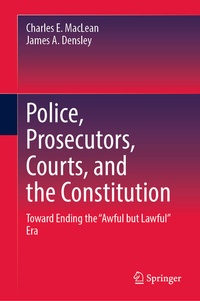
Police, Prosecutors, Courts, and the Constitution
Description

This book delves into a multitude of practices that, although deemed "lawful" by courts, are undeniably "awful" and unethical. From police officers employing deceit to extract confessions or consent to search, to prosecutors manipulating innocent individuals to relinquish their rights and plead guilty, to excessive force by law enforcement, these practices erode public trust in the criminal legal system and deny justice to those affected.
With a critical examination of these deeply flawed tactics, this volume goes beneath the surface to explore their profound impact on the ethical standards and emotional health of justice system practitioners. It forcefully argues for a reclaiming of The Social Contract and for peace officers and prosecutors to unequivocally reject these unethical methods and recognize the urgent need for a criminal justice system that truly embodies ethics and fairness.
This work equips police officers, prosecutors, judges, and legislators with invaluable research, enabling them to actively advocate for a transformed system that ethically serves justice for all in the post-George Floyd era.
More details
Other editions
Additional editions
Persons
Dr. Charles E. "Chuck" MacLean is Professor in the School of Criminology and Criminal Justice at Metro State University in Brooklyn Park, Minnesota, USA, and Lecturer in Constitutional Law at the University of Wisconsin-Eau Claire, USA. MacLean began his full-time teaching career in 2010 after serving twenty years as a state felony prosecutor. He is the author or co-author of four books, including Justice for All: Reforming American Criminal Justice (2022), plus 35 articles, 46 essays and book chapters, and 8 amicus briefs to the United States Supreme Court. He has been quoted in numerous media outlets, including the American Bar Association Journal, Canadian Broadcasting Corporation, Corriere della Sera, and USA Today. In addition to teaching undergraduate criminal justice courses, MacLean has taught criminal law, constitutional criminal procedure, evidence, and other courses at law schools in Indiana, Minnesota, and Tennessee. MacLean earned his law degree from William Mitchell College of Law and his doctorate from the Nova Southeastern University.
Dr. James Densley is Professor and Chair of the School of Criminology and Criminal Justice at Metro State University, USA. Densley has received global media attention for his work on street gangs, criminal networks, violence, and policing. He is the author or co-author of eight books, including the acclaimed, The Violence Project: How to Stop a Mass Shooting Epidemic , more than 50 peer-reviewed articles in leading scientific journals, as well as over 100 book chapters, essays, and other works in outlets such as The Los Angeles Times, The New York Times, USA Today, The Wall Street Journal, and The Washington Post. Densley earned his doctorate in sociology from the University of Oxford. He is a former middle school special education teacher and in 2017 he was awarded the Points of Light Award for outstanding community volunteerism by the UK Prime Minister.
