

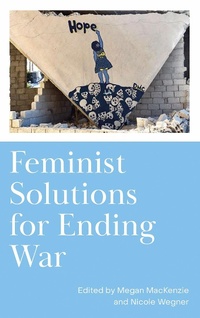
Feminist Solutions for Ending War
1st Edition
Published on 20. November 2021
272 pages
978-0-7453-4290-0 (ISBN)
Description

'War is a man's game,' or so goes the saying. Whether this is true or not, patriarchal capitalism is certainly one of the driving forces behind war in the modern era. So can we end war with feminism? This book argues that this is possible, and is in fact already happening.
Each chapter provides a solution to war using innovative examples of how feminist and queer theory and practice inform pacifist treaties, movements and methods, from the international to the domestic spheres. The contributors propose a range of solutions that include arms abolition, centring Indigenous knowledge, economic restructuring, and transforming how we 'count' civilian deaths.
Ending war requires challenging complex structures, but the solutions found in this edition have risen to this challenge. By thinking beyond the violence of the capitalist patriarchy, this book makes the powerful case that the possibility of life without war is real.
Each chapter provides a solution to war using innovative examples of how feminist and queer theory and practice inform pacifist treaties, movements and methods, from the international to the domestic spheres. The contributors propose a range of solutions that include arms abolition, centring Indigenous knowledge, economic restructuring, and transforming how we 'count' civilian deaths.
Ending war requires challenging complex structures, but the solutions found in this edition have risen to this challenge. By thinking beyond the violence of the capitalist patriarchy, this book makes the powerful case that the possibility of life without war is real.
Reviews / Votes
'So much of patriarchal political culture is sustained by the myth that war, like poverty, will always be with us. But as I read the grounded, energizing chapters of Mackenzie's and Wegner's engaging book, I realized that the unrealistic ones among us are actually those who perpetuate the myth of unending war' -- Cynthia Enloe, author of 'The Big Push: Exposing and Challenging Persistent Patriarchy' 'Explains the deeply-rooted gendered realities of war and builds on intersectional feminist analyses to articulate diverse creative possibilities for peace. In our increasingly militarised world it challenges us to use our political imaginations to think differently' -- Kimberly Hutchings, Professor of Politics and International Relations at Queen Mary University, London 'This collection shows that war is not a human inevitability, but a choice - a choice that states make over and over again. It offers intellectual and practical solidarity, and real tools for making other choices possible' -- Kenneth MacLeish, Associate Professor of Medicine, Health & Society and Anthropology at Vanderbilt UniversityMore details
Edition
1. Auflage
Language
English
Place of publication
London
United Kingdom
Target group
Professional and scholarly
File size
1,32 MB
ISBN-13
978-0-7453-4290-0 (9780745342900)
Copyright in bibliographic data and cover images is held by Nielsen Book Services Limited or by the publishers or by their respective licensors: all rights reserved.
Schweitzer Classification
Other editions
Additional editions
Megan MacKenzie | Nicole Wegner
Feminist Solutions for Ending War
Book
11/2021
Pluto Press
€26.50
Shipment within 10-20 days
Persons
Megan MacKenzie is the Simons Chair in International Law and Human Security in the School for International Studies at Simon Fraser University. She is the author of Beyond the Band of Brothers: The US Military and the Myth that Women Can't Fight (CUP, 2015).
Nicole Wegner is a post-doctoral research fellow at the University of Sydney. She is the author of Martialling Peace: How the Peacekeeper Myth Legitimizes Warfare (Edinburgh Press, 2022).
Nicole Wegner is a post-doctoral research fellow at the University of Sydney. She is the author of Martialling Peace: How the Peacekeeper Myth Legitimizes Warfare (Edinburgh Press, 2022).
Content
Abbreviations and Acronyms
Acknowledgements
Introduction to Feminist Solutions to Ending War - Megan MacKenzie and Nicole Wegner
1. Giyira: Indigenous Women's Knowing, Being and Doing as a Way to End War on Country - Jessica Russ-Smith, Lecturer, Australian Catholic University, Australia
2. One for All and All for One: Taking Collective Responsibility for Ending War and Sustaining Peace - Heidi Hudson, Professor of International Relations, University of the Free State, South Africa
3. Feminist Organising for Peace - Sarai B. Aharoni, Lecturer, Ben-Gurion University of the Negev, Israel
4. Piecing-up Peace in Kashmir: Feminist Perspectives on Education for Peace - Shweta Singh, Assistant Professor, South Asian University, India & Diksha Poddar, Researcher, Jawaharlal Nehru University, India
5. Learn from Kurdish Women's Liberation Movements to Imagine the Dissolution of the Nation-state System - Eda Gunyadin, Researcher, University of Sydney, Australia
6. Queer Our Vision of Security - Cai Wilkinson, Associate Professor in International Relations, Deakin University, Australia
7. Abolish Nuclear Weapons: Draw on Feminist, Queer and Indigenous Theory and Experiences to Support Movements to End Nuclear Weapons - Ray Acheson, Researcher at Program on Science and Global Security, Princeton University, USA
8. Make Foreign Policies as if Black and Brown Lives Mattered - Yolande Bouka, Assistant Professor, Queen's University, Canada
9. Draw on Ecofeminist and Indigenous Scholarship to Reimagine the Ways We Memorialise War - Sertan Saral, PHD Candidate, University of Sydney, Australia
10. Engage with Combatants as Interlocutors for Peace, Not Only as Authorities on Violence - Roxani Krystalli, Assistant Professor, University of St Andrews, Scotland
11. Recognise the Rights of Nature - Keina Yoshida, Research Officer in the Centre for Women, Peace, and Security, LSE, UK
12. Create Just, Inclusive Feminist Economies to Foster Sustainable Peace - Carol Cohn, Lecturer, University of Massachusetts Boston, USA & Claire Duncanson, Lecturer, University of Edinburgh, UK
13. Change How Civilian Casualties are 'Counted' - Thomas Gregory, Senior Lecturer, University of Auckland, New Zealand
14. Listen to Women When Creating Peace Initiatives - Laura J. Shepherd, Professor of International Relations, University of Sydney, Australia
Notes on Contributors
Index
Acknowledgements
Introduction to Feminist Solutions to Ending War - Megan MacKenzie and Nicole Wegner
1. Giyira: Indigenous Women's Knowing, Being and Doing as a Way to End War on Country - Jessica Russ-Smith, Lecturer, Australian Catholic University, Australia
2. One for All and All for One: Taking Collective Responsibility for Ending War and Sustaining Peace - Heidi Hudson, Professor of International Relations, University of the Free State, South Africa
3. Feminist Organising for Peace - Sarai B. Aharoni, Lecturer, Ben-Gurion University of the Negev, Israel
4. Piecing-up Peace in Kashmir: Feminist Perspectives on Education for Peace - Shweta Singh, Assistant Professor, South Asian University, India & Diksha Poddar, Researcher, Jawaharlal Nehru University, India
5. Learn from Kurdish Women's Liberation Movements to Imagine the Dissolution of the Nation-state System - Eda Gunyadin, Researcher, University of Sydney, Australia
6. Queer Our Vision of Security - Cai Wilkinson, Associate Professor in International Relations, Deakin University, Australia
7. Abolish Nuclear Weapons: Draw on Feminist, Queer and Indigenous Theory and Experiences to Support Movements to End Nuclear Weapons - Ray Acheson, Researcher at Program on Science and Global Security, Princeton University, USA
8. Make Foreign Policies as if Black and Brown Lives Mattered - Yolande Bouka, Assistant Professor, Queen's University, Canada
9. Draw on Ecofeminist and Indigenous Scholarship to Reimagine the Ways We Memorialise War - Sertan Saral, PHD Candidate, University of Sydney, Australia
10. Engage with Combatants as Interlocutors for Peace, Not Only as Authorities on Violence - Roxani Krystalli, Assistant Professor, University of St Andrews, Scotland
11. Recognise the Rights of Nature - Keina Yoshida, Research Officer in the Centre for Women, Peace, and Security, LSE, UK
12. Create Just, Inclusive Feminist Economies to Foster Sustainable Peace - Carol Cohn, Lecturer, University of Massachusetts Boston, USA & Claire Duncanson, Lecturer, University of Edinburgh, UK
13. Change How Civilian Casualties are 'Counted' - Thomas Gregory, Senior Lecturer, University of Auckland, New Zealand
14. Listen to Women When Creating Peace Initiatives - Laura J. Shepherd, Professor of International Relations, University of Sydney, Australia
Notes on Contributors
Index
