

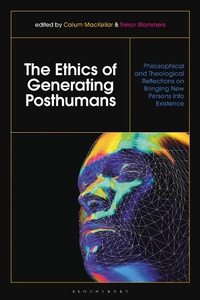
The Ethics of Generating Posthumans
Philosophical and Theological Reflections on Bringing New Persons into Existence
1st Edition
Published on 27. January 2022
248 pages
978-1-350-21655-6 (ISBN)
Description

Should transhuman and posthuman persons ever be brought into existence? And if so, could they be generated in a good and loving way? This study explores how society may respond to the actual generation of new kinds of persons from ethical, philosophical, and theological perspectives.
Contributors to this volume address a number of essential questions, including the ethical ramifications of generating new life, the relationships that generators may have with their creations, and how these creations may consider their generation. This collection's interdisciplinary approach traverses the philosophical writings of Aristotle, Aquinas, Kant, Nietzsche, and Heidegger, alongside theological considerations from Jewish, Christian, and Islamic traditions. It invites academics, faith leaders, policy makers, and stakeholders to think through the ethical gamut of generating posthuman and transhuman persons.
Contributors to this volume address a number of essential questions, including the ethical ramifications of generating new life, the relationships that generators may have with their creations, and how these creations may consider their generation. This collection's interdisciplinary approach traverses the philosophical writings of Aristotle, Aquinas, Kant, Nietzsche, and Heidegger, alongside theological considerations from Jewish, Christian, and Islamic traditions. It invites academics, faith leaders, policy makers, and stakeholders to think through the ethical gamut of generating posthuman and transhuman persons.
More details
Edition
1. Auflage
Language
English
Place of publication
London
United Kingdom
Publishing group
Bloomsbury Publishing PLC
Target group
Professional and scholarly
ISBN-13
978-1-350-21655-6 (9781350216556)
Copyright in bibliographic data and cover images is held by Nielsen Book Services Limited or by the publishers or by their respective licensors: all rights reserved.
Schweitzer Classification
Other editions
Additional editions
Calum MacKellar | Trevor Stammers
The Ethics of Generating Posthumans
Philosophical and Theological Reflections on Bringing New Persons into Existence
Book
08/2023
Bloomsbury Academic
€55.89
Shipment within 15-20 days
Calum MacKellar | Trevor Stammers
The Ethics of Generating Posthumans
Philosophical and Theological Reflections on Bringing New Persons into Existence
Book
02/2022
Bloomsbury Academic
€117.50
Shipment within 15-20 days
Persons
Calum MacKellar is Director of Research of the Scottish Council on Human Bioethics in Edinburgh, Scotland, UK.
Trevor Stammers is Associate Professor of Bioethics and Director of the Centre for Bioethics and Emerging Technologies at St Mary's University, London, UK.
Trevor Stammers is Associate Professor of Bioethics and Director of the Centre for Bioethics and Emerging Technologies at St Mary's University, London, UK.
Content
A note on the text
List of contributors
Faith perspectives
Introduction: Calum MacKellar (Scottish Council on Human Bioethics, UK) and Trevor Stammers
Part I Who is a transhuman and posthuman person?
1. The concept of a 'person' and its history, Michael Fuchs (Catholic University of Linz, Austria)
2. One of us: Humans, transhumans and posthumans, Richard Playford (St Mary's University, UK)
3. Remaining human: The philosophy of Charles Taylor aimed at the ethics of generating trans- and posthuman persons, Gregory Parker Jr. (University of Edinburgh, UK)
4. Being somebody: Towards a categorical imperative for the age of transhumanism, Christian Hölzchen
Part II How can transhuman and posthuman persons be generated?
5. On the scientific plausibility of transhumanism, Chris Willmott (University of Leicester, UK)
Part III Philosophical aspects in generating transhuman and posthuman persons
6. Domination and vulnerability: Herman Bavinck and posthumanism in the shadow of Friedrich Nietzsche, James Eglinton (University of Edinburgh, UK)
7. The question of technology and relationships: How might Martin Heidegger's idea of enframing shape how posthuman persons and their generators relate to one another? Matthew James (St Mary's University, UK)
8. Deliver us from (artificial) evil: Are the generators of Artificial Intelligences morally accountable for the actions of those they generate? Trevor Stammers
Part IV Theological aspects in generating transhuman and posthuman persons
9. A Jewish outlook: A Jewish case study in creating transhuman and posthuman persons, Deborah Blausten (Finchley Reform Synagogue, London)
10. A Christian outlook: The rational body: A Thomistic perspective on parenthood and posthumanism, Michael Wee (Durham University, UK)
11. An Islamic outlook: Islamic perspectives on the ethics of bringing transhuman and posthuman persons into existence Mehrunisha Suleman (University of Cambridge, UK)
Part V Ethical aspects in generating transhuman and posthuman persons
12 Procreating transhuman and posthuman persons, Calum MacKellar (St Mary's University, UK)
13 Posthuman children: Questions of identity, Gillian Wright (Scottish Council on Human Bioethics, UK)
Conclusion Calum MacKellar (Scottish Council on Human Bioethics, UK) and Trevor Stammers
Appendix: Scottish Council on Human Bioethics recommendations on the generation of transhuman and posthuman persons
Index
List of contributors
Faith perspectives
Introduction: Calum MacKellar (Scottish Council on Human Bioethics, UK) and Trevor Stammers
Part I Who is a transhuman and posthuman person?
1. The concept of a 'person' and its history, Michael Fuchs (Catholic University of Linz, Austria)
2. One of us: Humans, transhumans and posthumans, Richard Playford (St Mary's University, UK)
3. Remaining human: The philosophy of Charles Taylor aimed at the ethics of generating trans- and posthuman persons, Gregory Parker Jr. (University of Edinburgh, UK)
4. Being somebody: Towards a categorical imperative for the age of transhumanism, Christian Hölzchen
Part II How can transhuman and posthuman persons be generated?
5. On the scientific plausibility of transhumanism, Chris Willmott (University of Leicester, UK)
Part III Philosophical aspects in generating transhuman and posthuman persons
6. Domination and vulnerability: Herman Bavinck and posthumanism in the shadow of Friedrich Nietzsche, James Eglinton (University of Edinburgh, UK)
7. The question of technology and relationships: How might Martin Heidegger's idea of enframing shape how posthuman persons and their generators relate to one another? Matthew James (St Mary's University, UK)
8. Deliver us from (artificial) evil: Are the generators of Artificial Intelligences morally accountable for the actions of those they generate? Trevor Stammers
Part IV Theological aspects in generating transhuman and posthuman persons
9. A Jewish outlook: A Jewish case study in creating transhuman and posthuman persons, Deborah Blausten (Finchley Reform Synagogue, London)
10. A Christian outlook: The rational body: A Thomistic perspective on parenthood and posthumanism, Michael Wee (Durham University, UK)
11. An Islamic outlook: Islamic perspectives on the ethics of bringing transhuman and posthuman persons into existence Mehrunisha Suleman (University of Cambridge, UK)
Part V Ethical aspects in generating transhuman and posthuman persons
12 Procreating transhuman and posthuman persons, Calum MacKellar (St Mary's University, UK)
13 Posthuman children: Questions of identity, Gillian Wright (Scottish Council on Human Bioethics, UK)
Conclusion Calum MacKellar (Scottish Council on Human Bioethics, UK) and Trevor Stammers
Appendix: Scottish Council on Human Bioethics recommendations on the generation of transhuman and posthuman persons
Index
