

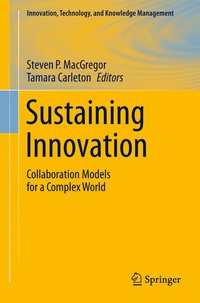
Sustaining Innovation
Description

In many ways, the process of innovation is a constant social dance, where the best dancers thrive by adapting new steps with multiple partners. The systematic and continuous generation of value in any innovation system relies on collaboration between different groups, who must overcome multiple, often competing agendas and needs to work together fruitfully over the long term. Featuring contributions from leading researchers, business leaders, and policymakers representing North America, Europe, India, Africa, and Australasia, this volume investigates different combinations of collaborative arrangements among innovation actors, many of which are changing conventional expectations of institutional relationships.
Collectively, the authors demonstrate that no particular combination has emerged as the most dominant, or even resilient, model of innovation. Several authors expand on our understanding of the triple helix model, with both academics and practitioners looking to the quadruple helix (encompassing business, academic, government, and civil society) as the new standard. Other authors address aspects of open innovation, co-creation, and user-centered design-all testaments to the rapidly shifting landscape. At the same time, many businesses, academics, and governments, not to mention non-profit organizations, foundations, and society at large, are active in conversations about how to pursue a more sustainable model of innovation. The pursuit of this holy grail of innovation is both facilitated and complicated by an ever-accelerating technological environment in which social networking and mobile tools are emerging as new dance arenas.
More details
Other editions
Additional editions
Content
- Intro
- Sustaining Innovation
- Series Foreword
- Foreword
- Introduction
- On Sustainability
- On Global Networks
- Models of Complex Collaboration
- Multiple Viewpoints on Sustaining Innovation
- Section I: Visions
- Section II: Research
- Section III: Experiences
- References
- Acknowledgments
- Contents
- Contributors
- Chapter 1: Exploring a Vision for Sustaining Innovation in African Economies
- 1 What is Technology Transfer?
- 2 How Many Players in the Innovation and Technology Transfer Helix?
- 3 Maximizing the Multihelix Technology Transfer Agenda
- 4 Telecom Networks as Physical Foundation for Continental Virtual Networks
- 4.1 Registration (1910-Recent)
- 4.2 Establishing Regulatory Infrastructure (1996-Recent)
- 4.3 Privatization (1998-Recent)
- 4.4 Adoption (1998-Recent)
- 4.5 Diffusion (1998-Recent)
- 5 Physical and Virtual Networks as Foundation for African Social Network
- 6 New Business Models Can Change Stakeholder Interactions and Benefit End-Users
- 7 Conclusion
- References
- Chapter 2: CLIQ: A Practical Approach to the Quadruple Helix and More Open Innovation
- 1 What is CLIQ?
- 1.1 CLIQ and European Innovation Discourse
- 1.2 Innovation and Public Authorities
- 2 Understanding Quadruple Helix
- 3 Ways to Learn
- 3.1 Learning from Experience
- 3.2 Ongoing Evaluation
- 3.3 Learning by Experiment
- 3.4 Search for the Phantom
- 4 Quadruple Helix Revisited
- References
- Chapter 3: The First Bank of Cents: Innovative Carpooling Through Social Currencies
- 1 The Quadruple Helix in Practice: Academia, Firms, Government, and Civil Society
- 1.1 Government Perspective
- 1.2 Business Perspective
- 1.3 Academic Perspective
- 1.4 Society Perspective
- 1.5 Integrating the Quadruple-Helix
- 2 The Vision and Mission of FBC
- 3 Social Currencies, a Type of Money
- 4 Background on Carpooling
- 5 The FBC Business Model: Building a Critical Mass
- 5.1 Implementation and Roll-Out
- 5.2 Vision in Action: Start-up Case: Girona, Catalonia, EU
- 6 Final Discussion and Conclusions
- References
- Chapter 4: Collaborative Healthcare Innovation in Sweden
- 1 Introduction
- 2 Method
- 3 Learning Networks
- 4 Experiences and Lessons Learned
- 4.1 Conditions and Expectations
- 4.2 Responsibilities, Meeting Cultures, and Cooperation
- 4.3 Approaches to Time
- 4.4 Lessons Learned
- 5 Conclusions and Discussion
- References
- Chapter 5: Understanding Collaboration in Knowledge Processes in Indian Industry
- 1 Introduction
- 2 Innovation and Collaborative Design
- 3 Knowledge Processes Models
- 4 Focus and Approach
- 5 The KRIT Model
- 6 Observations in Industry
- 6.1 Knowledge of Solutions
- 6.2 Requirements
- 6.3 Interactions
- 6.4 Tasks
- 7 Influence Model and Assessment
- 7.1 Knowledge Satisfaction
- 7.2 Requirement Satisfaction
- 7.3 Interaction Satisfaction
- 7.4 Task Satisfaction
- 8 Discussion and Conclusions
- References
- Chapter 6: Public Policy Support to Triple Helix R&D Collaborations: A European Model for Fourth Pillar Organizations
- 1 Introduction
- 2 Innovation Policy in the European Union
- 3 Public Policy Support to Fourth Pillar Organizations Managing Triple Helix R&D Collaborations
- 4 Empirical Method and Case Selection
- 5 Results from Case Studies
- 6 A European Model for Collaborative R&D Projects
- 7 Conclusions
- References
- Chapter 7: Strategic Process of Change: A Multiple Network Game-The Rohner Textil Case
- 1 Introduction
- 2 Method
- 2.1 Case Selection
- 2.2 Data Collection
- 2.3 Data Analysis
- 3 The Process of Change: Reconciling CR and Competitiveness
- 3.1 1981-1992: Challenging Systems for Survival
- 3.2 1992-1995: Exploring New Concepts
- 3.3 1995-1999: Formalization and Diffusion of the Concept
- 3.4 1999-2004: Pushing the Limits Even Further
- 3.5 2005-2011: Confronting a Changing Market
- 4 Discussion
- 5 Conclusion
- References
- Chapter 8: The BBVA Innovation Network
- 1 The Importance of Sustainable Value in Innovation
- 2 The Network's Role in BBVA's Innovation Model
- 3 The Innovation Network's Origins
- 4 Current Configuration: Five Innovation Poles
- 5 A Case Study of ABIL
- 6 Looking to the Future: Innovation Network Expansion
- Chapter 9: A Network of Networks: The Case of the UK Technology Strategy Board
- 1 Background
- 2 Innovation and Knowledge Sharing
- 2.1 Why Knowledge Sharing?
- 2.2 What Do We Mean by Knowledge?
- 3 Creating a Climate for a Knowledge Sharing Culture
- 4 Open Innovation, Knowledge Sharing, and Networking
- 5 Evolving a Network of Networks
- 5.1 From Faraday Partnerships to Knowledge Transfer Networks
- 5.2 What is a Knowledge Transfer Network?
- 5.3 KTN Communities
- 5.4 KTN Organization
- 5.5 The Network of Networks
- 6 Connect: A Platform for Open Innovation
- 6.1 A Virtual Open Innovation Space
- 6.2 The Importance of Community Management
- 7 The Future
- References
- Chapter 10: Revolutionizing the Value Chain in the Sporting Goods Industry Through Virtualization
- 1 The Traditional Value Chain
- 2 The Concept of Virtualization
- 2.1 Introducing Virtualization
- 2.2 Establishing Innovation Partnerships with External Parties
- 3 The Different Facets of the Value Chain
- 3.1 The Product Creation Process
- 3.2 The Sell-In Process
- 3.3 Tradition Meets Innovation
- 4 Internal Change Management: Making the Organization Part of Innovation
- 4.1 Addressing the Doubts
- 4.2 The Power of the Virtual Network
- 4.3 Lessons Learnt
- 4.4 Top Management Support: Make or Break
- 5 Expanding Virtualization from an Efficiency Driver to a Consumer Stimulus
- 5.1 Overcoming Resistance to Sell-In
- 5.2 Cataloguing
- 5.3 Customization
- 5.4 Brand Marketing
- 5.5 Design
- 5.6 A New Consumer Experience
- 6 Making Innovation Sustainable
- 7 Outlook
- Chapter 11: Technology Foresight: The Evolution of the Shell GameChanger Technology Futures Program
- 1 The Challenges of Robust Foresight : Why Look Across Adjacent Sectors?
- 2 Linking the Long and Short Term: How Technology Futures Was Used In-House?
- 3 An Example of a Power Company
- 4 Shell's GameChanger Methodology
- 5 Beyond Technology Futures: Future Agenda
- 6 In Practice: Using the Insights from Future Agenda
- 7 Open Foresight as a Core Asset
- 7.1 Sharing Views
- 7.2 Engaging a Broader Church
- 7.3 More Weak Signals
- 7.4 Stimulating Higher Levels of Innovation
- 8 Conclusion
- 9 Resources
- References
- Index
