

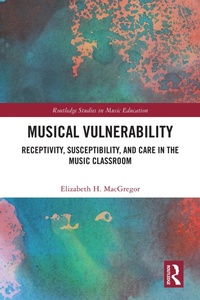
Musical Vulnerability
Receptivity, Susceptibility, and Care in the Music Classroom
1st Edition
Published on 24. December 2024
232 pages
978-1-040-22576-9 (ISBN)
Description

Since the early twenty- first century, music education across the world has been shaped by neoliberal discourse extolling the benefits of music upon academic achievement, health and wellbeing, and social development. However, such benefits are far from universal; on the contrary, music- making often reveals our shortcomings and dependencies. This highlights an urgent need for music education to be reframed by an understanding of 'musical vulnerability': our inherent and situational openness to being affected by the semantic and somatic properties of music- making.
Drawing on existing vulnerability studies, this book evaluates how musicmaking can foster both positive receptivity and negative susceptibility, depending on its delineation of self- identity, social identity, and space, and its embodiment through aural receptivity, mimetic participation, and affective transmission. Through phenomenological, ethnographic research with teachers and pupils, it exposes how values espoused in the music classroom require the personal and interpersonal negotiation of conflicting musical expectations, identities, and abilities. It makes recommendations for music education policymakers, teachers, and researchers in diverse global contexts, suggesting the importance of developing 'pedagogies of vulnerability' in order to foster caring classroom music- making praxes that acknowledge music's capacity both to heal and to harm.
Drawing on existing vulnerability studies, this book evaluates how musicmaking can foster both positive receptivity and negative susceptibility, depending on its delineation of self- identity, social identity, and space, and its embodiment through aural receptivity, mimetic participation, and affective transmission. Through phenomenological, ethnographic research with teachers and pupils, it exposes how values espoused in the music classroom require the personal and interpersonal negotiation of conflicting musical expectations, identities, and abilities. It makes recommendations for music education policymakers, teachers, and researchers in diverse global contexts, suggesting the importance of developing 'pedagogies of vulnerability' in order to foster caring classroom music- making praxes that acknowledge music's capacity both to heal and to harm.
Reviews / Votes
'An important contribution to critical music education studies, this book outlines new directions for theorising music education, most notably the concept of musical vulnerability. As MacGregor eloquently demonstrates, it is because people have powerful positive experiences of music that they can also have very strong negative experiences, and music education policy and practice must take this fundamental truth into account. As such, this book will be eagerly read by both music and education scholars internationally.'-Anna Bull, University of York, United Kingdom
'With insightful examples and theoretical depth, Musical Vulnerability compellingly departs from the celebratory narratives of music for individual and social betterment to insist upon a more nuanced perspective on school music education. A thought-provoking impetus to reshape music education policy, practice, and research in compassionate, relational, and ethical ways.'
-Alexis Anja Kallio, Queensland Conservatorium Griffith University, Australia
'Grounded in solid empirical work and rigorously theorised, Musical Vulnerability offers a provocative challenge to the belief that the teaching of music is without risks. Drawing attention to music's semantic and somatic qualities, MacGregor argues compellingly for the importance of a "pedagogy of vulnerability".'
-Roger Mantie, University of Toronto, Canada
More details
Series
Edition
1. Auflage
Language
English
Place of publication
London
United Kingdom
Publishing group
Taylor & Francis Ltd
Target group
College/higher education
Professional and scholarly
Illustrations
5 Tables, black and white; 12 Line drawings, black and white; 12 Illustrations, black and white
ISBN-13
978-1-040-22576-9 (9781040225769)
Copyright in bibliographic data and cover images is held by Nielsen Book Services Limited or by the publishers or by their respective licensors: all rights reserved.
Schweitzer Classification
Other editions
Additional editions
Elizabeth H. MacGregor
Musical Vulnerability
Receptivity, Susceptibility, and Care in the Music Classroom
Book
approx. 07/2026
1st Edition
Routledge
€57.50
Not yet published
Elizabeth H. MacGregor
Musical Vulnerability
Receptivity, Susceptibility, and Care in the Music Classroom
Book
12/2024
1st Edition
Routledge
€196.20
Shipment within 10-20 days

Elizabeth H. MacGregor
Musical Vulnerability
Receptivity, Susceptibility, and Care in the Music Classroom
Book
12/2024
Routledge
Unfortunately, price unknown
Available (delivery time upon request)
Person
Elizabeth H. MacGregor is currently the Joanna Randall- MacIver Junior Research Fellow at Somerville College, University of Oxford. She holds a PhD in music education from the University of Sheffield.
Content
1. Introducing musical vulnerability: Policy, pedagogy, and phenomenology
2. Inherent musical vulnerability: Music's semantic and somatic properties
3. Situational musical vulnerability: Music's institutional and interpersonal mediation
4. Characterising pupils' musical vulnerability
5. Characterising teachers' musical vulnerability
6. Observing musical vulnerability: East Fen High School
7. Experiencing musical vulnerability: Ethan, Greg, Iniya, and Juliette
8. Harnessing musical vulnerability: Implications and conclusions
2. Inherent musical vulnerability: Music's semantic and somatic properties
3. Situational musical vulnerability: Music's institutional and interpersonal mediation
4. Characterising pupils' musical vulnerability
5. Characterising teachers' musical vulnerability
6. Observing musical vulnerability: East Fen High School
7. Experiencing musical vulnerability: Ethan, Greg, Iniya, and Juliette
8. Harnessing musical vulnerability: Implications and conclusions
