

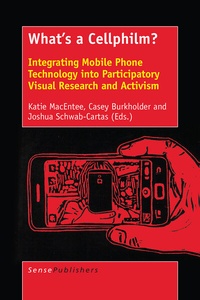
What's a Cellphilm?
Integrating Mobile Phone Technology into Participatory Visual Research and Activism
Published on 27. July 2016
VIII, 220 pages
978-94-6300-573-9 (ISBN)
Description

What's a Cellphilm? explores cellphone video production for its contributions to participatory visual research. There is a rich history of integrating participants' videos into community-based research and activism. However, a reliance on camcorders and digital cameras has come under criticism for exacerbating unequal power relations between researchers and their collaborators. Using cellphones in participatory visual research suggests a new way forward by working with accessible, everyday technology and integrating existing media practices. Cellphones are everywhere these days. People use mobile technology to visually document and share their lives. This new era of democratised media practices inspired Jonathan Dockney and Keyan Tomaselli to coin the term cellphilm (cellphone + film). The term signals the coming together of different technologies on one handheld device and the emerging media culture based on people's use of cellphones to create, share, and watch media. Chapters present practical examples of cellphilm research conducted in Canada, Hong Kong, Mexico, the Netherlands and South Africa. Together these contributions consider several important methodological questions, such as: Is cellphilming a new research method or is it re-packaged participatory video? What theories inform the analysis of cellphilms? What might the significance of frequent advancements in cellphone technology be on cellphilms? How does our existing use of cellphones inform the research process and cellphilm aesthetics? What are the ethical dimensions of cellphilm use, dissemination, and archiving? These questions are taken up from interdisciplinary perspectives by established and new academic contributors from education, Indigenous studies, communication, film and media studies.
More details
Other editions
Additional editions
Katie MacEntee | Casey Burkholder | Joshua Schwab-Cartas
What's a Cellphilm?
Integrating Mobile Phone Technology into Participatory Visual Research and Activism
Book
01/2016
Brill
€114.50
Shipment within 15-20 days
Katie MacEntee | Casey Burkholder | Joshua Schwab-Cartas
What's a Cellphilm?
Integrating Mobile Phone Technology into Participatory Visual Research and Activism
Book
01/2016
Brill
€58.00
Shipment within 15-20 days
Content
- Intro
- What's a Cellphilm?: Integrating Mobile Phone Technology into Participatory Visual Research and Activism
- TABLE OF CONTENTS
- Acknowledgments
- What's a Cellphilm? An Introduction
- Part I: Cellphilms from the Professional to the Personal
- 1. Poetry in a Pocket: The Cellphilms of South African Rural Women Teachers and the Poetics of the Everyday
- 2. Smaller Lens, Bigger Picture: Exploring Self-Generated Cellphilms in Participatory Research
- 3. Living Our Language: Zapotec Elders and Youth Fostering Intergenerational Dialogue through Cellphone Videos
- 4. Remaining Anonymous: Using Participatory Arts-Based Methods with Migrant Women Workers in the Age of the Smartphone
- Part II: Cellphilming as Pedagogy
- 5. Student A/r/tographers Creating Cellphilms
- 6. Cellphilms, Teachers, and HIV and AIDS Education: Revisiting Digital Voices Using the Framework of TPACK
- 7. "Safe Injection and Needle Disposal Spaces for UBC! Now!" Collective Reflections on a Cellphilm Workshop
- Part III: Cellphilm Dissemination and Audiences
- 8. Facing Responses to Cellphilm Screenings of African Girlhood in Academic Presentations
- 9. We Are HK Too: Disseminating Cellphilms in a Participatory Archive
- Part IV: Cellphilm Technologies and Aesthetics
- 10. The Evolution of the Cellphone as Film and Video Camera
- 11. Visual Culture, Aesthetics, and the Ethics of Cellphilming
- 12. Where Do We Go from Here? A Conclusion
- Index
