

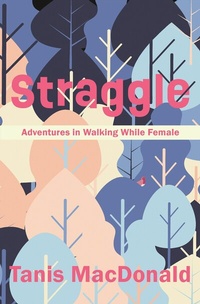
Straggle
Description

**Honourable Mention for the 2024 Alanna Bondar Memorial Book Prize**
**Honourable Mention for the VMI Betsy Warland Between Genres Award**
In this wide-ranging collection of essays Tanis MacDonald walks the reader down many paths, pointing out the sights, exclaiming over birds, sharing stories and asking questions about just who gets to walk freely through our cities, parks and wilderness. From a child spotting a snowy owl on her way to school to a young woman watching her own distinctive walk be imitated in an acting class, MacDonald shares how walking has shaped her life and the lives of many others. Wry, smart, political and lyrical, these essays share the joy of walking as well its danger and uncover the promise it offers ? of healing, of companionship and of understanding.
More details
Other editions
Additional editions
Content
Introduction
Dissolved by Walking
I'm on a solo walk through a part of Winnipeg where a high school friend once lived. I'm back for a few days in the city where I grew up, and now I'm doing what I often do: walking to let multiple associations rain down on me. I'm deep into my ragged and rattled memory of a place, which I like to think of as Barbara Kingsolver has described it: memory as "related to truth, but not its twin." I'm looking for my old friend's house and trying to recall details. It was one of the smallest on the block, I think, and stucco with painted yellow accents - what would have been called "harvest gold." I pass the house, or think I pass it, and am turning my memory over and over like a worn sock, wondering if I can mend it, when I see a path to the river. It leads through some bushes, the grass worn down to dirt by neighbourhood kids and dogwalkers. I push past some bushes and enter a clear space with a big sign warning of the dangers of getting too close to the riverbank, which I read and then, of course, move around to get closer to the river. The Assiniboine River is big and beautiful, flowing in its muddy way. I grew up walking along this river, and going to bush parties beside it. I miss having easy river access where I live now, in Waterloo, Ontario, and I love that I found this neighbourhood spot. I bend to take a photo and then I slip in the mud behind the sign. I slide a few feet toward the riverbank but dig in before my legs go over. I'm prone and alone, with muddy knees and hands, out of view of passersby but well in view of a sign that told me explicitly not to do exactly this. I get up, crawl carefully back to safety and work on brushing the worst of the mud away.
I spend the rest of the day a bit grimy, intentionally not returning to the place I was staying for clean clothes. I wanted to live with the consequences of my actions - a small price to pay. The dirt on my jeans reminded me that to walk, especially alone, especially if you are not cis-male, abled and white, is always a risk. The territory can be as familiar as the taste of your own spit or as strange as a moonscape, but walking invites newness, which involves delight and apprehension, though not always in equal measure. Walking invites thinking differently, breathing differently; it invites the vagus nerve to work its electric magic on your nervous system.
Not too long ago, I was out walking near my place in Waterloo and heard an amazing voice belting out a run of notes. I found the singer, a young Black woman in a snug green toque and camouflage-patterned tights, striding along the park's perimeter, just letting her voice soar. I can't sing like that kick-ass woman who I only saw for thirty striding seconds, but she reminded me to hum as I went, and that walking makes the private public, sometimes in beautiful ways. I liked her sense of risk and her sense of place; it's hard, some days, to access either - to love the local when the local doesn't love you back.
The much-quoted Latin phrase solvitur ambulando - "it is solved by walking" - always makes me a bit suspicious. Walking can give us a new perspective on what ails us, and some things can be solved by walking it out, walking it off or walking away, but it depends on the problem. Who is it who is doing the walking? Where and how? Does "walking well" necessarily involve speed or distance or achievement? Many books about walking lean toward adventure or distance hiking - hiking to campsites in remote areas, going on pilgrimages, endurance hikes, scientific hikes, even heritage hikes. There are fewer books about walking written by someone like me: a woman with a demanding trauma brain, more than a decade of chronic pain, an intense need for solitude and whose adventures are small. While it would be unfair to say that all books about walking written by white men are inevitably about feats of strength, books like Robert Macfarlane's Underland or George Monbiot's Feral suggest that the wild is about achievement, muscularity and encounters with the masculine self - and women who are not elite athletes are not invited.
But there's another gathering going on and that's the party I'm inviting you to: women walking. In her book Wanderlust, Rebecca Solnit notes that it is "the most obvious and the most obscure thing in the world, this walking that wanders so readily into religion, philosophy, landscape, urban policy, anatomy, allegory, and heartbreak." I agree, and to that list I will add the possibility of nature writing as disability writing, as a feminist world view and as an assault survivor narrative. These inclusions seem obvious to me, but survivor stories in nature are too often framed as cautionary tales and only cautionary tales, or the reverse, stories of individual triumph that don't address the larger question of spaces being both welcoming and dangerous for women, LGBTQA folks, people of colour and disabled people. But as soon as you begin to look for these accounts, you will find that they surface everywhere - from the pair of male hikers who menaced Cheryl Strayed in Wild, to ecology professor and self-named "Black birder" J. Drew Lanham's discussions of how racist violence limits his birdwatching, to UK critic and disabled walker Morag Rose's choice of "anarcho-flaneuse" as an identity to emphasize that the act and performance of walking, as well as walking space, should be accessible to everyone. For the past decade, especially since my own mobility has become a daily negotiation, the questions of who is walking and how have become more and more pointed.
I grew up in Winnipeg, close to the edge of the city, where there was still prairie. Most of that prairie is gone from the city limits now, but there was a time when I could bike down a paved path through the oak and poplar forest close to where I lived and if the wind was from the right direction, I could smell bison, a fluctuating herd of ten to fourteen animals penned in on the west side of the zoo. Stopping in the forest with the aspen leaves trembling, I always wondered why the bison didn't just break down the fence and light out for the prairie only half a kilometre away. In time, more bison were housed only a few kilometres away, at FortWhyte Alive, the environmental education preserve on the southern edge of the city. They must have been able to smell the bison in the zoo, and the bison in both fenced-in sites must have felt the bone memory of the spectacular herds of bison who roamed wild here until the 1880s. This swing of placement/displacement is what Jane Jacobs would call a "problem in organized complexity," or more plainly spoken, the ongoing force of colonialism on our cities, our walking and the flora and fauna that we move among.
Decades after I moved away from the Prairies, Cree poet Louise Bernice Halfe told me that the Cree word wahkohtowin is often translated as relationship but its meaning is more complex, and it's better to think of it as relationship plus energy. Together, the combination of relationship plus energy generates a "crooked, bent-over way with all the crooks and crannies within a relationship that encompasses energy." That "bent-over way" reminds us to pay attention to and be in concert with all forms of life: land, the four elements, people and animals, plants - all in those crannies of a complex system of intricate relationships. I remember Louise saying once, "I wake up with the dawn and I walk in this crooked way and then I come back and tell you with this energy." I love that Cree concept of the bent human life in those pockets and crannies, of vibrant life all existing together. I am also encouraged that writers like Eva Mackey, in her book Unsettled Expectations, note that discovering and remaining in a state of uncertainty about the land is a vital tool to use when choosing a respectful way to be. I also like how Stó:lo writer Lee Maracle puts it My Conversations with Canadians: "No one became curious about how Canadian law became the law that dominated the landscape. No one was curious about what was here before." I am curious, and uncertain, and have come to believe that these are good positions, positions a walker ought to consider when leaving their home. Not sure if you belong on this piece of land? Unsure about what belong might mean in this context? Uncomfortable when hearing about the ways your favourite parks and natural areas were formed and are maintained by some very good practices as well as some harmful colonial decisions? Yeah, me too. Wherever I walk, I know it's my responsibility to consider the history of colonization in Canada and not just be overwhelmed by the beauty of the land. Haudenosaunee scholar Susan M. Hill writes in The Clay We Are Made Of: Haudenosaunee Land Tenure on the Grand River that the mutual obligations of Indigenous and non-Indigenous people living here creates a chain of life and respect and, in her words, "it is time to polish that chain and commit to never letting it tarnish again." Uncertainty is a good learner's position. That won't be solved by walking, but individual locomotion sharpens my curiosity about what it means to step on this piece of ground, then this one.
Straggle is a book about imperfect walking in imperfect situations: sometimes dangerous, sometimes defiant, sometimes just trying to get down the street. What if walking is as much a problem as it is a pleasure? And what if that problem could become a pleasure if we walk with it? British psychogeographer Phil Smith suggests that any walk at any time has...
