

The Irish Defence Forces since 1922
1st Edition
Published on 20. February 2012
48 pages
978-1-78096-393-8 (ISBN)
Description

Born in the Civil War of 1922-23, the army of the Republic of Ireland occupied a sensitive place in the national culture for many years.
In World War II, it faced the challenge of maintaining Ireland's integrity as a neutral. Post-war, it found a new role in 1960, providing troops for the United Nations intervention in the war-torn Congo; and since then has supported UN missions in the Middle East and elsewhere. More recently the border with troubled Ulster obliged the Republic to invest in reform and modernisation.
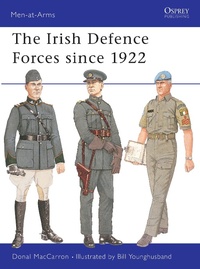
Ireland's freedom to seek examples and equipment worldwide has created an interesting progression of uniforms, illustrated in this study of Ireland's forces over 80 years.
In World War II, it faced the challenge of maintaining Ireland's integrity as a neutral. Post-war, it found a new role in 1960, providing troops for the United Nations intervention in the war-torn Congo; and since then has supported UN missions in the Middle East and elsewhere. More recently the border with troubled Ulster obliged the Republic to invest in reform and modernisation.
Ireland's freedom to seek examples and equipment worldwide has created an interesting progression of uniforms, illustrated in this study of Ireland's forces over 80 years.
More details
Series
Edition
1. Auflage
Language
English
Place of publication
London
United Kingdom
Publishing group
Bloomsbury Publishing PLC
Illustrations
36 b/w; 8 col
ISBN-13
978-1-78096-393-8 (9781780963938)
Copyright in bibliographic data and cover images is held by Nielsen Book Services Limited or by the publishers or by their respective licensors: all rights reserved.
Schweitzer Classification
Other editions
Additional editions
Donal MacCarron
The Irish Defence Forces since 1922
Book
10/2004
Osprey Publishing
€19.00
Shipment within 3-4 weeks
Persons
Donal MacCarron is an established military and aviation historian. Educated at CBS, he studied civil engineering and architecture at University College, Dublin. He has had a number of books and articles published, including 'Wings over Ireland: the Story of the Irish Air Corps', and 'Step Together, the story of Ireland's Emergency Army'. This is his first book for Osprey.
Bill Younghusband was born in 1936. He has been interested in all things military since childhood, an interest compounded through the reading of authors such as G. A. Henty. Bill is a respected military illustrator of many years' experience, and has illustrated numerous Osprey books on 18th and 19th century subjects. He is married, and lives in Ireland.
Bill Younghusband was born in 1936. He has been interested in all things military since childhood, an interest compounded through the reading of authors such as G. A. Henty. Bill is a respected military illustrator of many years' experience, and has illustrated numerous Osprey books on 18th and 19th century subjects. He is married, and lives in Ireland.
Content
Formation of Free State national army
Civil War 1922-23
The diminished force of the 1930s
The political background to the volunteer Territorial Force
The Treaty Ports & Forts handed back in 1938
World War II: the difficulties of neutrality - the Emergency Army & Local Defence Force - the eight invasion scares
Post-war reorganisation
Peace-keeping missions
Border security & counter-terrorism since 1968
The controversial EU commitment
Civil War 1922-23
The diminished force of the 1930s
The political background to the volunteer Territorial Force
The Treaty Ports & Forts handed back in 1938
World War II: the difficulties of neutrality - the Emergency Army & Local Defence Force - the eight invasion scares
Post-war reorganisation
Peace-keeping missions
Border security & counter-terrorism since 1968
The controversial EU commitment
