

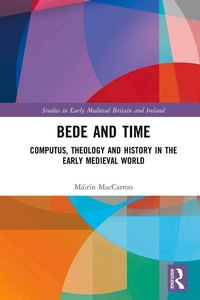
Bede and Time
Computus, Theology and History in the Early Medieval World
1st Edition
Published on 19. September 2019
222 pages
978-1-317-17575-9 (ISBN)
Description

Awarded the Irish Historical Research Prize 2021.
The Venerable Bede (c. 673-735) was the leading intellectual figure of the early Anglo-Saxon Church, and his extensive corpus of writings encompassed themes of exegesis, computus (dating of Easter and construction of calendars), history and hagiography. Rather than look at these works in isolation, Mairin MacCarron argues that Bede's work in different genres needs to be read together to be properly understood. This book provides the first integrated analysis of Bede's thought on time, and demonstrates that such a comprehensive examination allows a greater understanding of Bede's writings on time, and illuminates the place of time and chronology in his other works. Bede was an outstanding intellect whose creativity and ingenuity were apparent in various genres of writing. This book argues that in innovatively combining computus, theology and history, Bede transformed his contemporaries' understanding of time and chronology.
The Venerable Bede (c. 673-735) was the leading intellectual figure of the early Anglo-Saxon Church, and his extensive corpus of writings encompassed themes of exegesis, computus (dating of Easter and construction of calendars), history and hagiography. Rather than look at these works in isolation, Mairin MacCarron argues that Bede's work in different genres needs to be read together to be properly understood. This book provides the first integrated analysis of Bede's thought on time, and demonstrates that such a comprehensive examination allows a greater understanding of Bede's writings on time, and illuminates the place of time and chronology in his other works. Bede was an outstanding intellect whose creativity and ingenuity were apparent in various genres of writing. This book argues that in innovatively combining computus, theology and history, Bede transformed his contemporaries' understanding of time and chronology.
Reviews / Votes
'... in many ... observations throughout this carefully researched book MacCarron has brought fresh insight to the many dimensions of Bede's relationship with time' - Arthur Holder, Speculum 97/1 (January 2022).'The National University of Ireland (NUI) is pleased to announce that the Irish Historical Research Prize 2021 is awarded to Dr Mairin MacCarron for her publication Bede and Time: Computus, Theology and History in the Early Medieval World.'
'MacCarron's book offers a welcome and fresh introduction to a key theme in Bede's thought, while making some important arguments about how best to read his work in context' - James Palmer, Early Medieval Europe 29; 4 (2021).
'In all, MacCarron tackles an impressive range of highly complex issues, contributing and often enriching the scholarly debate in more aspects than can be covered within the scope of a simple review ... MacCarron's book is an important contribution' - Northern History, LIX:1, March 2022
More details
Series
Edition
1. Auflage
Language
English
Place of publication
London
United Kingdom
Publishing group
Taylor & Francis Ltd
Target group
College/higher education
Illustrations
8 Tables, black and white
ISBN-13
978-1-317-17575-9 (9781317175759)
Copyright in bibliographic data and cover images is held by Nielsen Book Services Limited or by the publishers or by their respective licensors: all rights reserved.
Schweitzer Classification
Other editions
Additional editions
Book
06/2021
1st Edition
Routledge
€67.20
Shipment within 10-20 days
Book
10/2019
1st Edition
Routledge
€206.30
Shipment within 10-20 days
Person
Mairin MacCarron is Lecturer in Digital Humanities at University College Cork, having previously held posts at NUI Galway and the University of Sheffield. Her research interests include Time, Chronology and the writing of History; Women in the Middle Ages; and Digital approaches to studying the past.
Content
Acknowledgements
Abbreviations
Introduction: Computus, Contexts and Controversies
Chapter 1: De temporibus
Transmission and Terminology of Bede's works on Time
Insular computistica
Structure and content of computistical textbooks
De temporibus and Insular computus tradition
Why did Bede write De temporibus?
Chapter 2: The De temporibus chronicle
Structure of the De temporibus chronicle
Purpose of the De temporibus chronicle
Terminology and titles for Bede's chronicles
Chapter 3: Bede's Anno Mundi chronology and the 'Chronicle of 703'
Chronography in Late Antiquity and the early Middle Ages
Chronology in the Insular World
Why did Bede use Vulgate chronology?
Conclusion
Chapter 4: Bede's chronicles: contents and sources
First to Fifth World Ages
Sixth World Age
Conclusion
Chapter 5: Nativity and Incarnation in Bede's Theology of Time
Baptism, Passion and Nativity in World Chronicle Tradition
Bede and counting time from the coming of Christ
Nativity and Incarnation in Bede's thought
Nativity and Incarnation in early medieval theology
Chapter 6: Bede, Dionysius Exiguus and Anno Domini chronology
Annus Domini prior to the seventh century
Anglo-Saxon England
Willibrord and Francia
Bede and Annus Domini in the Historia Ecclesiastica
Afterword
Appendix 1: Table of chapter headings in Bede's De temporibus and his principal sources
Appendix 2: Table of key chronological events in the Chronicle of Eusebius and Jerome
Appendix 3: Chronological comparison of Bede's chronicles
Appendix 4: Table of Popes in the Liber Pontificalis, De temporibus 22 and De temporum ratione 66
Appendix 5: Incarnation dating clauses in the Historia Ecclesiastica
Appendix 6: Comparison of Bede's AD-years in the Historia Ecclesiastica with AD-years calculated from his chronicles
Glossary
Bibliography
Index
Abbreviations
Introduction: Computus, Contexts and Controversies
Chapter 1: De temporibus
Transmission and Terminology of Bede's works on Time
Insular computistica
Structure and content of computistical textbooks
De temporibus and Insular computus tradition
Why did Bede write De temporibus?
Chapter 2: The De temporibus chronicle
Structure of the De temporibus chronicle
Purpose of the De temporibus chronicle
Terminology and titles for Bede's chronicles
Chapter 3: Bede's Anno Mundi chronology and the 'Chronicle of 703'
Chronography in Late Antiquity and the early Middle Ages
Chronology in the Insular World
Why did Bede use Vulgate chronology?
Conclusion
Chapter 4: Bede's chronicles: contents and sources
First to Fifth World Ages
Sixth World Age
Conclusion
Chapter 5: Nativity and Incarnation in Bede's Theology of Time
Baptism, Passion and Nativity in World Chronicle Tradition
Bede and counting time from the coming of Christ
Nativity and Incarnation in Bede's thought
Nativity and Incarnation in early medieval theology
Chapter 6: Bede, Dionysius Exiguus and Anno Domini chronology
Annus Domini prior to the seventh century
Anglo-Saxon England
Willibrord and Francia
Bede and Annus Domini in the Historia Ecclesiastica
Afterword
Appendix 1: Table of chapter headings in Bede's De temporibus and his principal sources
Appendix 2: Table of key chronological events in the Chronicle of Eusebius and Jerome
Appendix 3: Chronological comparison of Bede's chronicles
Appendix 4: Table of Popes in the Liber Pontificalis, De temporibus 22 and De temporum ratione 66
Appendix 5: Incarnation dating clauses in the Historia Ecclesiastica
Appendix 6: Comparison of Bede's AD-years in the Historia Ecclesiastica with AD-years calculated from his chronicles
Glossary
Bibliography
Index
