

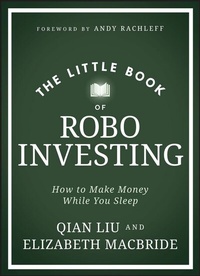
The Little Book of Robo Investing
Description

-Burton G. Malkiel, author of A Random Walk Down Wall Street (50th anniversary edition, 2023)
Explore easy, automated, and low-cost ways to invest using online platforms
In The Little Book of Robo Investing: How to Make Money While You Sleep, a pair of long-time investors and founding team members at the pioneering and award-winning online investment platform Wealthfront deliver a fun, invaluable, and simple roadmap to making your money make money. You'll learn how to start investing with the easy, automated, and low-cost strategies that robo investment advisors have made super accessible to everyday people.
You don't need a ton of detailed knowledge about the financial and investment sectors to make impressive returns. The authors walk you through how to use techniques like automation, diversification and indexing to manage your risk and keep things absurdly simple. You'll also learn:
* The most common mistakes that new investors make when they're just getting started in the markets and how to avoid them
* Strategies for getting the ball rolling and investing your first dollar
* Valuable insights from behavioral economics and psychology to help you steer clear of major investing errors that even experienced and knowledgeable investors tend to make
Perfect for working professionals, members of young and growing families, and people beginning to think about their retirement plans, The Little Book of Robo Investing is a straightforward, engaging, and fun read that will get you ready to put your money to work intelligently and responsibly.
More details
Other editions
Additional editions
Persons
Qian Liu is the Chief Data Officer at Guideline, an online investment platform that manages small business 401(k) plans. Prior to this position, Qian was the Head of Data at GoFundMe. Qian was also previously the Director of Research at Wealthfront where she led the research and development of automated investment products.
Content
Acknowledgments xix
Introduction xxi
Section One The Science, Business, and Art of Robo Investing 1
Chapter One Make Investing Work for You 3
Chapter Two A Brief History of Indexing and Robo Investing 25
Chapter Three The Philosophy of Robo Investment Advice: Avoid the Gimmicks, Embrace the Science 45
Section Two What the Platforms Do 63
Chapter Four Diversify and De-risk Investments 65
Chapter Five Increase Your Return over Time with Lower Fees 81
Chapter Six Lower Tax Bills 97
Chapter Seven Technology Brings It Home 117
Section Three How to Use a Robo Platform 129
Chapter Eight Be Self- Aware about Money 131
Chapter Nine Investing Is Dating for the Long Term 143
Chapter Ten Budgeting and Wealth Building 155
Chapter Eleven Understand Risk and Pick the Right Risk Tolerance 169
Chapter Twelve Live for the Present, Invest for the Future 185
Section Four Where You Begin 199
Chapter Thirteen Is a Robo Investment Platform Right for You? 201
Chapter Fourteen Find the Right Platform 215
Chapter Fifteen Now I've Finished the Book and So What? 235
References 249
About the Authors 257
Introduction
BACK IN 2011, ELIZABETH was feeling decidedly disillusioned with traditional Wall Street firms. As an editor for a business newspaper in New York City, she had covered the 2008-09 financial crisis. Everyday investors, including Elizabeth, had taken hits on their retirement savings while big companies got bailouts. On a trip to California, she met Andy Rachleff at a backyard party for investment advisors, where he was gathering intel for the company he was launching.
He leaned awkwardly across a makeshift tiki bar to look her in the eyes-he's six feet three, and she's a full foot shorter. He explained himself and his idea in a voice so loud someone could have heard it across the Grand Canyon. People in Silicon Valley used to say, "No one says no to Andy Rachleff." He eventually persuaded Elizabeth to join Wealthfront, which in true lean start-up mode was operating out of a former dry cleaner's storefront in the center of Palo Alto. Andy was already a successful investor, but his big idea was to help regular people-anybody, in fact-invest well. He was putting together a team from outside the world of traditional finance, people who could think about the problems that investors faced with fresh eyes.
The company had many of the right pieces in place. Unlike brokerage firms, Wealthfront was registered as an investment advisor, for one thing. All online and offline registered financial advisors have a legal obligation to do what's in their clients' best interest, not theirs. The executive team was accomplished: Andy had cofounded one of the most successful investment companies of all time, a venture firm called Benchmark Capital. And as a trustee he helped oversee the endowment of the University of Pennsylvania. Eventually, famous economist and Princeton University Professor Burt Malkiel-a longtime advocate for individual investors-joined to design investment strategies. And so did a woman named Qian Liu, who was just coming out of the University of Pennsylvania and already building a reputation as one of the smartest people in financial technology, or fintech. Qian did groundbreaking technical work to build Wealthfront (and to invent the category of online investment advice), while Elizabeth established the language and narrative that helped launch the robo investment movement.
Wealthfront, as you probably know, took off, thanks to the whole team.
In 2023, Bill Falloon, a top editor at Wiley, asked Elizabeth about writing a robo investing book. Elizabeth in turn asked Qian to join the effort.
Both of us have known financial vulnerability. Elizabeth is a single mom with two kids, who worked her way through the University of Maryland with the help of scholarships and support from her family. Qian is an immigrant. In 2003, she arrived in the United States from China with a PhD scholarship to the University of Pennsylvania and $1,000 cash in her pocket, to rent a room in UPenn's graduate student dorm building. Qian's PhD advisor-then the department chair of the UPenn's computer science department and now an executive at Google-recommended her to Andy. At Wealthfront, she studied and passed the test to become a chartered financial analyst.
In other words, neither of us was an expert investor, and both of us, over time, learned how to use a robo investment platform with ease.. The two of us have stayed friends over the years. Qian and Elizabeth's kids have competed head-to-head in Taboo! Qian learned from them and almost won. Qian also learned how to outsmart dating apps' algorithms to actually meet decent people and shared that knowledge with Elizabeth. (If you make it to Chapter 9, you'll learn the secret and also how investing and dating are similar.)
Our Qualifications
Our own knowledge of investing comes from years of working in the finance and technology industries, helping everyday investors understand the market, economy, and technology.
In the years after Wealthfront, Qian went on to work for GoFundMe, an online social fundraising platform, and then as chief data officer for Guideline, an online investment platform that manages small business 401(k) plans. She's one of the hidden figures of the movement over the last 15 years to bring high-quality financial services to everyday investors.
After the Great Recession, Elizabeth traveled all over the world as a business journalist, writing about entrepreneurship in the Middle East, international trade, and always keeping an interest in personal finance and investing. She worked with the United Nations, Georgetown University, and Massachusetts Institute of Technology on projects to make the economic systems in the United States and abroad more fair for everyone. In 2021, she coauthored a book about how and why to invest in Main Street businesses, The New Builders.
We want to particularly express our appreciation for Burt Malkiel's A Random Walk Down Wall Street, Charley Ellis's Winning the Loser's Game, and David Swensen's Unconventional Success. In previous decades, these men were some of the first to advocate for a research-based approach to investing, one that puts the needs of everyday investors, not wealthy people, at heart. We love those books and are honored to have worked with Burt and Charley and to distill some of their wisdom into this Little Book.
The winter before Bill asked Elizabeth about writing the Little Book of Robo Investing, Qian and Elizabeth were in Costa Rica on a girls' trip: Qian was learning to surf. Elizabeth went on a yoga retreat. One lesson to be a successful investor is balance. And one gift of financial security is time: when you feel that you're set up for the long term, you can relax and splurge a little bit on the short term. Together, we wrote this book to teach you how to invest well, using a robo platform. By "invest well," we mean that you'll feel secure and confident about making enough money for your future so that you can relax and enjoy life more. Most investors spend way too much time and money trying to beat the market. Our approach is different: figure out how much money you need, and then invest as safely as possible to reach your goals. Robo investing was invented to help you do just that.
Let's put some numbers on our results on the platform. Since 2014, when she started using a robo investment platform, Elizabeth has almost doubled her retirement investment, earning a 90% return while taking a middling level of risk. Eventually, she started a taxable account because she knew the platform would help keep her taxes low; it has saved her about $1,100 in taxes in three years (from tax-loss harvesting, a feature introduced and popularized by Wealthfront, which will be explained at length in Chapter 6). Her cash, meanwhile, is returning 4.85% per year in the summer of 2023. These are good rates of return, and we'll tell you more about how the platform helped achieve them in the following chapters.
Qian started a Roth IRA and a taxable account at Wealthfront in December 2011 while developing the very first version of the company's investment software, as part of the "eating your own dog food" product development practice in the technology industry. She earned a higher return than Elizabeth did because she took more risk: so far the cumulative return in the two accounts are 120% and 140%, with estimated tax saving of about $5,200. Qian also used the company's line of credit feature, a button click triggering an instant cash transfer, and borrowed $10,000 at a low interest rate to pay an unexpected bill in early 2022, without having to sell her investments. She repaid the loan about 40 days later with $40 interest.
These are features pioneered by Wealthfront, which today is a thriving large company. Wealthfront was the first company to take off, but after we broke the ground, many other companies joined the industry. As of 2022 more than 7 million people use online investment advisors, or robo advisors or robo investing platforms (we use the terms interchangeably).1 Like many good ideas, most of these features have spread across the industry. If you join the millions of investors using online services, these features will be available easily to you, too.
Both of us own Wealthfront stock, which is a significant asset for both of us but not the largest one we have. Our careers are more valuable than the stock. We're proud of what we helped build at Wealthfront, but we're prouder still of helping to invent this category-and to have companies from Vanguard, which now offers a robo advisor, to Robinhood follow in Wealthfront's path by offering financial services in mobile apps. There are a lot of options in the market today, and you need to be a smart shopper to decide what is best for you. We aim to be agnostic in this book. We'll give you the tools to evaluate robo investment platforms, to help decide which one is best for you. In Section 4, we offer a list of the major robo investment platforms in the market.
How the Book Works
We start each chapter with one misconception about investing and explain why it's harmful. Today's robo investment platforms have been designed to implement proven investing strategies. Those strategies are often counter to marketing from traditional financial services companies. We also want readers to understand why the platforms work the way they do so you can get the best out of them.
This...
