

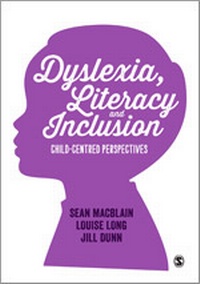
Dyslexia, Literacy and Inclusion
Child-centred perspectives
1st Edition
Published on 23. March 2015
232 pages
978-1-4739-1836-8 (ISBN)
Description

This book is about raising standards in literacy for children with dyslexia by putting the child at the centre of everything you do, focusing on wellbeing, and recognising the role that adults have to play in ensuring all children reach their potential. Concentrating on children in primary schools and early years settings the book looks at:
Early intervention
Pupil voice
Working as a team
New literacies
Child-centred identification, assessment and provision
Challenges for the inclusive school.
Suitable for all those working with children with dyslexia this book contains strategies that can be easily adopted to academically and emotionally benefit the children you are working with.
Early intervention
Pupil voice
Working as a team
New literacies
Child-centred identification, assessment and provision
Challenges for the inclusive school.
Suitable for all those working with children with dyslexia this book contains strategies that can be easily adopted to academically and emotionally benefit the children you are working with.
Reviews / Votes
This book is a very valuable resource for a wide range of professionals (including student teachers and teachers) to better address the needs of pupils with dyslexia, including those in the Early Years. The authors give a very detailed examination of dyslexia and the wider issues affecting the pupil, the family and society. Policies influencing the education of dyslexic pupils are discussed, as are major relevant issues such as poverty. Clear real life examples are well used to aid understanding and the structure of each chapter allows the reader to reflect on what they have been reading through exercises, suggestions for further reading and useful websites and video material which are freely available.The authors have presented a text which will not only assist anyone studying dyslexia but will help professionals to enhance their understanding and professional practice and thereby raise standards in pupils with dyslexia. -- Kathy Jarrett I work with both undergraduates and postgraduates and would be very keen to use this highly accessible book within each of the courses. In Wales, of course, the comments on the statutory framework with Early Years would need to be set in the context of our Framework for the Foundation Phase but the sense of the content and the focus on dyslexia would be appropriate to the early years of teaching and learning, regardless of the differing contexts.
This is a clear, concise approach to the discussion on dyslexia and literacy. The child is central to the thinking here; whilst the novice practitioner is given an introduction to the issues, the mature practitioner is challenged to review their outlook and look afresh. I cannot wait for my own copy.
-- Sharon James This is a very accessible text that engages the reader in a child centered and holistic issues and approached. It is full of valuable information that professionals (both in preparation and more experienced) will find helpful as they meet the needs of this group of learners in inclusive settings. The literacy focus is particularly important and contributes to our goal of raised standards and high expectations for learners with dyslexia. The perspective of the children themselves is something that raises the quality of the book and a reason why I will recommend it to the teachers I work with! -- Phyllis Jones, Associate Professor This is a very important book which offers a refreshingly honest account of the current challenges facing children with dyslexia and developmental literacy difficulties. It acknowledges the conceptual confusion which continues to surround this area, but rightly places an emphasis on understanding the holistic needs of the child in a changing familial and cultural context, and of seeking to meet those needs in a child-friendly, rights-respecting manner. In so doing practitioners are encouraged to appreciate and address the potentially significant emotional impact of dyslexia and literacy difficulties on children, to learn the lessons from the critical reviews of the most recent international research in this field, and to embrace new technologies and popular culture to enhance motivation and self-esteem while offering new learning opportunities. I would thoroughly recommend this book. -- Noel Purdy * Review * This is a well-written book that focuses on early years and the primary sector and provides much information and guidance as well as raising important issues about how dyslexia can be reframed in the 21st Century. -- Mary Mountstephen
More details
Language
English
Place of publication
London
United Kingdom
Target group
College/higher education
ISBN-13
978-1-4739-1836-8 (9781473918368)
Copyright in bibliographic data and cover images is held by Nielsen Book Services Limited or by the publishers or by their respective licensors: all rights reserved.
Schweitzer Classification
Other editions
Additional editions
Book
04/2015
1st Edition
SAGE Publications Ltd
€156.20
Shipment within 15-20 days
Book
04/2015
1st Edition
SAGE Publications Ltd
€71.10
Shipment within 15-20 days
Persons
Sean MacBlain PhD is a distinguished author and academic whose publications include: MacBlain (Sage, 2021) Children's Learning in Early Childhood; MacBlain (Sage, 2020) Child Development for Teachers; MacBlain, Dunn and Luke (Sage, 2017) Contemporary Childhood; Gray and MacBlain (Sage, 2015) Learning Theories in Childhood; MacBlain, Long and Dunn, (Sage, 2015) Dyslexia, Literacy and Inclusion: Child-centred Perspectives; MacBlain (Sage, 2014) How Children Learn. Sean's publications are used by students, practitioners and academics throughout the world and have been widely translated including into Chinese and Vietnamese. Sean was previously a senior academic at the University of St Mark & St John, Plymouth, England where he held the positions of Research lead for the Centre for Education and Applied Research, Research Lead for the Centre for Professional and Educational Research, Research Coordinator for the School of Education and Deputy Chair of the Ethics Committee. Sean has also worked as a Senior Lecturer in Education and Developmental Psychology at Stranmillis University College, Queen's University Belfast. In addition to this, Sean has worked for over twenty years as an educational psychologist and continues in this field as an independent practitioner.
Louise Long is a senior lecturer in education at Saint Mary's University College Belfast where she coordinates a number of Masters' modules in special educational needs and pastoral issues, as well as post-graduate programmes on child development. She is engaged in supervision of M-level research dissertations. Louise is a chartered educational psychologist and has previously worked as an Education and Library Board psychologist, primary school teacher and Further Education lecturer. She has just returned from a seconded post as assistant project manager (research) on a DE-funded project, which aimed to build capacity in literacy and dyslexia in Northern Irish primary schools. Louise's research interests are in inclusive teacher learning, dyslexia and pupil well-being. She has published extensively in national and international peer-reviewed journals and has contributed to international books on teacher education. In the last five years Louise has procured funding for a number of research projects on inclusion and dyslexia.
Jill Dunn is a senior lecturer in Stranmillis University College, Belfast. She was a primary school teacher working in Foundation Stage and Key Stage One classrooms before moving into teacher education. Jill teaches widely across the BEd and PGCE Early Years programmes. However, her main interests lie in the teaching of literacy in the early years. Jill has just completed her EdD in 2013 and her dissertation focused on children's views on using popular culture to teach writing. She has been involved in a number of funded research projects on literacy and is currently involved in an evaluation of iPads in the Early Years. Jill lives in Lisburn, Northern Ireland with her husband Ian and two daughters Holly and Katy.
Louise Long is a senior lecturer in education at Saint Mary's University College Belfast where she coordinates a number of Masters' modules in special educational needs and pastoral issues, as well as post-graduate programmes on child development. She is engaged in supervision of M-level research dissertations. Louise is a chartered educational psychologist and has previously worked as an Education and Library Board psychologist, primary school teacher and Further Education lecturer. She has just returned from a seconded post as assistant project manager (research) on a DE-funded project, which aimed to build capacity in literacy and dyslexia in Northern Irish primary schools. Louise's research interests are in inclusive teacher learning, dyslexia and pupil well-being. She has published extensively in national and international peer-reviewed journals and has contributed to international books on teacher education. In the last five years Louise has procured funding for a number of research projects on inclusion and dyslexia.
Jill Dunn is a senior lecturer in Stranmillis University College, Belfast. She was a primary school teacher working in Foundation Stage and Key Stage One classrooms before moving into teacher education. Jill teaches widely across the BEd and PGCE Early Years programmes. However, her main interests lie in the teaching of literacy in the early years. Jill has just completed her EdD in 2013 and her dissertation focused on children's views on using popular culture to teach writing. She has been involved in a number of funded research projects on literacy and is currently involved in an evaluation of iPads in the Early Years. Jill lives in Lisburn, Northern Ireland with her husband Ian and two daughters Holly and Katy.
Content
SECTION 1: NEW HORIZONS FOR PUPILS WITH DYSLEXIA
Chapter 1: Changing experiences in childhood: challenges for the 21st Century, Sean MacBlain
Chapter 2: Child-centred literacy pathways: pupils' perspectives, Louise Long
Chapter 3: Meeting the needs of children with dyslexia and developmental literacy difficulties: holistic approaches, Sean MacBlain
SECTION 2: BUILDING CAPACITY TO RAISE LITERACY STANDARDS FOR CHILDREN WITH DYSLEXIA AND DEVELOPMENTAL LITERACY DIFFICULTIES
Chapter 4: Child-centred approaches to the identification and assessment of dyslexia and developmental literacy difficulties, Sean MacBlain and Louise Long
Chapter 5: Raising literacy standards: perspectives on best practice, Sean MacBlain, Louise Long and Jill Dunn
Chapter 6: Advancing inclusive cultures for literacy learning in the mainstream primary school, Louise Long
SECTION 3: LITERACY IN CONTEMPORARY SETTINGS
Chapter 7: New literacies in the classroom: forging culturally responsive curricula, Jill Dunn
Contemporary Challenges: Looking to the Future, Sean MacBlain and Jill Dunn
Chapter 1: Changing experiences in childhood: challenges for the 21st Century, Sean MacBlain
Chapter 2: Child-centred literacy pathways: pupils' perspectives, Louise Long
Chapter 3: Meeting the needs of children with dyslexia and developmental literacy difficulties: holistic approaches, Sean MacBlain
SECTION 2: BUILDING CAPACITY TO RAISE LITERACY STANDARDS FOR CHILDREN WITH DYSLEXIA AND DEVELOPMENTAL LITERACY DIFFICULTIES
Chapter 4: Child-centred approaches to the identification and assessment of dyslexia and developmental literacy difficulties, Sean MacBlain and Louise Long
Chapter 5: Raising literacy standards: perspectives on best practice, Sean MacBlain, Louise Long and Jill Dunn
Chapter 6: Advancing inclusive cultures for literacy learning in the mainstream primary school, Louise Long
SECTION 3: LITERACY IN CONTEMPORARY SETTINGS
Chapter 7: New literacies in the classroom: forging culturally responsive curricula, Jill Dunn
Contemporary Challenges: Looking to the Future, Sean MacBlain and Jill Dunn
