

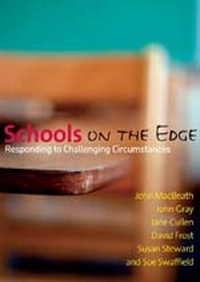
Schools on the Edge
Responding to Challenging Circumstances
1st Edition
Published on 16. November 2006
168 pages
978-1-84787-888-5 (ISBN)
Description

'An ideal text for challenging the thinking of those studying for NPQH... The conclusion by the authors suggests nine major points to consider if improvement for schools in extremely challenging circumstances is to happen and be sustained. These 'nine lesson for policy makers' are very frank and pertinent points, let's hope at least some of our policy makers read them!' - ESCalate
'Rarely does a book on education reform capture both the big and the small picture with such brilliant clarity. MacBeath and his colleagues furnish a 'no holds barred' account of the ins and outs of understanding and assessing the impact of schools struggling for success. A fascinating read' - Michael Fullan, Professor Emeritus, OISE/University of Toronto
Schools serving young people on the margins of society face a major challenge in trying to create an environment where students can succeed.
The book examines key issues in the field of school improvement. More specifically, it draws on evidence from the SFECC (Schools Facing Exceptionally Challenging Circumstances) project to explore:
o the policy context of schools on the edge
o the nature of extreme challenges
o the way schools have responded to extreme challenge
o what seems to be effective in helping such schools to meet the challenge
o obstacles to success and the facilities and resources that can make a difference
o strategies to meet the needs of the local community and facilitate lasting change.
Each of the authors has wide experience of school effectiveness and improvement, and of working with schools in disadvantaged communities in Britain, the USA and many other parts of the world.
School leaders, local authorities, practitioners and all those involved in any aspect of school leadership and school improvement will find this book highly pertinent.
'Rarely does a book on education reform capture both the big and the small picture with such brilliant clarity. MacBeath and his colleagues furnish a 'no holds barred' account of the ins and outs of understanding and assessing the impact of schools struggling for success. A fascinating read' - Michael Fullan, Professor Emeritus, OISE/University of Toronto
Schools serving young people on the margins of society face a major challenge in trying to create an environment where students can succeed.
The book examines key issues in the field of school improvement. More specifically, it draws on evidence from the SFECC (Schools Facing Exceptionally Challenging Circumstances) project to explore:
o the policy context of schools on the edge
o the nature of extreme challenges
o the way schools have responded to extreme challenge
o what seems to be effective in helping such schools to meet the challenge
o obstacles to success and the facilities and resources that can make a difference
o strategies to meet the needs of the local community and facilitate lasting change.
Each of the authors has wide experience of school effectiveness and improvement, and of working with schools in disadvantaged communities in Britain, the USA and many other parts of the world.
School leaders, local authorities, practitioners and all those involved in any aspect of school leadership and school improvement will find this book highly pertinent.
Reviews / Votes
' An ideal text for challenging the thinking of those studying for NPQH...The conclusion by the authors suggests nine major points to consider if improvement for schools in extremely challenging circumstances is to happen and be sustained. These 'nine lesson for policy makers' are very frank and pertinent points, let's hope at least some of our policy makers read them!'-ESCalate'Those who have written about Octet before have suffered from the mixed blessing of receiving DfES cash to carry out their evaluations. This book gets closest to breaking free from the shackles of having accepted the Government shilling. Presumably this is in part because the main originators of the scheme have left the DfES and been replaced by others less wedded to proving the success of the model. In any case, such is the reputation of the authors that they would not be prepared to trim their findings to suit some official line... It's to be hoped that policy-makers in all three main political parties read at least the last chapter' - Times Educational Supplement
'Rarely does a book on education reform capture both the big and the small picture with such brilliant clarity. MacBeath and his colleagues furnish a 'no holds barred' account of the ins and outs of understanding and assessing the impact of schools struggling for success. A fascinating read' - Michael Fullan, Professor Emeritus, OISE/University of Toronto
All prices
More details
Language
English
Place of publication
London
United Kingdom
Target group
Professional and scholarly
ISBN-13
978-1-84787-888-5 (9781847878885)
Copyright in bibliographic data and cover images is held by Nielsen Book Services Limited or by the publishers or by their respective licensors: all rights reserved.
Schweitzer Classification
Other editions
Additional editions
John MacBeath | John M. Gray | Jane Cullen
Schools on the Edge
Responding to Challenging Circumstances
Book
11/2006
1st Edition
SAGE Publications Inc
€96.80
Shipment within 10-20 days
John MacBeath | John M. Gray | Jane Cullen
Schools on the Edge
Responding to Challenging Circumstances
Book
11/2006
1st Edition
SAGE Publications Inc
€221.35
Shipment within 10-20 days
Persons
John MacBeath is Professor Emeritus at the University of Cambridge, Director of Leadership for Learning: the Cambridge Network and Projects Director for the Centre for Commonwealth Education. Until 2000 he was Director of the Quality in Education Centre at the University of Strathclyde in Glasgow. As well as his interest and research on leadership he has, for the last decade, worked with schools, education authorities and national governments on school self-evaluation. Five books on self-evaluation have been addressed mainly to a teacher and senior management readership. These include Schools Must Speak for Themselves, Self-Evaluation in European Schools, Self-evaluation: what's in it for schools? Self-evaluation in the Global Classroom and School Inspection and Self evaluation - all published by Routledge and now in twelve European languages. All of these books derive from collaboration with schools, with teachers and school students, the Global Classroom book being written mainly by school students from eight different countries. Issues in School Improvement, a CD-rom resource for schools in Hong Kong, contains many of these self-evaluation tools in both English and Chinese while a recent addition to self evaluation and inspection Hong Kong is an interactive website illustrating good practice in Hong Kong special, primary and secondary schools.
He has acted in a consultancy role to the Organisation for Economic Co-operation and Development (OECD), UNESCO and ILO (International Labour Organisation), the Bertelsmann Foundation, the Prince's Trust, the European Commission, the Scottish Executive, the Swiss Federal Government, the Varkey Group in Dubai (Emirates) and the Hong Kong Education Department. He was a member of the Government Task Force on Standards from 1997-2001 and was awarded the OBE for services to education in 1997 Sue Swaffield is a member of the Leadership for Learning academic group in the Faculty of Education and a founder member of Leadership for Learning: the Cambridge Network. Sue's teaching and research interests are within the fields of educational leadership, school improvement and assessment. Leadership for learning, critical friendship for headteachers, and assessment for learning are particular interests. She co-directed the Wallenberg funded Leadership for Learning Carpe Vitam project working with schools and universities in seven countries. Sue was also a member of the ESRC/TLRP Learning How to Learn project involving 40 schools and five universities in England, and worked on the DfES funded evaluation of Schools Facing Exceptionally Challenging Circumstances project. Current research activity includes investigating support and challenge for headteachers, and with the Faculty's Centre for Commonwealth Education Sue is engaged in a collaborative development and research programme building headteachers' leadership capacity in Ghana. She teaches on the Masters and Certificate programmes and co-ordinates the Educational Leadership and School Improvement MEd and MPhil. She is an Executive Editor of the international journal 'Assessment in Education: Principles, Policy and Practice', Associate Editor of 'Professional Development in Education' and is on the Editorial Board of 'Reflective Teaching'. Her work in Higher Education builds on previous experiences as a teacher and adviser.
He has acted in a consultancy role to the Organisation for Economic Co-operation and Development (OECD), UNESCO and ILO (International Labour Organisation), the Bertelsmann Foundation, the Prince's Trust, the European Commission, the Scottish Executive, the Swiss Federal Government, the Varkey Group in Dubai (Emirates) and the Hong Kong Education Department. He was a member of the Government Task Force on Standards from 1997-2001 and was awarded the OBE for services to education in 1997 Sue Swaffield is a member of the Leadership for Learning academic group in the Faculty of Education and a founder member of Leadership for Learning: the Cambridge Network. Sue's teaching and research interests are within the fields of educational leadership, school improvement and assessment. Leadership for learning, critical friendship for headteachers, and assessment for learning are particular interests. She co-directed the Wallenberg funded Leadership for Learning Carpe Vitam project working with schools and universities in seven countries. Sue was also a member of the ESRC/TLRP Learning How to Learn project involving 40 schools and five universities in England, and worked on the DfES funded evaluation of Schools Facing Exceptionally Challenging Circumstances project. Current research activity includes investigating support and challenge for headteachers, and with the Faculty's Centre for Commonwealth Education Sue is engaged in a collaborative development and research programme building headteachers' leadership capacity in Ghana. She teaches on the Masters and Certificate programmes and co-ordinates the Educational Leadership and School Improvement MEd and MPhil. She is an Executive Editor of the international journal 'Assessment in Education: Principles, Policy and Practice', Associate Editor of 'Professional Development in Education' and is on the Editorial Board of 'Reflective Teaching'. Her work in Higher Education builds on previous experiences as a teacher and adviser.
Content
Every Child Matters?
Policy Matters
Extreme Challenges
Schools Of Hope
Can Governments Change Schools?
Measuring Improvement
Schools For The Future?
Policy Matters
Extreme Challenges
Schools Of Hope
Can Governments Change Schools?
Measuring Improvement
Schools For The Future?
