

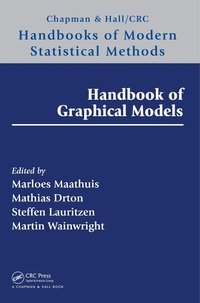
Handbook of Graphical Models
1st Edition
Published on 12. November 2018
554 pages
978-0-429-87424-6 (ISBN)
Description

A graphical model is a statistical model that is represented by a graph. The factorization properties underlying graphical models facilitate tractable computation with multivariate distributions, making the models a valuable tool with a plethora of applications. Furthermore, directed graphical models allow intuitive causal interpretations and have become a cornerstone for causal inference.
While there exist a number of excellent books on graphical models, the field has grown so much that individual authors can hardly cover its entire scope. Moreover, the field is interdisciplinary by nature. Through chapters by leading researchers from different areas, this handbook provides a broad and accessible overview of the state of the art.
Key features:
* Contributions by leading researchers from a range of disciplines
* Structured in five parts, covering foundations, computational aspects, statistical inference, causal inference, and applications
* Balanced coverage of concepts, theory, methods, examples, and applications
* Chapters can be read mostly independently, while cross-references highlight connections
The handbook is targeted at a wide audience, including graduate students, applied researchers, and experts in graphical models.
While there exist a number of excellent books on graphical models, the field has grown so much that individual authors can hardly cover its entire scope. Moreover, the field is interdisciplinary by nature. Through chapters by leading researchers from different areas, this handbook provides a broad and accessible overview of the state of the art.
Key features:
* Contributions by leading researchers from a range of disciplines
* Structured in five parts, covering foundations, computational aspects, statistical inference, causal inference, and applications
* Balanced coverage of concepts, theory, methods, examples, and applications
* Chapters can be read mostly independently, while cross-references highlight connections
The handbook is targeted at a wide audience, including graduate students, applied researchers, and experts in graphical models.
Reviews / Votes
"The Handbook of Graphical Models is an edited collection of chapters written by leading researchers and covering a wide range of topics on probabilistic graphical models. The editors, Marloes Maathuis, Mathias Drton, Steffen Lauritzen, and Martin Wainwright, are well-known statisticians and have conducted foundational research on graphical models. They have done a great job of soliciting and organizing chapters authored by top researchers from a variety of disciplines beyond just mathematics, probability and statistics; many authors hail from computer science, electrical engineering, economics, and even philosophy. It is precisely the multidisciplinary nature of this book that makes it stand out from other texts on graphical models. Because of this, the Handbook of Graphical Models will have broad appeal across many disciplines, providing a unique resource and excellent reference for those researching, studying, and using graphical models...Overall, the Handbook of Graphical Models is an important reference on probabilistic graphical models that will be used by researchers in statistics and probability, computer science, electrical engineering and beyond. The book stands out for its broad, multidisciplinary nature, with wide-ranging and largely theoretical coverage of core topics and the latest research on graphical models."- Genevera I. Allen, JASA, August 2020
More details
Series
Edition
1. Auflage
Language
English
Place of publication
London
United Kingdom
Publishing group
Taylor & Francis Ltd
Target group
College/higher education
Illustrations
3 Tables, black and white; 98 Line drawings, black and white; 98 Illustrations, black and white
File size
28,64 MB
ISBN-13
978-0-429-87424-6 (9780429874246)
Copyright in bibliographic data and cover images is held by Nielsen Book Services Limited or by the publishers or by their respective licensors: all rights reserved.
Schweitzer Classification
Other editions
Additional editions
Marloes Maathuis | Mathias Drton | Steffen Lauritzen
Handbook of Graphical Models
Book
12/2020
1st Edition
CRC Press
€92.70
Shipment within 15-20 days
Marloes Maathuis | Mathias Drton | Steffen Lauritzen
Handbook of Graphical Models
Book
11/2018
CRC Press
€185.10
Shipment within 15-20 days
Persons
Marloes Maathuis is Professor of Statistics at ETH Zurich.
Mathias Drton is Professor of Statistics at the University of Copenhagen and the University of Washington.
Steffen Lauritzen is Professor of Statistics at the University of Copenhagen.
Martin Wainwright is Chancellor's Professor at the University of Berkeley.
Mathias Drton is Professor of Statistics at the University of Copenhagen and the University of Washington.
Steffen Lauritzen is Professor of Statistics at the University of Copenhagen.
Martin Wainwright is Chancellor's Professor at the University of Berkeley.
Content
Part I Conditional independencies and Markov properties 1. Conditional Independence and Basic Markov Properties - Milan Studeny 2.Markov Properties for Mixed Graphical Models - Robin Evans 3. Algebraic Aspects of Conditional Independence and Graphical Models - Thomas Kahle, Johannes Rauh, and Seth Sullivant
Part II Computing with factorizing distributions 4. MAP Estimation: Linear Programming Relaxation and Message-Passing Algorithms - Ofer Meshi and Alexander G. Schwing 5. Sequential Monte Carlo Methods - Arnaud Doucet and Anthony Lee
Part III Statistical inference 6. Discrete Graphical Models and their Parametrization - Luca La Rocca and Alberto Roverato 7. Gaussian Graphical Models - Caroline Uhler 8. Bayesian inference in Graphical Gaussian Models - Helene Massam 9. Latent tree models - Piotr Zwiernik 10.Neighborhood selection methods - Po-Ling Loh 11. Nonparametric Graphical Models - Han Liu and John La?erty 12.Inference in high-dimensional graphical models - Jana Jankova and Sara van de Geer
Part IV Causal inference 13. Causal Concepts and Graphical Models - Vanessa Didelez 14. Identi?cation In Graphical Causal Models - Ilya Shpitser 15. Mediation Analysis - Johan Steen and Stijn Vansteelandt 16.Search for Causal Models - Peter Spirtes and Kun Zhang
Part V Applications 17.Graphical Models for Forensic Analysis - A. Philip Dawid and Julia Mortera 18. Graphical models in molecular systems biology - Sach Mukherjee and Chris Oates 19.Graphical Models in Genetics, Genomics and Metagenomics - Hongzhe Li and Jing Ma
Part II Computing with factorizing distributions 4. MAP Estimation: Linear Programming Relaxation and Message-Passing Algorithms - Ofer Meshi and Alexander G. Schwing 5. Sequential Monte Carlo Methods - Arnaud Doucet and Anthony Lee
Part III Statistical inference 6. Discrete Graphical Models and their Parametrization - Luca La Rocca and Alberto Roverato 7. Gaussian Graphical Models - Caroline Uhler 8. Bayesian inference in Graphical Gaussian Models - Helene Massam 9. Latent tree models - Piotr Zwiernik 10.Neighborhood selection methods - Po-Ling Loh 11. Nonparametric Graphical Models - Han Liu and John La?erty 12.Inference in high-dimensional graphical models - Jana Jankova and Sara van de Geer
Part IV Causal inference 13. Causal Concepts and Graphical Models - Vanessa Didelez 14. Identi?cation In Graphical Causal Models - Ilya Shpitser 15. Mediation Analysis - Johan Steen and Stijn Vansteelandt 16.Search for Causal Models - Peter Spirtes and Kun Zhang
Part V Applications 17.Graphical Models for Forensic Analysis - A. Philip Dawid and Julia Mortera 18. Graphical models in molecular systems biology - Sach Mukherjee and Chris Oates 19.Graphical Models in Genetics, Genomics and Metagenomics - Hongzhe Li and Jing Ma
