

Conceptual Modeling
Description

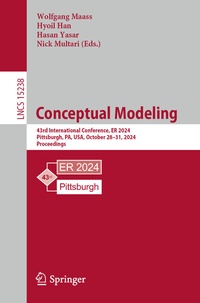
This book constitutes the proceedings of the 43rd International Conference on Conceptual Modeling, ER 2024, which took place in Pittsburgh, PA, USA, during October 28-31, 2024.
The 22 full papers presented in this volume were carefully reviewed and selected from 113 submissions.
They are grouped into the following topics: process modeling; advanced modeling languages; ontological modeling; domain and goal modeling; language models and conceptual modeling; applications of conceptual modeling.
More details
Other editions
Additional editions
Content
.- Process Modeling.
.- Enhancing BERT Performance: Multi-Teacher Adversarial Distillation with Clean and Robust Guidance.
.- On the Task-specific Effects of Fragmentation in Modular Process Models.
.- A Universal Prompting Strategy for Extracting Process Model Information from Natural Language Text using Large Language Models.
.- Agent System Event Data: Concepts, Dimensions, Applications.
.- Advanced Modeling Languages.
.- Multi-Faceted Evaluation of Modeling Languages for Augmented Reality Applications - The Case of ARWFML.
.- Application of the Tree-of-Thoughts Framework to LLM-Based Domain Modeling.
.- ECQL: Towards Succinct and Extensible Modeling of Multi-model Query Results.
.- Ontological Modeling.
.- An Analysis of the Semantic Foundation of KerML and SysML.
.- Portions of Matter and their Existential Events: An ontology-based conceptual model.
.- Model-Driven Design and Generation of Training Simulators for Reinforcement Learning.
.- Domain and Goal Modeling.
.- Generating Secure Workflow Designs from Requirements Goal Models Using Patterns.
.- Modeling and Reasoning about Explanation Requirements using Goal Models.
.- Enhancing Domain Modeling with Pre-trained Large Language Models: An Automated Assistant for Domain Modelers.
.- Language Models and Conceptual Modeling.
.- How Are LLMs Used for Conceptual Modeling? An Exploratory Study on Interaction Behavior and User Perception.
.- Small, Medium, and Large Language Models for Text-to-SQL.
.- Establishing Traceability between Natural Language Requirements and Software Artifacts by Combining RAG and LLMs.
.- Applications of Conceptual Modeling.
.- GenACT: An Ontology based Temporal Web Data Generator.
.- SAQI: An Ontology based Knowledge Graph Platform for Social Air Quality Index.
.- Conceptual Framework for Designing Hippocratic APIs.
.- The Role-Artifact-Function Framework for Understanding Digital Identity Models.
.- Ontological Foundations of Resilience.
.- Conceptual modelling method for digital twins.
