

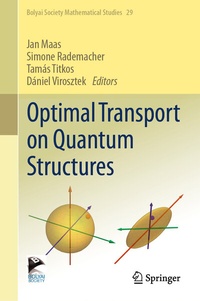
Optimal Transport on Quantum Structures
Description

The flourishing theory of classical optimal transport concerns mass transportation at minimal cost. This book introduces the reader to optimal transport on quantum structures, i.e., optimal transportation between quantum states and related non-commutative concepts of mass transportation. It contains lecture notes on
- classical optimal transport and Wasserstein gradient flows
- dynamics and quantum optimal transport
- quantum couplings and many-body problems
- quantum channels and qubits
These notes are based on lectures given by the authors at the "Optimal Transport on Quantum Structures" School held at the Erdös Center in Budapest in the fall of 2022. The lecture notes are complemented by two survey chapters presenting the state of the art in different research areas of non-commutative optimal transport.
More details
Other editions
Additional editions
Persons
Jan Maas is Professor at the Institute of Science and Technology Austria (ISTA). He holds a PhD degree from TU Delft and he was a post-doctoral researcher at the University of Warwick and the University of Bonn. He received an ERC Starting Grant in 2016. His research interests are in analysis and probability theory.
Simone Rademacher is a researcher in mathematical physics. She received her doctoral degree from the University of Zurich and was a post-doctoral researcher at the Institute of Science and Technology Austria (ISTA). Currently, she is an interim professor at the Ludwig-Maximilians University Munich (LMU).
Tamás Titkos is a researcher at the HUN-REN Alfréd Rényi Institute of Mathematics and an associate professor at Corvinus University of Budapest. He holds a PhD degree from Eötvös Loránd University. He is the recipient of the Youth Award and the Alexits Prize of the Hungarian Academy of Sciences. His research interest is in functional analysis.
Dániel Virosztek is a research fellow leading the Optimal Transport Research Group of the Rényi Institute. He got his Ph.D. degree in 2016 at TU Budapest and spent four years at the IST Austria as a postdoctoral researcher. He returned to Hungary with a HAS-Momentum grant in 2021. He is working on the geometry of classical and quantum optimal transport.
Content
Preface.- Chapter 1. An Introduction to Optimal Transport and Wasserstein Gradient Flows by Alessio Figalli.- Chapter 2. Dynamics and Quantum Optimal Transport:Three Lectures on Quantum Entropy and Quantum Markov Semigroups by Eric A. Carlen.- Chapter 3. Quantum Couplings and Many-body Problems by Francois Golse.- Chapter 4. Quantum Channels and Qubits by Giacomo De Palma and Dario Trevisan.- Chapter 5. Entropic Regularised Optimal Transport in a Noncommutative Setting by Lorenzo Portinale.- Chapter 6. Logarithmic Sobolev Inequalities for Finite Dimensional Quantum Markov Chains by Cambyse Rouzé.
