

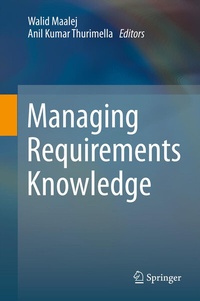
Managing Requirements Knowledge
Description

Requirements engineering is one of the most complex and at the same time most crucial aspects of software engineering. It typically involves different stakeholders with different backgrounds. Constant changes in both the problem and the solution domain make the work of the stakeholders extremely dynamic. New problems are discovered, additional information is needed, alternative solutions are proposed, several options are evaluated, and new hands-on experience is gained on a daily basis. The knowledge needed to define and implement requirements is immense, often interdisciplinary and constantly expanding. It typically includes engineering, management and collaboration information, as well as psychological aspects and best practices.
This book discusses systematic means for managing requirements knowledge and its owners as valuable assets. It focuses on potentials and benefits of "lightweight," modern knowledge technologies such as semantic Wikis, machine learning, and recommender systems applied to requirements engineering. The 17 chapters are authored by some of the most renowned researchers in the field, distilling the discussions held over the last five years at the MARK workshop series. They present novel ideas, emerging methodologies, frameworks, tools and key industrial experience in capturing, representing, sharing, and reusing knowledge in requirements engineering.
While the book primarily addresses researchers and graduate students, practitioners will also benefit from the reports and approaches presented in this comprehensive work.
Reviews / Votes
"This book shows how the best practitioners can become even better. It assembles 15 valuable research papers, contributed by 51 experts . presented at workshops between 2008 and 2013. . this assemblage and its contributing community are a valuable resource to those interested in advancing the state of the art." (Sushil Birla, Computing Reviews, October, 2015)
"This book delivers exciting insights into the benefits and use of knowledge technology for requirements engineering". Barbara Paech, University of Heidelberg, Germany; Spokeswoman of the SIG "Software Engineering" in the German Computer Science Society (GI)
"Managing requirements knowledge lies at the heart of understanding stakeholder's needs and building software systems that address those needs. This book assembles key research contributions that will serve as an invaluable resource for researchers and enlightened practitioners in the area." Bashar Nuseibeh, The Open University, UK; Editor-in-Chief of IEEE Transactions on Software Engineering
More details
Other editions
Additional editions
Persons
Walid Maalej recently became a professor of informatics at the University of Hamburg. Prior to that, he had led a research group on context and human aspects in software engineering at the TU Munich, where he also received his Master and Doctorate degrees. For the Managing Requirements Knowledge book, Walid brings in a unique multidisciplinary and internationally renowned research profile covering the fields of Knowledge Management, Empirical Software Engineering, and Requirements Engineering.
Anil Kumar Thurimella is currently leading Requirements Engineering and Management for the BMW Programs at Harman Automotive Division in Munich. He is also an external Senior Researcher at the TU Munich, where he completed his Master's degree and doctorate in Computer Science. For the Managing Requirements Knowledge book, Anil has contributed a unique blend of industrial and academic experience on Requirements Engineering.