

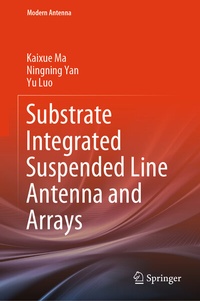
Substrate Integrated Suspended Line Antenna and Arrays
1st Edition
Published on 21. November 2023
IX, 227 pages
978-981-99-5011-9 (ISBN)
Description

This book delves deeply into the substrate integrated suspended line antenna technologies and evaluates its potential to replace conventional three-dimensional (3D) metal-based antennas. Over the years, studies on substrate integrated suspended line antennas have captivated engineers and scientists from the antennas and related engineering fields, all aiming to achieve low-cost and low-loss characteristics. The book establishes a fundamental framework for this topic, while emphasizing the importance of substrate integrated suspended line antennas in the wireless communication and radar systems. It is designed for undergraduate and graduate students who are interested in antenna technology, researchers investigating substrate integrated technology, and antenna engineers working on low-cost and low-loss antennas and arrays.
More details
Series
Language
English
Place of publication
Singapore
Singapore
Publishing group
Springer Singapore
Target group
Professional and scholarly
Product notice
Reflowable
Illustrations
IX, 227 p. 292 illus., 277 illus. in color.
File size
27,76 MB
ISBN-13
978-981-99-5011-9 (9789819950119)
DOI
10.1007/978-981-99-5011-9
Schweitzer Classification
Other editions
Additional editions
Kaixue Ma | Ningning Yan | Yu Luo
Substrate Integrated Suspended Line Antenna and Arrays
Book
11/2023
Springer
€149.79
Shipment within 3-4 weeks
Persons
Kaixue Ma
received B.E. and M.E. degrees from Northwestern Polytechnical University (NWPU), Xi'an, China, and Ph.D. degree from Nanyang Technological University (NTU), Singapore. From 1997 to 2002, he worked in Chinese Academy of Space Technology (Xi'an) as a group leader. From 2005 to 2007, he was with MEDs Technologies as an R&D Manager. From 2007 to 2010, he was with Singapore based public listed company ST Electronics as R&D manager, Project Leader, technique management Committee and technique consultant in 2011. From 2010 to 2013, he was with NTU as a Senior Research Fellow and Millimetre-wave RFIC team leader for 60-GHz Flagship Chipset project. From 2013 to 2018, He is Full Professor with the University of Electronic Science and Technology of China (UESTC), Chengdu, China. Since Feb. 2018, he has been the Dean and Distinguished Professor of the School of Microelectronics in Tianjin University, PI of National IC Innovation & Entrepreneurship Platform of Tianjin,the Director of Tianjin Key Laboratory of Imaging and Sensing Microelectronics Technology and the Chairperson of Tianjin IC Association. Dr. Ma proposed a variety of RF and microwave integrated circuits based on advanced CMOS, SiGe BiCMOS, GaAs and SOI technologies, and microwave circuit and system design technology patented with "quasi-planar circuits with embedded air cavity" named as SISL in publication. He was responsible for designing the first low-power reconfigurable 60 GHz SiGe millimetre-wave transceiver SOC, packaging and system testing, and completed a high-speed dual-chip wireless communication system. He is currently working on GaAs and silicon-based RF millimeter-wave and THz integrated circuits and systems for wireless communication and sensor applications. He has filed more than 40 patents, two books, over 170 IEEE journal articles and 190 international conference papers.
Dr. Ma is Fellow of Chinese Institute of Electronics and awardee ofthe Chinese National Science Fund for Distinguished Young Scholars. He received 10 technique awards including best paper award etc. He was Associate Editor for the IEEE Transactions on Microwave Theory and Techniques and Guest Editor of IEEE Microwave Magazine and the organizers for international conferences. He was the Coordinator IEEE MTT-S R10 for China and Singapore from 2016 to 2022 and current member of MTT-4 etc.
Ningning Yan received the B. E and Ph. D. degree from University of Electronic Science and Technology of China (UESTC), Chengdu, China, in 2012 and 2019, respectively. From 2016 to 2017, she was a joint Ph.D. student Scholar at the Applied Electromagnetics Laboratory, University of Houston, Houston, USA. Since 2019, she has been with Tianjin University, Tianjin, China, where She is currently an associate professor. She has authored and co-authored over 70 science citation index/engineering index (SCI/EI) indexed articles.
Her current research interests include substrate integrated suspended line (SISL) antennas, dielectric resonator antennas, Yagi antennas, leaky-wave antennas, multiband antennas, antenna arrays and feeding networks. She was the session chair of several international conferences and the serves as a reviewer of several international journals.
Yu Luo received his B.Eng. and Doctorate degrees in electronic engineering from South China University of Technology, Guangzhou, Guangdong, China, in 2010 and 2015, respectively. He worked as a research assistant at the University of Macau, Macau SAR, during Apr. 2014-Sep. 2014, worked as a post-doctoral fellow at the University of Victoria, BC, Canada, during Sep. 2015-Aug. 2016 and worked as a research fellow at National University of Singapore during Sep. 2016-Sep. 2018. Currently, he is a full professor in the School of Microelectronics, Tianjin University. He has authored orco-authored more than 120 technical papers, including IEEE Transactions on Antennas and Propagation (IEEE TAP), IEEE Transactions on Microwave Theory and Techniques (IEEE TMTT) and Proceedings of the National Academy of Sciences of the United States of America (PNAS). His research interest focuses on antennas in new-generation mobile communications and synthetic aperture radar (SAR) systems, such as SIW antennas, base-station antennas, circularly polarized antennas, MIMO antennas, Yagi-Uda antennas, and mmW/THz antennas.
He is the Co-Chair of the technical program committee (TPC) of UCMMT 2020 and associated editor of Frontiers of Physics. He is also the TPC member or the session chair of more than ten international conferences. He is the vice chair of IEEE Tianjin AP/MTT/SSC Joint Chapter. He is the TOP reviewer IEEE Transactions on Antennas and Propagation in 2021 and 2022. He won the second prize of the National Teaching Achievement Award in 2023.
Dr. Ma is Fellow of Chinese Institute of Electronics and awardee ofthe Chinese National Science Fund for Distinguished Young Scholars. He received 10 technique awards including best paper award etc. He was Associate Editor for the IEEE Transactions on Microwave Theory and Techniques and Guest Editor of IEEE Microwave Magazine and the organizers for international conferences. He was the Coordinator IEEE MTT-S R10 for China and Singapore from 2016 to 2022 and current member of MTT-4 etc.
Ningning Yan received the B. E and Ph. D. degree from University of Electronic Science and Technology of China (UESTC), Chengdu, China, in 2012 and 2019, respectively. From 2016 to 2017, she was a joint Ph.D. student Scholar at the Applied Electromagnetics Laboratory, University of Houston, Houston, USA. Since 2019, she has been with Tianjin University, Tianjin, China, where She is currently an associate professor. She has authored and co-authored over 70 science citation index/engineering index (SCI/EI) indexed articles.
Her current research interests include substrate integrated suspended line (SISL) antennas, dielectric resonator antennas, Yagi antennas, leaky-wave antennas, multiband antennas, antenna arrays and feeding networks. She was the session chair of several international conferences and the serves as a reviewer of several international journals.
Yu Luo received his B.Eng. and Doctorate degrees in electronic engineering from South China University of Technology, Guangzhou, Guangdong, China, in 2010 and 2015, respectively. He worked as a research assistant at the University of Macau, Macau SAR, during Apr. 2014-Sep. 2014, worked as a post-doctoral fellow at the University of Victoria, BC, Canada, during Sep. 2015-Aug. 2016 and worked as a research fellow at National University of Singapore during Sep. 2016-Sep. 2018. Currently, he is a full professor in the School of Microelectronics, Tianjin University. He has authored orco-authored more than 120 technical papers, including IEEE Transactions on Antennas and Propagation (IEEE TAP), IEEE Transactions on Microwave Theory and Techniques (IEEE TMTT) and Proceedings of the National Academy of Sciences of the United States of America (PNAS). His research interest focuses on antennas in new-generation mobile communications and synthetic aperture radar (SAR) systems, such as SIW antennas, base-station antennas, circularly polarized antennas, MIMO antennas, Yagi-Uda antennas, and mmW/THz antennas.
He is the Co-Chair of the technical program committee (TPC) of UCMMT 2020 and associated editor of Frontiers of Physics. He is also the TPC member or the session chair of more than ten international conferences. He is the vice chair of IEEE Tianjin AP/MTT/SSC Joint Chapter. He is the TOP reviewer IEEE Transactions on Antennas and Propagation in 2021 and 2022. He won the second prize of the National Teaching Achievement Award in 2023.
Content
Preface.- Chapter 1 Substrate Integrated Suspended Line.- Chapter 2 SISL Antenna Array Feeding Network.- Chapter 3 SISL Broadside Antenna.- Chapter 4 SISL Antennas Based on Characteristic Mode Analysis.- Chapter 5 SISL End-fire Antenna.- Chapter 6 SISL Filtering Antenna.- Chapter 7 Substrate Integrated Dielectric Resonant Antenna.- Chapter 8 Substrate Integrated Radar Antenna.
