

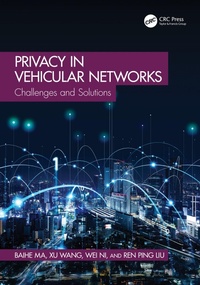
Privacy in Vehicular Networks
Challenges and Solutions
1st Edition
Published on 18. February 2025
188 pages
978-1-040-30272-9 (ISBN)
Description

In an era where vehicular networks and Location-Based Services (LBS) are rapidly expanding, safeguarding location privacy has become a critical challenge. Privacy in Vehicular Networks delves into the complexities of protecting sensitive location data within the dynamic and decentralized environment of vehicular networks. This book stands out by addressing both the theoretical and practical aspects of location privacy, offering a thorough analysis of existing vulnerabilities and innovative solutions.
This book meticulously examines the interplay between location privacy and the operational necessities of road networks. It introduces a differential privacy framework tailored specifically for vehicular environments, ensuring robust protection against various types of privacy breaches. By integrating advanced detection algorithms and personalized obfuscation schemes, the book provides a multi-faceted approach to enhancing location privacy without compromising data utility.
The key features of this book can be summarized as follows:
Comprehensive Analysis: Detailed examination of location privacy requirements and existing preservation mechanisms
Innovative Solutions: Introduction of a Personalized Location Privacy-Preserving (PLPP) mechanism based on Road Network-Indistinguishability (RN-I)
Advanced Detection: Utilization of Convolutional Neural Networks (CNN) for detecting illegal trajectories and enhancing data integrity
Collective Security: Implementation of the Cloaking Region Obfuscation (CRO) mechanism to secure multiple vehicles in high-density road networks
Holistic Approach: Joint Trajectory Obfuscation and Pseudonym Swapping (JTOPS) mechanism to seamlessly integrate privacy preservation with traffic management
Future-Ready: Exploration of upcoming challenges and recommendations for future research in vehicular network privacy
This book is essential for researchers, practitioners, and policymakers in the fields of vehicular networks, data privacy, and cybersecurity. It provides valuable insights for anyone involved in the development and implementation of LBS, ensuring they are equipped with the knowledge to protect user privacy effectively.
This book meticulously examines the interplay between location privacy and the operational necessities of road networks. It introduces a differential privacy framework tailored specifically for vehicular environments, ensuring robust protection against various types of privacy breaches. By integrating advanced detection algorithms and personalized obfuscation schemes, the book provides a multi-faceted approach to enhancing location privacy without compromising data utility.
The key features of this book can be summarized as follows:
Comprehensive Analysis: Detailed examination of location privacy requirements and existing preservation mechanisms
Innovative Solutions: Introduction of a Personalized Location Privacy-Preserving (PLPP) mechanism based on Road Network-Indistinguishability (RN-I)
Advanced Detection: Utilization of Convolutional Neural Networks (CNN) for detecting illegal trajectories and enhancing data integrity
Collective Security: Implementation of the Cloaking Region Obfuscation (CRO) mechanism to secure multiple vehicles in high-density road networks
Holistic Approach: Joint Trajectory Obfuscation and Pseudonym Swapping (JTOPS) mechanism to seamlessly integrate privacy preservation with traffic management
Future-Ready: Exploration of upcoming challenges and recommendations for future research in vehicular network privacy
This book is essential for researchers, practitioners, and policymakers in the fields of vehicular networks, data privacy, and cybersecurity. It provides valuable insights for anyone involved in the development and implementation of LBS, ensuring they are equipped with the knowledge to protect user privacy effectively.
More details
Edition
1. Auflage
Language
English
Place of publication
London
United Kingdom
Publishing group
Taylor & Francis Ltd
Target group
Professional and scholarly
College/higher education
Illustrations
14 Tables, black and white; 51 Line drawings, black and white; 51 Illustrations, black and white
ISBN-13
978-1-040-30272-9 (9781040302729)
Copyright in bibliographic data and cover images is held by Nielsen Book Services Limited or by the publishers or by their respective licensors: all rights reserved.
Schweitzer Classification
Other editions
Additional editions

Book
03/2025
CRC Press
Unfortunately, price unknown
Available (delivery time upon request)
Book
02/2025
1st Edition
CRC Press
€175.60
Shipment within 10-20 days

Book
02/2025
1st Edition
CRC Press
€72.90
Shipment within 10-20 days
Persons
Baihe Ma received his B.E. and M.E. degrees from Xidian University, China, in 2016 and 2019, respectively, and he received his Ph.D. degree from the University of Technology Sydney, Australia, in 2024. His primary research interests encompass cybersecurity, data privacy, location privacy, and trust management. He has published 26 papers and 5 patents.
Dr. Xu Wang received his B.E. from Beijing Information Science and Technology University, China, in 2010, and dual Ph.D. degrees from Beijing University of Posts and Telecommunications, China, in 2019 and the University of Technology Sydney, Australia, in 2020. He is currently a Senior Lecturer in the Faculty of Engineering and IT (FEIT) at UTS and teaches Cybersecurity subjects. His primary research interests encompass several domains, including blockchain, cybersecurity, vehicle privacy and security, IoT and AI. He has published 42 research papers and 3 patents.
Dr. Wei Ni3 received the B.E. and Ph.D. degrees in Communication Science and Engineering from Fudan University, Shanghai, China, in 2000 and 2005, respectively. He is a Principal Research Scientist at CSIRO, Sydney, Australia, a Fellow of IEEE, a Conjoint Professor at the University of New South Wales, an Adjunct Professor at the University of Technology Sydney, and an Honorary Professor at Macquarie University. He was a Postdoctoral Fellow at Shanghai Jiaotong University from 2005 to 2008; Deputy Project Manager at Bell Labs, Alcatel/Alcatel-Lucent from 2005 to 2008; and Senior Researcher at Nokia from 2008 to 2009. He has authored eight book chapters, more than 300 journal papers, more than 100 conference papers, 26 patents, and ten standard proposals accepted by IEEE. His research interests include machine learning, online learning, and stochastic optimization and their applications to the security, integrity, and efficiency of network systems. Dr. Ni has served as an Editor for IEEE Transactions on Vehicular Technology since 2022, IEEE Transactions on Wireless Communications since 2018, and Cambridge Press New Research Directions: Cyber-Physical Systems since 2022. He served as the Chair of the IEEE Vehicular Technology Society New South Wales Chapter from 2020 to 2022, the Secretary and then the Vice-Chair of the Chapter from 2015 to 2019, Track Chair for VTC-Spring 2017, Track Co-chair for IEEE VTC-Spring 2016, Publication Chair for BodyNet 2015, and Student Travel Grant Chair for WPMC 2014.
Ren Ping Liu received his B.E. degree from Beijing University of Posts and Telecommunications, China, and the Ph.D. degree from the University of Newcastle, Australia, in 1985 and 1996, respectively. Ren Ping Liu is a Professor and Head of the Discipline of Network & Cybersecurity at the University of Technology Sydney (UTS). As a research leader, a certified network professional, and a full-stack web developer, he has delivered networking and cybersecurity solutions to government agencies and industry customers. His research interests include wireless networking, 5G, IoT, Vehicular Networks, 6G, Cybersecurity, and Blockchain. He has supervised over 30 PhD students, and has over 200 research publications. Professor Liu was the winner of NSW iAwards 2020 for leading the BeFAQT (Blockchain-enabled Fish provenance And Quality Tracking) project. He was awarded the Australian Engineering Innovation Award 2012 and the CSIRO Chairman's Medal for his contribution to the Wireless Backhaul project. Professor Liu was the founding chair of the IEEE NSW VTS Chapter and a Senior Member of IEEE.
1https://scholar.google.com/citations?user=AfvXcVoAAAAJ&hl=en&oi=ao
2https://profiles.uts.edu.au/Xu.Wang-1
3https://people.csiro.au/N/W/Wei-Ni, https://www.unsw.edu.au/staff/wei-ni
4https://profiles.uts.edu.au/renping.liu
Dr. Xu Wang received his B.E. from Beijing Information Science and Technology University, China, in 2010, and dual Ph.D. degrees from Beijing University of Posts and Telecommunications, China, in 2019 and the University of Technology Sydney, Australia, in 2020. He is currently a Senior Lecturer in the Faculty of Engineering and IT (FEIT) at UTS and teaches Cybersecurity subjects. His primary research interests encompass several domains, including blockchain, cybersecurity, vehicle privacy and security, IoT and AI. He has published 42 research papers and 3 patents.
Dr. Wei Ni3 received the B.E. and Ph.D. degrees in Communication Science and Engineering from Fudan University, Shanghai, China, in 2000 and 2005, respectively. He is a Principal Research Scientist at CSIRO, Sydney, Australia, a Fellow of IEEE, a Conjoint Professor at the University of New South Wales, an Adjunct Professor at the University of Technology Sydney, and an Honorary Professor at Macquarie University. He was a Postdoctoral Fellow at Shanghai Jiaotong University from 2005 to 2008; Deputy Project Manager at Bell Labs, Alcatel/Alcatel-Lucent from 2005 to 2008; and Senior Researcher at Nokia from 2008 to 2009. He has authored eight book chapters, more than 300 journal papers, more than 100 conference papers, 26 patents, and ten standard proposals accepted by IEEE. His research interests include machine learning, online learning, and stochastic optimization and their applications to the security, integrity, and efficiency of network systems. Dr. Ni has served as an Editor for IEEE Transactions on Vehicular Technology since 2022, IEEE Transactions on Wireless Communications since 2018, and Cambridge Press New Research Directions: Cyber-Physical Systems since 2022. He served as the Chair of the IEEE Vehicular Technology Society New South Wales Chapter from 2020 to 2022, the Secretary and then the Vice-Chair of the Chapter from 2015 to 2019, Track Chair for VTC-Spring 2017, Track Co-chair for IEEE VTC-Spring 2016, Publication Chair for BodyNet 2015, and Student Travel Grant Chair for WPMC 2014.
Ren Ping Liu received his B.E. degree from Beijing University of Posts and Telecommunications, China, and the Ph.D. degree from the University of Newcastle, Australia, in 1985 and 1996, respectively. Ren Ping Liu is a Professor and Head of the Discipline of Network & Cybersecurity at the University of Technology Sydney (UTS). As a research leader, a certified network professional, and a full-stack web developer, he has delivered networking and cybersecurity solutions to government agencies and industry customers. His research interests include wireless networking, 5G, IoT, Vehicular Networks, 6G, Cybersecurity, and Blockchain. He has supervised over 30 PhD students, and has over 200 research publications. Professor Liu was the winner of NSW iAwards 2020 for leading the BeFAQT (Blockchain-enabled Fish provenance And Quality Tracking) project. He was awarded the Australian Engineering Innovation Award 2012 and the CSIRO Chairman's Medal for his contribution to the Wireless Backhaul project. Professor Liu was the founding chair of the IEEE NSW VTS Chapter and a Senior Member of IEEE.
1https://scholar.google.com/citations?user=AfvXcVoAAAAJ&hl=en&oi=ao
2https://profiles.uts.edu.au/Xu.Wang-1
3https://people.csiro.au/N/W/Wei-Ni, https://www.unsw.edu.au/staff/wei-ni
4https://profiles.uts.edu.au/renping.liu
Content
Abstract. List of Figures. List of Tables. 1. Introduction. 2. Earlier Development of LPPM. 3. Personalized Location Privacy with RN-I. 4. Vehicle Trajectory Obfuscation and Detection. 5. Cloaking Region Obfuscation for RN-I and Location Privacy. 6. Cooperative Trajectory Privacy Protection. 7. Conclusion. Bibliography. Index.
