

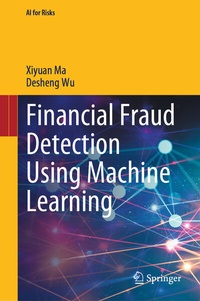
Financial Fraud Detection Using Machine Learning
Description

This book serves as a comprehensive guide to learning various aspects of financial fraud, encompassing the related research, the current situation, potential causes, implementation process, detection methods, regulatory penalties and management challenges in publicly listed companies. In this book, readers learn about the fraudulent practices that may occur in corporate operations, the executing mechanisms, an identifying indicators framework, and diverse detection methods including qualitative and quantitative models. Quantitative models include discriminant analysis, econometric analysis, and machine learning (ML) models. This book highlights the application of ML algorithms to detect financial fraud detection and discusses their limitations, such as high false-positive costs, delayed detection, the demand for interdisciplinary expertise, dependency on specific application scenarios, and issues with fraud data quality. Each related chapter provides a structured overview of the problems addressed, the algorithms used, experimental result and comparisons. Additionally, this book examines the cost-benefit trade-offs faced by companies engaging in financial fraud, considering factors such as ethical dilemmas, opportunities, practical needs, exposure risks, and litigation costs. This book is written for financial regulation institutions, business leaders, auditors, academics, and anyone interested in financial fraud detection. It offers practical insights into effectively preventing and controlling financial fraud and an overview of the latest advancements in ML technologies. Through real-world case studies, readers will gain a deeper understanding of the financial fraud, how ML can be used to detect it, as well as its pitfalls and limitations. Overall, this book bridges the gap between theory and application, equipping readers to understand how to detect financial fraud with the power of accounting and ML in the modern business environment.
More details
Other editions
Additional editions
Persons
Xiyuan Ma is a Postdoctoral Fellow in at the Institutes of Science and Development, Chinese Academy of Sciences. She has published multiple papers in journals such as Decision Support Systems and China Journal of Econometrics, with research interests in financial fraud, financial risk management, and government fund management.
Desheng Wu is a Distinguished Professor at the University of Chinese Academy of Sciences and a Professor at Stockholm University. He has published over 150 papers in journals such as Production and Operations Management, Decision Sciences, and Risk Analysis. With research interests in risk management and intelligent decision-making, he is a member of prestigious academic institutions including Academia Europaea and the European Academy of Sciences and Arts. Prof. Wu has received several notable awards and serves as an editor for various journals, including Risk Analysis and IEEE Transactions on Systems, Man, and Cybernetics.
Content
Introduction.- The Definition of Financial Fraud.- The Basic Theory of Financial Fraud.- Financial Fraud Litigation and Forensic Accounting.- Resampling Techniques and Feature Selection.- Detection Models and Applications.- Financial Fraud Detection Based on Litigation and Resampling Methods.- Financial Fraud Detection Based on Feature Selection and the GONE Framework.- Financial Fraud Detection Based on Multi-Source Data.- The Classical Case of Financial Fraud.
