

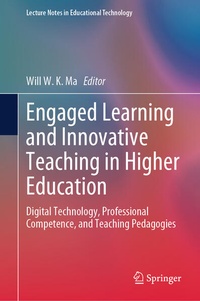
Engaged Learning and Innovative Teaching in Higher Education
Description

This book presents research studies investigating innovative curriculum design, effective teaching pedagogies, skilling and assessment of relevant competencies, and innovative and learning-associated technology. The book is categorized into three sections: (I) Innovative and digital learning environments; (II) Assessment and development of future professional competencies; and (III) Innovative curriculum design and teaching pedagogies. It serves as a useful resource for academic instruction in higher education. Employers, administrators, practitioners, postgraduate students, and postsecondary students in general will also find it informative.
More details
Other editions
Additional editions
Person
Professor Will W. K. Ma, Ph.D., is Professor and serves as Director of the Centre for Innovative Teaching and Learning (CITL) at Tung Wah College in Hong Kong. He earned a Ph.D. in educational technology from the University of Hong Kong and obtained his Master of Science (MSc) and Master of Philosophy (MPhil) in Information Systems Management from Hong Kong University of Science and Technology. Dr. Ma's study is concerned with the application of information systems to communication, knowledge sharing, and knowledge creation. He has published in journals such as Computers & Education, Computers in Human Behavior, Journal of Computer Assisted Learning, International Journal of Communications, Law and Policy, and Information & Management. He has also co-edited over ten books in the fields of education, communication, and technology. Dr. Ma is Co-editor of the Journal of Communication and Education (2015-present), and he was Editor of Cogent Social Sciences, Taylor & Francis Online (2017-2019). Since 2018, he has served as Editor of the Educational Communications and Technology Yearbook series (ECTY) published by Springer.
Content
Engaging Learning and Innovative Teaching.- Part I. Innovative and Digital Learning Environments.- Educators' experiences in enabling students learning for the VUCA World.- An examination and analysis of the integration of artificial intelligence and gamification in the pedagogy of Chinese higher education.- Peer learning to promote active learning in online/hybrid classes - a case study for science education.- Big data integration in digital marketing education: A focus group study.- The impacts of e-learning and virtual reality on diagnostic radiography education. Part II. Assessment and Development of Future Professional Competencies.- Vocational education input for a sustainable hospitality industry.- Closing competency gaps for engineering students using a competence-based assessment format.- Empowering the future of construction and quantity surveying professionals: Unveiling the skills revolution in New Zealand's construction industry.- Modelling of domain-specific competenceamong technicians (EQF 6) at higher education facilities in Germany and integration thereof in Ackerman9s PPIK Theory as a possible framework.- Re-validating an assessment tool to identify, assess, and develop higher education students' innovation competence in online education.- Part III. Innovative Curriculum Design and Teaching Pedagogies.- Work-life-study balance challenges and the overcoming strategies of women in the New Zealand construction industry.- A philosophical approach to teacher education.- The structure of vocational interests of future technicians (EQF 6) in mechanical engineering for interpreting technical drawings.- Technology-aided learning at the intersection of presence-at-hand and readiness-to-hand, and the fusion of horizons among students, technology, and teachers.- Existential relationship between teacher-centred and student-centred learning inauthentic solicitude as a necessary condition of authentic solicitude.- Hollowing out and reinventing higher education: An individualist perspective.
