

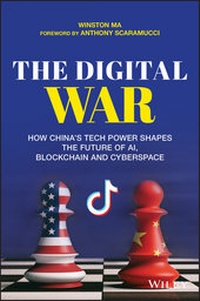
The Digital War
Description

China is the largest homogenous digital market on Earth: unified by language, culture, and mobile payments. Not only a consumer market of unrivaled size, it's also a vast and hyperactive innovation ecosystem for new technologies. And as China's digital economy moves from a consumer-focused phase to an enterprise-oriented one, Chinese companies are rushing to capitalize on ways the newer wave of tech--the Internet of Things, AI, blockchain, cloud computing, and data analytics (iABCD)--can unlock value for their businesses from non-traditional angles.
In The Digital War, Winston Ma--investment professional, capital markets attorney, adjunct professor of digital economy, and bestselling author--details the profound global implications of this new direction, including how Chinese apps for services such as food delivery expand so quickly they surpass their U.S. models within a couple of years, and how the sheer scale and pace of Chinese innovation might lead to an AI arms race in which China and the U.S. vie aggressively for leadership.
* How China's younger netizens participate in their evolving digital economy as consumers, creators, and entrepreneurs
* Why Online/Office (OMO, Online-merge-with-Offline) integration is viewed as the natural next step on from the O2O (Online-to-Offline) model used in the rest of the world
* The ways in which traditional Chinese industries such as retail, banking, and insurance are innovating to stay in the game
* What emerging markets can learn from China as they leapfrog past the personal computer age altogether, diving straight into the mobile-first economy
Anyone interested in what's next for Chinese digital powerhouses--investors, governments, entrepreneurs, international business players--will find this an essential guide to what lies ahead as China's flexes new digital muscles to create new forms of value and challenge established tech giants across the world.
More details
Other editions
Additional editions
Person
Content
Author's Notes and Acknowledgments xvii
About the Author xxi
Preface xxiii
Part One From "Mobile Economy" to "Digital Economy" 1
Chapter 1 China's Leap into 5G iABCD 3
Chapter 2 The World's Largest Mobile Economy 43
Part Two China's Digital Transformation and Innovation 71
Chapter 3 Big Data on the Digital Middle Class 73
Chapter 4 The AI-powered Internet Celebrities and Fans Economy 105
Chapter 5 The Heartland of Blockchain and Fintech 143
Chapter 6 O2O and the Shared Economy 178
Chapter 7 From C2C to 2CC: "Innovated in China" 210
Chapter 8 Land of Big Data and Its Legal Framework 241
Part Three Shared Digital Future 271
Chapter 9 The Tech Cold War 273
Chapter 10 The Silk Road in Cyberspace 301
Bibliography 333
China's Digital Innovation Challenges US Tech Supremacy 355
Index 357
Preface
In May 2017, China hosted the historical match of the weiqi game (the "Go" game) between Ke Jie, the world's No.1 ranked player and world champion, and the AI (artificial intelligence)-enabled computer Go program named AlphaGo, designed by the DeepMind Lab of the US internet giant Google. The Wuzhen showdown was ripe with suspense and symbolism-human versus machine, intuition versus algorithm, tradition versus modern, and with the AI machine's straight 3-0 win over the world's best human player, the unequivocal rise of the "digital economy".
Almost overnight, the internet business community in China started discussing "the second half" of the mobile economy era, which in 2013-2016 drove a boom in e-commerce and mobile entertainment. In particular, the image of a top human player crying at his loss to AI has triggered a great sense of determination and urgency among Chinese businesses and companies: either adapt to the fast-evolving technology of AI, big data analysis, and computer chips to upgrade - or be destroyed. Since 2017, the new key words have been data and intelligence.
As covered by my 2016 book China's Mobile Economy (published by Wiley and called one of "the best 2016 business books for Chief Information Officers" by i-CIO.com), China has built the world's largest mobile internet economy, powered by the world's largest group of internet users, smart devices, mobile applications, and social networks. China's digitally connected new middle class has led to a seismic change in the Chinese consumer market. Even for multinational corporations that have done business in China for many decades, a comprehensive rethink of their strategies in China may be necessary.
Today, China's consumer-focused Internet is transforming into a more enterprise-oriented Internet, characterized by faster 5G mobile networks and more advanced digital technologies, including the Internet of Things, artificial intelligence (AI), blockchain, cloud computing, and data analytics (iABCD). Across just about every industry sector, Chinese companies have rushed to learn how 5G iABCD digital technologies can be integrated into their businesses to unlock value from nontraditional angles (see figure above). In short, China is leaping forward from "mobile first" to "intelligence first".
For example, Tencent, one of the highest-valued Chinese internet companies, with its roots in gaming and online services, has made dramatic changes in response to the new trend. In 2018, for the first time in six years, Tencent announced a major restructuring to move from a consumer-only business toward one that caters to industries as well. The restructuring includes the creation of a new Cloud and Smart Industries Group, focusing on artificial intelligence, cloud service, Big Data and security; furthermore, Tencent has formed a new technology committee to better coordinate fundamental technology research across the company.
As a result, the next phase of development is referred to as the "second half game" of the mobile internet economy. The market expects far more profound and broader transformation of China's economy to come from "intelligent +" (data economy) than from earlier years of "internet +" (mobile economy). The years 2017 to 2018 were an even more important inflection point for China's digital transformation than the 2014-2015 inflection point (see the following figure). We are at the cusp of another major digital revolution in China.
This shift has profound implications for emerging markets that are looking at China as a reference case when they work on their own digital transformation. That means they need to look beyond mobile phone and digital wallet; instead, they must start positioning themselves for the next phase of AI and the digital economy - now. The billion-user messaging service of the WeChat app (Tencent), the US$30 billion and more total GMV (Gross Merchandise Value) in 24 hours on the Single's Day, and the "smile-to-pay" functions creating a cashless society are already snapshots from the past.
For example, yes, the November 11 (Singles' Day) festival remains the world's largest online shopping day, beating Black Friday and Cyber Monday combined. However, the highlight of late is no longer the GMV number but the advanced data technologies involved. Because the logistics issue of Singles' Day-the inventory, distribution and delivery of numerous orders close to US$40 billion in a short span of time-is such a challenge, Alibaba's logistics affiliate, Cainiao, has used AI techniques and GIS (Geographic Information System) to determine the fastest and most cost-effective delivery routes in a variety of complex road networks, including both rural villages and crowded urban areas.
As such, China's leaping forward may also give the rest of the world (emerging markets) a sense of urgency. But it may also be a leapfrogging opportunity for them, if those countries embrace the new technology revolution just as keenly. From "mobile" to "digital", what's truly extraordinary is the decisive commitment from the Chinese government. It plans to become possibly the world's first AI superpower through its ambitious move to embrace the AI and Fourth Industrial Revolutions.
Furthermore, in late 2019 President Xi urged that China should accelerate the development of blockchain to "seize the opportunity", in remarks that marked the first major world leader to issue such a strong endorsement of the widely hyped-but still unproven-technology. During the 2020 coronavirus pandemic, China launched the "New Infrastructure" initiative in May, which acts as a stimulus to help stabilize the economy against COVID-19 disruptions, as well as a foundation for China to stay competitive and succeed in the age of Industry 4.0.
Meanwhile, the rise of China's tech power has also disrupted the global competition landscape, challenging the long-held dominance of America's Silicon Valley. In fact, the years of 2019-2020 may be remembered as an important inflection point for the global digital economy, from collaborative co-existence to head-on tension. It is critical for the United States and China to reach a new equilibrium to collectively lead innovation in the age of AI because at the core of the digital economy is the free flow of trade, capital, intellectual, and data. Global dialogue and cooperation are ever more important for a shared digital future of the world.
The book is organized in three parts, as follows.
Part One: From "Mobile Economy" to "Digital Economy"
The two chapters in Part One lay the foundation for the rest of book. China is the largest homogenous digital market in the world, unified by the same language, culture, and mobile payment system. They provide an overview of China's mobile internet revolution during the last few years and how the mobile economy set up the foundation for the forthcoming industrial revolution.
Chapter 1: China's Leap into 5G iABCD
The opening chapter is an overview of China's digital transformation. Chinese internet companies have turned themselves into tech companies, and they subsequently help companies from all sectors of the economy to digitally transform. Blockchain is the latest addition to the innovation mix, and the Blockchain BaaS services from tech giants are enabling entrepreneurs to focus on building new applications, leading to a wave of blockchain startups in China.
Chapter 2: The World's Largest Mobile Economy
Chapter 2 explains the evolution of mobile internet businesses in China during the past years. In addition to the unrivalled internet user population size, what also makes the China market unique is the fact that China is the largest "mobile first" and "mobile only" market in the world. One extraordinary example is Singles' Day (a Chinese holiday on November 11, now the world's largest shopping day), which in 2019 had more than US$38 billion GMV in 24 hours, connecting buyers and sellers from more than 200 countries across the world-with more than 90% transacted from mobile terminals.
Still, China's mobile internet market shows no sign of slowing down in innovation, and the competition between the leading giants and the hungry upcomers is ever fierce. The mobile infrastructure, corresponding data accumulation, and industries digitalizing their businesses along the way, collectively provide a powerful foundation for China's AI innovation and digital transformation today.
Part Two: China's Digital Transformation and Innovation
The chapters in Part Two cover in detail Chinese companies' digital transformation, which is reshaping retail, financial, entertainment, transportation, lifestyle services, education, smart hardware, and many traditional industries. China is one of the most interesting innovation centers in the world and where the new generation startups are pioneering 5G iABCD innovation.
Chapter 3: Big Data on the Digital Middle Class
There is no longer a single, one-size-fits-all definition of the Chinese consumer. The key to all industry sectors is to personalize products and services to serve the varying needs and demands of millions...
