

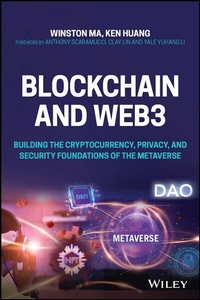
Blockchain and Web3
Description

In Blockchain and Web3: Building the Cryptocurrency, Privacy, and Security Foundations of the Metaverse, two tech and finance experts deliver a comprehensive and accessible guide to the present and future of blockchain technology and how it will form the foundation of a new, better internet.
To support a concept as bold as the Metaverse, we need several orders of magnitude more powerful computing capability, accessible at much lower latencies, across a multitude of devices and screens. You'll discover how blockchain can accelerate data flow, exchange, and transactions to create and transfer value around the world and, at the same time, how it can be used to protect user data privacy and security with decentralized web infrastructures. The book also includes:
* Discussions of how sovereign governments are entering the blockchain fray and how their entry, especially with CBDC digital currency, shapes the conversations around Web3
* Explorations of whether we will ever realize the holy grail of blockchain tech: interoperability to compete with Big Tech platforms
Discussion of new security and privacy issues rising from the intersection of Blockchain, Web3 and Metaverse.A fascinating and eye-opening treatment of the past, present, and future of blockchain and the role it will play on the internet and metaverse, Blockchain and Web3 is a truly original and engaging discussion of a timely and critical topic.
More details
Other editions
Additional editions
Persons
Ken Huang is CEO of DistributedApps and chair of Blockchain Security Working Group for Cloud Security Alliance in the Great China Region. Over the past 18 years, he has worked on application security, identity access management, cloud security, and blockchain for the fintech industry and health care industry. He is a Certified Information Systems Security Professional since 2007 and is the author of Blockchain Security Technical Guide, published by China Machine Press in 2018.
Content
Acknowledgments xvii
About the Authors xxiii
Preface xxvii
Part I Mega Convergence of Digital Technologies in Metaverse 1
Chapter 1 Metaverse: Convergence of Tech and Business Models 3
Chapter 2 Blockchain, the Backbone of Web3 33
Part II Blockchain Breakthroughs Set the Transaction, Privacy, and Security Foundation for the Digital Economy 69
Chapter 3 Cryptocurrencies and Tokenomics 71
Chapter 4 DeFi (Decentralized Finance): Bankless Metaverse 97
Chapter 5 NFTs, Creator Economy, and Open Metaverse 131
Chapter 6 Blockchain Gaming in Metaverse 157
Chapter 7 Metaverse Privacy: Blockchain vs. Big Tech 183
Chapter 8 Metaverse Security 217
Part III Three-Way War among Open Metaverse, Big Tech Walled Gardens, and Sovereign States 255
Chapter 9 Public Crypto, Government CBDC, and Big Tech Coin 257
Chapter 10 Web3 Creator Economy on Blockchain 289
Glossary 323
Index 349
Foreword
Great Leap Forward into Web3
In September 2017, JPMorgan Chase (America's largest investment bank firm) CEO Jamie Dimon called Bitcoin a "fraud." "It's worse than tulip bulbs. It won't end well. Someone is going to get killed," Dimon said. Now, its wealthiest clients can invest in the asset on the bank's own platform. The dramatic shift of JPMorgan is a significant milestone for the Bitcoin, as well as broad cryptocurrencies, as an asset class.
Various financial institutions like JPMorgan, both on Wall Street and in international governments, have had a very complicated relationship with cryptocurrency as a whole since Bitcoin (together with blockchain technology) first crashed onto the world stage 10 years ago. But as digital finance has accelerated by the pandemic, institutions actively explore new avenues to get involved in the crypto space. This institutional adoption has benefited not only Bitcoin but also the entire crypto asset industry, helping break barriers all across the board.
For example, Morgan Stanley, which has the country's largest wealth management unit with nearly $5 trillion in assets under management and advisement, has created Bitcoin products on its platform for ultra-high-net-worth investors. U.S. Bank, which is part of U.S. Bancorp, the fifth-largest bank in America announced a new cryptocurrency custody product. Goldman Sachs and other Wall Street banks have started looking into how to use bitcoin as collateral for cash loans to institutions.
Going beyond crypto investments and trading, Bank of America recently released a major research report, stating that they see a massive opportunity in the Metaverse, and that it could spur the wider adoption of the crypto industry. One of their top strategists said that he expects large traditional financial companies to enter the space once crypto assets gain wider adoption and usage in the metaverse, and it will finally cause cryptocurrencies to start being used widely for transactions.
In short, Bitcoin, crypto assets, and decentralized technologies (including blockchain) are much more than its financial origins, and this is becoming apparent around the world. Instead, it's about a new, better internet known as Web3. Digital assets and Web3 projects are radically changing how we invest, strategize business models, and deploy products and services. These projects have not only disrupted the thinking of institutional and professional investors, but also have inspired global brands and entrepreneurs to develop new products and services for both the physical and virtual worlds.
Blockchain is the backbone of Web3, which may be the next major platform in computing after the World Wide Web (Web1.0) and mobile internet (Web2.0). It is poised to revolutionize every industry and function, from finance and health care to media entertainment and real estate, creating trillions in new value - and the radical reshaping of society.
Ma has produced a terrific and highly accessible field guide to understanding how the digital economy is accelerating in the Web3 metaverse. A nationally certified software programmer as early as 1994, Ma has published many books on global tech revolution, including The Hunt for Unicorns: How Sovereign Funds Are Reshaping Investment in the Digital Economy (2020) and The Digital War - How China's Tech Power Shapes the Future of AI, Blockchain, and Cyberspace (2021). For both, I made similar book recommendations to major financial institutions, asset managers, hedge funds, as well as other key players and stakeholders.
As an investor, attorney, author, and adjunct professor in the global digital economy, Ma addressed the crypto-based Web3 metaverse from various perspectives, together with his co-author Ken Huang, a blockchain security expert. The authors' extensive, hands-on involvement in the deals and operations of this mystical world lends vibrancy as they recount practical, illustrative examples in a non-pedantic style. Together, their unique perspectives and differing approaches have produced a nuanced roadmap to the little-known past and exciting prospects of blockchain internet.
Sometimes a book sheds light on a little-known but powerful force. Sometimes it is timely because it catches the world at an inflection point. Rarely does a book accomplish both. With the arrival of Blockchain and Web3 from Winston Ma and Ken Huang, we have that rare beast: a book that, against the backdrop of the world-altering coronavirus epidemic, provides a thoughtful guide to the role blockchain and crypto assets play in the world-changing internet transformation - and how one accelerates the other.
Anthony Scaramucci
Founder and Managing Partner of SkyBridge
The Opportunities and Challenges of Metaverse
Covid-19 has accelerated digital transformation across the globe, from virtual meetings and electronic signatures to digital payments and remote supervision, just to name a few. In the meantime, another strong force is shaping up the next-generation internet, or Web3. We often hear the ingredients of Web3: blockchain, decentralized finance or DeFi, nonfungible tokens (NFTs), and most recently the metaverse. We hear the opportunities as well as challenges these emerging technologies bring about to individuals, organizations, and regulators, and become anxious every day.
As a fast-evolving field, Web3 and its enabling technologies are developing very rapidly. This makes it hard for people to stay current and make informed decisions as to how to take advantage of the opportunities, how to manage the risks, or simply, how to participate.
Luckily, Winston Ma and Ken Huang have provided readers of this book a very detailed picture of the current Web3 landscape. Having been practitioners in this space for many years, Winston and Ken give us a vivid account of the major events and players in each of the fields in the Web3 ecosystem, from technology innovation, new business models, participation by established companies whose current business may be disrupted, the various types and stances of cybersecurity hacks, to reactions from government regulators. This holistic view is beneficial for people to understand the development of this dynamic and complex ecosystem before they can take informed actions.
The year 2021 was marked as the year of the NFTs, when it became a buzzword for the masses and brought us landmark deals worth multimillion dollars. But many people do not understand what exactly they are getting into when they purchase an NFT generated from things like digital art. The recent story of the avid NFT collector, who paid $2.9 million for an NFT in 2021 but was not able to even get a bid close to $10,000 a year later, shows that people have different perceptions of what an NFT represents and what its intrinsic value is. Chapter 5 of the book provides the audience with useful information on this topic.
As Facebook changed its name to Meta in 2021, and Microsoft acquired gaming company Activision Blizzard for $68.7 billion in early 2022, many are puzzled about the value proposition of the metaverse, and what it means for them. The book provides a colorful account of how things like gaming, blockchain, NFTs, AR/VR, DAOs, and DeFi have converged and ultimately presented to us this whole package called metaverse. The chapters also present the challenges and opportunities that metaverse faces, prompting the audience to think about what these mean for their organization and for themselves.
Congratulations to Winston and Ken on a comprehensive and easy-to-read book that offers so much information and presents so many intriguing open questions for the audience to ponder and act on. Their research will elevate the level of understanding of Web3 by the blockchain and fintech communities and trigger actions that will help shape the next-generation internet for the benefit of humanity!
Clay Lin
Chief Information Security Officer (CISO)
World Bank Group
Blockchain: The Building Blocks of a Trusted Metaverse
Metaverse was predicted 30 years ago in Neal Stephenson's novel Snow Crash, where people interact as avatars within a high-definition virtual environment projected onto special goggles. Today, new digital technologies like blockchain will gradually join up and form the building blocks of the future metaverse, which could be the next generation of internet capable of transmitting 3D holograms and a lot more.
However, there are numerous potential obstacles - from technological and economical to political, security, and many other aspects - we must overcome to pave the way of the metaverse. From cloud computing's perspective, the majority of metaverse platform components will have to run on a secured cloud environment, which enforces zero trust and embraces blockchain innovations such as privacy preserving computing, decentralized storage, and decentralized identity as described in this book.
This book provides a valuable window into metaverse and covers the important building blocks for a trusted metaverse. Particularly, it explains blockchain as a critical technology to converge with metaverse. Cryptocurrencies, DeFi, NFT, gaming tokens, and other usage scenarios are discussed extensively in the book. Security and privacy have always been challenges to the internet and the digital world, and fortunately, they are paid full attention in the book as well. I have no doubt that you would enjoy state-of-the-art knowledge and insights on the...
