

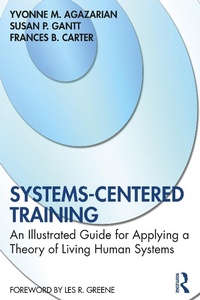
Systems-Centered Training
An Illustrated Guide for Applying a Theory of Living Human Systems
1st Edition
Published on 30. December 2020
258 pages
978-1-000-29104-9 (ISBN)
Description

This illustrated book shows how "thinking" systems offer new ways of seeing people which can help us see and do things differently. The authors describe how a theory of living human systems was developed and even recently revised. This major revision led to a theory of the person-as-a-system and its role-systems map that helps us see which system in us and in others is running the show.
The authors illustrate how life force energy fuels the hierarchy of living human systems and how theory and practice with role-systems can be useful in everyday life. They begin with describing how they have used the new illustrations as a map to locate the contexts of our roles. Using this map has also enabled the authors to identify the role-systems and explore the territory of ourselves and our groups in new ways that deepened our understanding of roles and role locks.
This book illustrates systems-centered therapy and training (SCT) theory by offering a practical theory to guide group psychotherapists, leaders and consultants in working with group dynamics.
The authors illustrate how life force energy fuels the hierarchy of living human systems and how theory and practice with role-systems can be useful in everyday life. They begin with describing how they have used the new illustrations as a map to locate the contexts of our roles. Using this map has also enabled the authors to identify the role-systems and explore the territory of ourselves and our groups in new ways that deepened our understanding of roles and role locks.
This book illustrates systems-centered therapy and training (SCT) theory by offering a practical theory to guide group psychotherapists, leaders and consultants in working with group dynamics.
Reviews / Votes
"A must read for all group therapists and anyone working with groups. Building on decades of scholarship and experience, this book is a triumph in theory and practice. It provides a penetrating guide and practical insights with extraordinary clarity and unparalleled depth into understanding and working with all dimensions of group life." - Francis Kaklauskas, Psy.D., CGP, FAGPA, Naropa University, University of Colorado, & Saybrook University"Reading this book was a deeply personal experience for me: opening to their idea of "seeing one's role in context rather than taking it just personally" and its useful ramifications for all of us who work with individuals, couples, families, groups or organizations. Helpful for both journeyman and senior practitioners, this compelling book discusses their wide range of system ideas integrating contemporary neuroscience, social science, psychology, and medicine." - Joshua M. Gross, Ph.D., ABPP, CGP, FAGPA, FAAGP, Director of Group Programs, Florida State University
"Yvonne never tired of trying to clarify and simplify her theory in order to make it as widely accessible as it deserves to be. Here is her final effort, aided and abetted by two of her closest collaborators. A great resource!" - Ken Eisold, Ph.D., President, The William Alanson White Institute
"The authors have illustrated their work with creative images (perhaps inspired by Kurt Lewin's influence) so that theory comes alive and is a true pleasure to read. Their new concept of the "person-as-a-system" completes a Theory of Living Human Systems (TLHS) and widens its applications. Beyond the theory, this is a handbook which can be used by practitioners for many years to come." - Christer Sandahl, Professor of Social and Behavioural Sciences, Karolinska Institutet, Stockholm, Sweden. Past president of the International Association for Group Psychotherapy and Group Processes (IAGP)
More details
Edition
1. Auflage
Language
English
Place of publication
London
United Kingdom
Publishing group
Taylor & Francis Ltd
Target group
College/higher education
Professional and scholarly
Illustrations
20 Tables, black and white; 142 Line drawings, black and white; 3 Halftones, black and white; 145 Illustrations, black and white
ISBN-13
978-1-000-29104-9 (9781000291049)
Copyright in bibliographic data and cover images is held by Nielsen Book Services Limited or by the publishers or by their respective licensors: all rights reserved.
Schweitzer Classification
Other editions
Additional editions
Yvonne M. Agazarian | Susan P. Gantt | Frances B. Carter
Systems-Centered Training
An Illustrated Guide for Applying a Theory of Living Human Systems
Book
12/2020
1st Edition
Routledge
€167.41
Shipment within 15-20 days
Yvonne M. Agazarian | Susan P. Gantt | Frances B. Carter
Systems-Centered Training
An Illustrated Guide for Applying a Theory of Living Human Systems
Book
12/2020
1st Edition
Routledge
€54.10
Shipment within 15-20 days
Persons
Yvonne M. Agazarian, Ed.D., developed a theory of living human systems and its systems-centered therapy and training. She loved theorizing and has authored six books and many articles in SCT.
Susan P. Gantt, Ph.D., taught group psychotherapy for Emory University School of Medicine, chairs the Systems-Centered Training and Research Institute (SCTRI) and leads ongoing SCT training groups in Atlanta, San Francisco and the Netherlands. She has published widely in SCT.
Frances B. Carter, MSW, is a founding member of SCTRI, co-directs the SCTRI Training and Resource Center, leads SCT training in the US and Europe. She brings her early background as an artist to all her work.
Susan P. Gantt, Ph.D., taught group psychotherapy for Emory University School of Medicine, chairs the Systems-Centered Training and Research Institute (SCTRI) and leads ongoing SCT training groups in Atlanta, San Francisco and the Netherlands. She has published widely in SCT.
Frances B. Carter, MSW, is a founding member of SCTRI, co-directs the SCTRI Training and Resource Center, leads SCT training in the US and Europe. She brings her early background as an artist to all her work.
Content
Introduction
Chapter 1 Illustrating the Nuts and Bolts of a Theory of Living Human Systems
Chapter 2 Energy, Information and Communication
Chapter 3 Transitions in SCT Theory and Practice 2013-2016
Chapter 4 Role-Systems: Theory and Implications
Chapter 5 Role-Systems in Systems-Centered Practice
Chapter 6 Exploring Our Inner-Person System Roles
Chapter 7 Implications for Practice from Our Role-Systems Map
Chapter 8 Theorizing About Phases of System Development
Chapter 9 Putting the Phases of System Development into Practice
Epilogue
Appendix
Chapter 1 Illustrating the Nuts and Bolts of a Theory of Living Human Systems
Chapter 2 Energy, Information and Communication
Chapter 3 Transitions in SCT Theory and Practice 2013-2016
Chapter 4 Role-Systems: Theory and Implications
Chapter 5 Role-Systems in Systems-Centered Practice
Chapter 6 Exploring Our Inner-Person System Roles
Chapter 7 Implications for Practice from Our Role-Systems Map
Chapter 8 Theorizing About Phases of System Development
Chapter 9 Putting the Phases of System Development into Practice
Epilogue
Appendix
