Alles über E-Books | Antworten auf Fragen rund um E-Books, Kopierschutz und Dateiformate finden Sie in unserem Info- & Hilfebereich.
Since its inception in 1968, software engineering has undergone numerous changes. In the early years, software development was organized using the waterfall model, where the focus of requirements engineering was on a frozen requirements document, which formed the basis of the subsequent design and implementation process. Since then, a lot has changed: software has to be developed faster, in larger and distributed teams, for pervasive as well as large-scale applications, with more flexibility, and with ongoing maintenance and quick release cycles.
What do these ongoing developments and changes imply for the future of requirements engineering and software design? Now is the time to rethink the role of requirements and design for software intensive systems in transportation, life sciences, banking, e-government and other areas. Past assumptions need to be questioned, research and education need to be rethought.
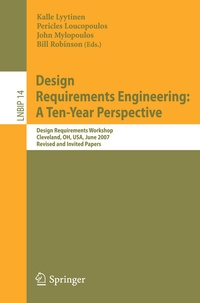
This book is based on the Design Requirements Workshop, held June 3-6, 2007, in Cleveland, OH, USA, where leading researchers met to assess the current state of affairs and define new directions. The papers included were carefully reviewed and selected to give an overview of the current state of the art as well as an outlook on probable future challenges and priorities. After a general introduction to the workshop and the related NSF-funded project, the contributions are organized in topical sections on fundamental concepts of design; evolution and the fluidity of design; quality and value-based requirements; requirements intertwining; and adapting requirements practices in different domains.
Series
Language
Place of publication
Publishing group
Illustrations
File size
ISBN-13
978-3-540-92966-6 (9783540929666)
DOI
10.1007/978-3-540-92966-6
Schweitzer Classification
High Impact Design Requirements - Key Design Challenges for the Next Decade.- High Impact Design Requirements - Key Design Challenges for the Next Decade.- Current and Future Research Directions in Requirements Engineering.- Requirements in the 21st Century: Current Practice and Emerging Trends.- Section 1: Fundamental Concepts of Design.- Section 1: Fundamental Concepts of Design.- The Evolution of Design Requirements in the Trajectory of Artificiality: A Research Agenda.- A Proposal for a Formal Definition of the Design Concept.- Incomplete by Design and Designing for Incompleteness.- Challenges in Requirements Engineering: A Research Agenda for Conceptual Modeling.- Section 2: Evolution and the Fluidity of Design.- Section 2: Evolution and the Fluidity of Design.- On the Inevitable Intertwining of Requirements and Architecture.- Requirements Evolution and What (Research) to Do about It.- Designs Can Talk: A Case of Feedback for Design Evolution in Assistive Technology.- Section 3: Quality and Value-Based Requirements.- Section 3: Quality and Value-Based Requirements.- Value-Based Requirements Traceability: Lessons Learned.- Impact of Requirements Quality on Project Success or Failure.- Designing Value-Based Inter-organizational Controls Using Patterns.- Section 4: Requirements Intertwining.- Section 4: Requirements Intertwining.- Exploring the Fitness Relationship between System Functionality and Business Needs.- A Framework for Business Process Change Requirements Analysis.- The Intertwining of Enterprise Strategy and Requirements.- Managing Legal Texts in Requirements Engineering.- Requirements' Role in Mobilizing and Enabling Design Conversation.- Design Requirements for Communication-Intensive Interactive Applications.- Requirements Engineering and Aspects.-Section 5: Adapting Requirements Practices in Different Domains.- Section 5: Adapting Requirements Practices in Different Domains.- On Technology Convergence and Platforms: Requirements Challenges from New Technologies and System Architectures.- Understanding Requirements for Open Source Software.