

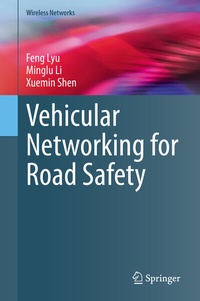
Vehicular Networking for Road Safety
1st Edition
Published on 6. August 2020
XIV, 162 pages
978-3-030-51229-3 (ISBN)
Description

The topics addressed in this book are crucial for both the academic community and industry, since the vehicular network has become an essential building block for intelligent transportation systems. The systematic principle of this book provides valuable guidance on the deployment and implementation of V2X-enabled road-safety applications. In addition, this book carries out structured technologies from the MAC layer to the link and network layer, which can provide a general introduction for interested readers with a comprehensive understanding of applying vehicular networks in enhancing road safety, and offers a systematized view for researchers and practitioners in the field of vehicular networks to help them optimize and improve the desired vehicular communication systems.
Road safety has always been the first priority for daily commuters on the road. Vehicular networks can be an effective solution to enhance road safety, via which vehicles can exchange cooperative awareness messages rapidly, contributing to better situation awareness and maneuvering cooperation. However, with the fast-changing network topology, intermittent wireless link, and dynamic traffic density, it is challenging to achieve satisfying network performance.
This book introduces the background of vehicular networks, provides a comprehensive overview of networking techniques in supporting road-safety applications, states the technical motivations per the MAC, link, and network layer, and proposes/designs vehicular networking technologies at the corresponding layer respectively to guarantee low-latency and reliable V2X communications for road-safety applications. By extending the proposed networking technologies to support all types of vehicular services, this book also outlines open issues and research directions in future 5G and beyond vehicular networks.
Road safety has always been the first priority for daily commuters on the road. Vehicular networks can be an effective solution to enhance road safety, via which vehicles can exchange cooperative awareness messages rapidly, contributing to better situation awareness and maneuvering cooperation. However, with the fast-changing network topology, intermittent wireless link, and dynamic traffic density, it is challenging to achieve satisfying network performance.
This book introduces the background of vehicular networks, provides a comprehensive overview of networking techniques in supporting road-safety applications, states the technical motivations per the MAC, link, and network layer, and proposes/designs vehicular networking technologies at the corresponding layer respectively to guarantee low-latency and reliable V2X communications for road-safety applications. By extending the proposed networking technologies to support all types of vehicular services, this book also outlines open issues and research directions in future 5G and beyond vehicular networks.
More details
Series
Language
English
Place of publication
Cham
Switzerland
Publishing group
Springer International Publishing
Target group
Professional and scholarly
Product notice
Reflowable
Illustrations
XIV, 162 p. 62 illus., 55 illus. in color.
File size
5,07 MB
ISBN-13
978-3-030-51229-3 (9783030512293)
DOI
10.1007/978-3-030-51229-3
Schweitzer Classification
Other editions
Additional editions
Feng Lyu | Minglu Li | Xuemin Shen
Vehicular Networking for Road Safety
Book
08/2020
Springer
€106.99
Shipment within 7-9 days
Persons
Feng Lyu
received the PhD degree from the Department of Computer Science and Engineering, Shanghai Jiao Tong University, Shanghai, China, in 2018, and the BS degree in software engineering from Central South University, Changsha, China, in 2013. He is currently a professor with the School of Computer Science and Engineering, Central South University, Changsha, China. During respective September 2018-December 2019 and October 2016-October 2017, he worked as a postdoctoral fellow and was a visiting PhD student in BBCR Group, Department of Electrical and Computer Engineering, University of Waterloo, Canada. His research interests include vehicular networks, beyond 5G networks, big data measurement and application design, and could/edge computing. He is a member of the IEEE Computer Society, Communication Society, and Vehicular Technology Society.
Minglu Li received the PhD degree in computer software from Shanghai Jiao Tong University in 1996. He is a fullprofessor and the director of Network Computing Center at Shanghai Jiao Tong University. He has published more than 350 papers in academic journals and international conferences. He was the chairman of Technical Committee on Services Computing (TCSVC) (2004-2016) and Technical Committee on Distributed Processing (TCDP) (2005-2017), of IEEE Computer Society in Great China region. He served as a general co-chair of IEEE SCC, IEEE CCGrid, IEEE ICPADS, and IEEE IPDPS, and a vice chair of IEEE INFOCOM. He also served as a TPC member for more than 50 international conferences including IEEE INFOCOM 2009-2016, IEEE CCGrid 2008, etc. His research interests include vehicular networks, big data, cloud computing, grid computing, and wireless sensor networks.
Xuemin Shen received the Ph.D. degree in electrical engineering from Rutgers University, New Brunswick, NJ, USA, in 1990. He is currently a University Professor with the Department of Electrical and Computer Engineering, University of Waterloo, Waterloo, ON, Canada. His research focuses on network resource management, wireless network security, social networks, 5G and beyond, and vehicular ad hoc and sensor networks. He is a registered Professional Engineer of Ontario, Canada, an Engineering Institute of Canada Fellow, a Canadian Academy of Engineering Fellow, a Royal Society of Canada Fellow, a Chinese Academy of Engineering Foreign Fellow, and a Distinguished Lecturer of the IEEE Vehicular Technology Society and Communications Society.
Dr. Shen received the R.A. Fessenden Award in 2019 from IEEE, Canada, James Evans Avant Garde Award in 2018 from the IEEE Vehicular Technology Society, Joseph LoCicero Award in 2015 and Education Award in 2017 from the IEEE Communications Society. He has also received the Excellent Graduate Supervision Award in 2006 from the University of Waterloo, and the Premier's Research Excellence Award (PREA) in 2003 from the Province of Ontario, Canada. He served as the Technical Program Committee Chair/Co-Chair for the IEEE Globecom'16, the IEEE Infocom'14, the IEEE VTC'10 Fall, the IEEE Globecom'07, the Symposia Chair for the IEEE ICC'10, the Tutorial Chair for the IEEE VTC'11 Spring, and the Chair for the IEEE Communications Society Technical Committee on Wireless Communications. He was the Editor-in-Chief of the IEEE INTERNET OF THINGS JOURNAL and Vice President on Publications of the IEEE Communications Society.
Minglu Li received the PhD degree in computer software from Shanghai Jiao Tong University in 1996. He is a fullprofessor and the director of Network Computing Center at Shanghai Jiao Tong University. He has published more than 350 papers in academic journals and international conferences. He was the chairman of Technical Committee on Services Computing (TCSVC) (2004-2016) and Technical Committee on Distributed Processing (TCDP) (2005-2017), of IEEE Computer Society in Great China region. He served as a general co-chair of IEEE SCC, IEEE CCGrid, IEEE ICPADS, and IEEE IPDPS, and a vice chair of IEEE INFOCOM. He also served as a TPC member for more than 50 international conferences including IEEE INFOCOM 2009-2016, IEEE CCGrid 2008, etc. His research interests include vehicular networks, big data, cloud computing, grid computing, and wireless sensor networks.
Xuemin Shen received the Ph.D. degree in electrical engineering from Rutgers University, New Brunswick, NJ, USA, in 1990. He is currently a University Professor with the Department of Electrical and Computer Engineering, University of Waterloo, Waterloo, ON, Canada. His research focuses on network resource management, wireless network security, social networks, 5G and beyond, and vehicular ad hoc and sensor networks. He is a registered Professional Engineer of Ontario, Canada, an Engineering Institute of Canada Fellow, a Canadian Academy of Engineering Fellow, a Royal Society of Canada Fellow, a Chinese Academy of Engineering Foreign Fellow, and a Distinguished Lecturer of the IEEE Vehicular Technology Society and Communications Society.
Dr. Shen received the R.A. Fessenden Award in 2019 from IEEE, Canada, James Evans Avant Garde Award in 2018 from the IEEE Vehicular Technology Society, Joseph LoCicero Award in 2015 and Education Award in 2017 from the IEEE Communications Society. He has also received the Excellent Graduate Supervision Award in 2006 from the University of Waterloo, and the Premier's Research Excellence Award (PREA) in 2003 from the Province of Ontario, Canada. He served as the Technical Program Committee Chair/Co-Chair for the IEEE Globecom'16, the IEEE Infocom'14, the IEEE VTC'10 Fall, the IEEE Globecom'07, the Symposia Chair for the IEEE ICC'10, the Tutorial Chair for the IEEE VTC'11 Spring, and the Chair for the IEEE Communications Society Technical Committee on Wireless Communications. He was the Editor-in-Chief of the IEEE INTERNET OF THINGS JOURNAL and Vice President on Publications of the IEEE Communications Society.
Content
1. Introduction.- 2. Vehicular Networking Techniques for Road-SafetyApplication.- 3. Mobility-Aware and Collision-Avoidance MAC Design.- 3. E?cient and Scalable MAC Design.- 4. Characterizing Urban V2V Link Communications.- Link-Aware Reliable Beaconing Scheme Design. 5.
