

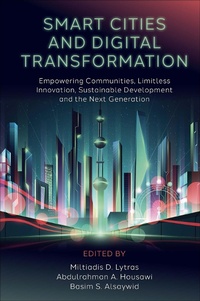
Smart Cities and Digital Transformation
Empowering Communities, Limitless Innovation, Sustainable Development and the Next Generation
Published on 14. June 2023
408 pages
978-1-80455-994-9 (ISBN)
Description

Smart Cities and Digital Transformation offers a three-tiered approach to tomorrow's cities in terms of limitless innovation, sustainable development and empowering communities.
Discussing key issues including civic engagement, communication, ethicality, participation and motivation, Smart Cities and Digital Transformation proposes best practices, applied research and lessons learnt in the fields of digital transformation and sustainable development. Authors integrate scientific knowledge and industry services with significant social sciences research to provide an end-to-end understanding of the components of future smart city applications or services. Emphasising emerging technologies such as artificial intelligence, cloud computing, open sources platforms and virtual reality, chapters also provide the reader with a unique analysis of a new generation of transparent technologies for the improvement of the quality of life and well-being in modern cities.
Employing an active learning approach focused on building critical thinking skills, Smart Cities and Digital Transformation serves a diverse ecosystem of industry changemakers to jointly mobilize a new form of economy directly linked to the development, value and impact of smart cities.
Discussing key issues including civic engagement, communication, ethicality, participation and motivation, Smart Cities and Digital Transformation proposes best practices, applied research and lessons learnt in the fields of digital transformation and sustainable development. Authors integrate scientific knowledge and industry services with significant social sciences research to provide an end-to-end understanding of the components of future smart city applications or services. Emphasising emerging technologies such as artificial intelligence, cloud computing, open sources platforms and virtual reality, chapters also provide the reader with a unique analysis of a new generation of transparent technologies for the improvement of the quality of life and well-being in modern cities.
Employing an active learning approach focused on building critical thinking skills, Smart Cities and Digital Transformation serves a diverse ecosystem of industry changemakers to jointly mobilize a new form of economy directly linked to the development, value and impact of smart cities.
More details
Language
English
Place of publication
Bingley
United Kingdom
Target group
Professional and scholarly
File size
9,67 MB
ISBN-13
978-1-80455-994-9 (9781804559949)
Copyright in bibliographic data and cover images is held by Nielsen Book Services Limited or by the publishers or by their respective licensors: all rights reserved.
Schweitzer Classification
Other editions
Additional editions
Miltiadis Lytras | Abdulrahman A. Housawi | Basim S. Alsaywid
Smart Cities and Digital Transformation
Empowering Communities, Limitless Innovation, Sustainable Development and the Next Generation
Book
06/2023
Emerald Publishing Limited
€129.10
Shipment within 3-4 weeks
Persons
Miltiadis D. Lytras is a world-class information systems expert and consultant. He is Research Professor at Deree College, the American College of Greece, Greece, Distinguished Scientist at King Abdulaziz University, Saudi Arabia, and Visiting Scholar at Effat University, Saudi Arabia.
Abdulrahman A. Housawi is a practicing Nephrologist and Transplant Physician at King Fahad Specialist Hospital, Dammam (KFSH-D), the Director of Privatization Affairs at the Ministry of Health (MoH) and the Chief Officer for Planning and Organizational Excellence at the Saudi Commission for Health Specialties (SCFHS).
Basim S. Alsaywid is a Consultant Pediatric Urologist in Urology Department at King Faisal Specialist Hospital and Research Center, Saudi Arabia, as well as the Director of Education and Research Skills at Saudi National Institute of Health Initiative.
Abdulrahman A. Housawi is a practicing Nephrologist and Transplant Physician at King Fahad Specialist Hospital, Dammam (KFSH-D), the Director of Privatization Affairs at the Ministry of Health (MoH) and the Chief Officer for Planning and Organizational Excellence at the Saudi Commission for Health Specialties (SCFHS).
Basim S. Alsaywid is a Consultant Pediatric Urologist in Urology Department at King Faisal Specialist Hospital and Research Center, Saudi Arabia, as well as the Director of Education and Research Skills at Saudi National Institute of Health Initiative.
Content
Chapter 1. Future Smart Cities Research: Indentifying the Next Generation Challenges; Miltiadis D. Lytras
Chapter 2. Accelerating the Digital Transformation of Smart Cities in Covid-19 Pandemic Context; Laura-Diana Radu and Ana Iolanda Voda
Chapter 3. Smart City 5.0 as Digital Ecosystem of Smart Services. Basic Concept; Miroslav Svitek and Sergei Kozhevnikov
Chapter 4. Digital Transformation: Management of Smart Cities; Andreia De Bem Machado, Joao Rodrigues Dos Santos, Antonio Sacavem, and Maria Jose Sousa
Chapter 5. Smart Citizen in Smart City; Weronika Dopierala-Kalinska and Szymon Ossowski
Chapter 6. Mobility and Health in the Smart City 3.0: Trends and Innovations in Italian Context; Chiara Garau, Giulia Desogus, Alfonso Annunziata, and Francesca Mighela
Chapter 7. Future Mobility - Digital Transformation of Automotive Companies as a Question of Organizational Identity; Angela Graf, Thomas Hess, Lea Mueller, and Fabian Zimmer
Chapter 8. Digital Transformation of City Branding: Comparison of the Role of Digital Communication in Branding Of Selected Cities in Europe and Slovakia; Darina Rojikova, Kamila Borsekova, Katarina Vitalisova, and Anna Vanova
Chapter 9. Designing Policy for Smart Cities; M. Cavada
Chapter 10. The Role of Commons in Smart Sustainable Development: A Hybrid Approach for the Recovery of Settlement Systems; Martina Bosone and Anna Onesti
Chapter 11.The Role Of Open Data In The Transformation To Society 5.0: A Resource Or A Tool For Sdg-Compliant Smart Living?; Anastasija Nikiforova, Miguel Angel Alor Flores, and Miltiadis D. Lytras
Chapter 12. Ai and Employability: Challenges and Solutions from This Technology Transfer; Regina Negri Pagani, Clayton Pereira De Sa, Alana Corsi, and Fabiane Florencio De Souza
Chapter 13. The Use of Iot Technology and Big Data in Smart Cities: Examples from Slovenia; Simona Stojanova, Jure Verhovnik, Andrej Kos, and Emilija Stojmenova Duh
Chapter 14. Cost-Benefit Analysis Of Advanced Metering Infrastructure Implementation For Strengthening Smart City In Indonesia; Zainal Arifin, Rudy Setyobudi, and Kartika Asri Elnur
Chapter 15. Digital Transformation and Smart Cities: Insights from the Healthcare Domain; Miltiadis D. Lytras, Basim Alsaywid, and Abdulrahman Housawi
Chapter 16. Smart City 5.0 as the digital ecosystem of smart services. Practical Applications; Miroslav Svitek, Sergei Kozhevnikov, Jiri Tencar, Sagnik Bhattacharjee, and Viktor Benes
Chapter 2. Accelerating the Digital Transformation of Smart Cities in Covid-19 Pandemic Context; Laura-Diana Radu and Ana Iolanda Voda
Chapter 3. Smart City 5.0 as Digital Ecosystem of Smart Services. Basic Concept; Miroslav Svitek and Sergei Kozhevnikov
Chapter 4. Digital Transformation: Management of Smart Cities; Andreia De Bem Machado, Joao Rodrigues Dos Santos, Antonio Sacavem, and Maria Jose Sousa
Chapter 5. Smart Citizen in Smart City; Weronika Dopierala-Kalinska and Szymon Ossowski
Chapter 6. Mobility and Health in the Smart City 3.0: Trends and Innovations in Italian Context; Chiara Garau, Giulia Desogus, Alfonso Annunziata, and Francesca Mighela
Chapter 7. Future Mobility - Digital Transformation of Automotive Companies as a Question of Organizational Identity; Angela Graf, Thomas Hess, Lea Mueller, and Fabian Zimmer
Chapter 8. Digital Transformation of City Branding: Comparison of the Role of Digital Communication in Branding Of Selected Cities in Europe and Slovakia; Darina Rojikova, Kamila Borsekova, Katarina Vitalisova, and Anna Vanova
Chapter 9. Designing Policy for Smart Cities; M. Cavada
Chapter 10. The Role of Commons in Smart Sustainable Development: A Hybrid Approach for the Recovery of Settlement Systems; Martina Bosone and Anna Onesti
Chapter 11.The Role Of Open Data In The Transformation To Society 5.0: A Resource Or A Tool For Sdg-Compliant Smart Living?; Anastasija Nikiforova, Miguel Angel Alor Flores, and Miltiadis D. Lytras
Chapter 12. Ai and Employability: Challenges and Solutions from This Technology Transfer; Regina Negri Pagani, Clayton Pereira De Sa, Alana Corsi, and Fabiane Florencio De Souza
Chapter 13. The Use of Iot Technology and Big Data in Smart Cities: Examples from Slovenia; Simona Stojanova, Jure Verhovnik, Andrej Kos, and Emilija Stojmenova Duh
Chapter 14. Cost-Benefit Analysis Of Advanced Metering Infrastructure Implementation For Strengthening Smart City In Indonesia; Zainal Arifin, Rudy Setyobudi, and Kartika Asri Elnur
Chapter 15. Digital Transformation and Smart Cities: Insights from the Healthcare Domain; Miltiadis D. Lytras, Basim Alsaywid, and Abdulrahman Housawi
Chapter 16. Smart City 5.0 as the digital ecosystem of smart services. Practical Applications; Miroslav Svitek, Sergei Kozhevnikov, Jiri Tencar, Sagnik Bhattacharjee, and Viktor Benes
