

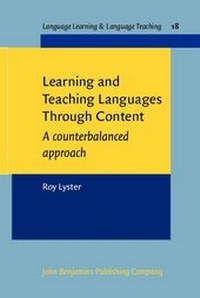
Learning and Teaching Languages Through Content
A counterbalanced approach
1st Edition
Published on 14. March 2007
XII, 173 pages
978-90-272-9261-2 (ISBN)
Description

Based on a synthesis of classroom SLA research that has helped to shape evolving perspectives of content-based instruction since the introduction of immersion programs in Montreal more than 40 years ago, this book presents an updated perspective on integrating language and content in ways that engage second language learners with language across the curriculum. A range of instructional practices observed in immersion and content-based classrooms is highlighted to set the stage for justifying a counterbalanced approach that integrates both content-based and form-focused instructional options as complementary ways of intervening to develop a learner's interlanguage system. A counterbalanced approach is outlined as an array of opportunities for learners to process language through content by means of comprehension, awareness, and production mechanisms, and to negotiate language through content by means of interactional strategies involving teacher scaffolding and feedback.
More details
Other editions
Additional editions
Book
03/2007
John Benjamins Publishing Co
€111.30
Shipment within 10-15 days
Person
Content
- Learning and Teaching Languages Through Content
- Editorial page
- Title page
- LCC data
- Dedication
- Table of contents
- Tables and figures
- Preface
- Introduction
- 1. Emphasizing language in content-based instruction
- 2. Characteristics and contexts of content-based instruction
- 3. Research on outcomes of immersion education
- 3.1. First language development and academic achievement
- 3.2. Social-psychological outcomes
- 3.3. Second language outcomes
- 4. Theoretical perspectives
- 5. Purpose of this book
- Instructional practices at the interface of language and content
- 1. Incidental focus on language
- 1.1. Linguistic challenges
- 2. Decontextualized grammar instruction
- 3. Form-focused instruction
- 3.1. Proactive approaches
- 3.2. Reactive approaches
- 4. Literacy instruction
- 4.1. Sequencing instruction in two languages
- 4.2. Whole language and process writing
- 4.3. Vocabulary and reading instruction
- 4.4. Language across the curriculum
- 5. Summary
- Processing language through content
- 1. Comprehension
- 2. Awareness
- 3. Production
- 3.1. Content-based tasks
- 3.2. Form-focused tasks
- 3.3. Skill acquisition through practice
- 4. Summary
- Negotiating language through content
- 1. Whole-class interaction
- 2. IRF exchanges and teacher questions
- 3. Negotiated scaffolding and feedback
- 3.1. Recasting
- 3.2. Negotiation for meaning
- 3.3. Negotiation of form
- 3.4. Classroom intervention studies
- 4. Counterbalanced feedback
- Counterbalanced instruction
- 1. Why a counterbalanced approach?
- 1.1. Support from research on proactive approaches
- 1.2. Support from research on reactive approaches
- 2. Engaging with language across the curriculum
- 3. Conclusion
- References
- Author index
- Subject index
- The series Language Learning & Language Teaching
