

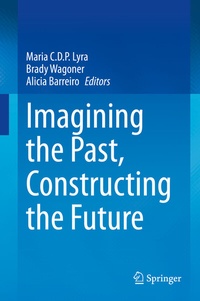
Imagining the Past, Constructing the Future
Description

More details
Other editions
Additional editions
Persons
Maria C.D.P. Lyra is a Professor of Psychology at the Federal University of Pernambuco, Brazil. She is interested in the process of human cultural development, the dynamic features through which human beings faces change and stability throughout their lives. She received her M. A. at Cornell University, U.S.A. and her Ph.D. at São Paulo University, Brazil. She coordinates a research laboratory - LabCCom - dedicated to the study of the process of emergence and development of the subject (self) in and through communication, concentrating on its microgenetic transformations embedded in sociocultural milieu. Culture and sign dynamics are particular relevant to explore diverse themes through reconstructive memory and imagination highlighting the process of internalization/externalization. She co- edited, Determinism and Indeterminism in Developmental and Social Science (Lawrence Welbaum, 1997), Dynamic Process Methodology in the Social and Developmental Sciences (Springer, 2009), Challenges and Strategies for Studying Human Development in Cultural Contexts (Firera & Liuzzo Publishing, 2009)
Brady Wagoner is Professor of Psychology and Director of the MA and PhD programs in Cultural Psychology at Aalborg University. He received his PhD from the University of Cambridge, where he also co-created the F.C. Bartlett Internet Archive. He is associate editor of the journals Culture & Psychology and Peace & Conflict. His research focuses on the cultural and constructive dimensions of the mind, particularly in relation to memory, imagination and social change. His most recent books include The Constructive Mind: Bartlett's Psychology in Reconstruction (Cambridge University Press, 2017), Handbook of Culture and Memory (Oxford University Press, 2018), The Psychology of Radical Social Change with Fathali Moghaddam and Jaan Valsiner (Cambridge University Press, 2018) and Remembering as a Cultural Process with Ignacio Bresco and Sarah H. Awad (Springer, 2019). He has received two early career awards from the American Psychological Association (divisions 24 and 26) and has held visiting fellowships at Institutes for Advanced Studies in Lyon and Madrid.
Alicia Barreiro is a PhD in Educational Sciences and Postdoctoral Studies in Social Sciences, Magister in Educational Psychology. She is a Professor of Genetic Psychology and Epistemology at the University of Buenos Aires, and an endowed researcher at the National Scientific and Technological Research Council (CONICET-Argentine) at the Latina American Faculty of Social Sciences. Also, she is Member of the Directive Board of the Jean Piaget Society and Associate Editor of the journal Papers on Social Representations. Her research interests are focused on the construction of social knowledge and moral development of children, adolescents and adults, combining social and developmental psychology approaches. Her most recent work explores how collective memory, collective moral judgements and social inequality constrain identity development and intergroup relations