

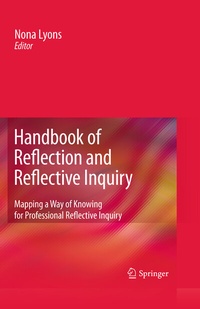
Handbook of Reflection and Reflective Inquiry
Description

Philosophers have warned of the perils of a life spent without reflection, but what constitutes reflective inquiry - and why it's necessary in our lives - can be an elusive concept. Synthesizing ideas from minds as diverse as John Dewey and Paulo Freire, theHandbook of Reflection and Reflective Inquiry presents reflective thought in its most vital aspects, not as a fanciful or nostalgic exercise, but as a powerful means of seeing familiar events anew, encouraging critical thinking and crucial insight, teaching and learning. In its opening pages, two seasoned educators, Maxine Greene and Lee Shulman, discuss reflective inquiry as a form of active attention (Thoreau's "wide-awakeness"), an act of consciousness, and a process by which people can understand themselves, their work (particularly in the form of life projects), and others. Building on this foundation, the Handbook analyzes through the work of 40 internationally oriented authors: - Definitional issues concerning reflection, what it is and is not; - Worldwide social and moral conditions contributing to the growing interest in reflective inquiry in professional education; - Reflection as promoted across professional educational domains, including K-12 education, teacher education, occupational therapy, and the law; - Methods of facilitating and scaffolding reflective engagement; - Current pedagogical and research practices in reflection; - Approaches to assessing reflective inquiry.
Educators across the professions as well as adult educators, counselors and psychologists, and curriculum developers concerned with adult learning will find the Handbook of Reflection and Reflective Inquiry an invaluable teaching tool for challenging times.
More details
Other editions
Additional editions
Content
Part III of the Handbook takes up a major component of the work to offer a rich set of data useful for comparisons, presenting a set of overviews of reflective inquiry in several professions: teacher education, the law, medicine, occupational therapy, nursing, social work, teaching, adult education and probation services. These vignettes comprise state of the art views of reflective practice within the profession, a brief historical overview, a description of the conceptualization of reflection, how it is employed and a view of where the profession is today and might be in the future. In brief, these chapters present nine professions.
Chapter 4: Teacher Education
Ken Zeichner and Katrina Yan Liu, the authors of this chapter, discuss different views of reflection as a goal for teacher education over the last 30 years. The authors do this with three critical questions in mind: the degree to which reflection in teacher education has resulted in genuine teacher development; the extent to which the goal of reflection has contributed to educational equity; and, the relationship between the goal of preparing reflective teachers and what we know about the realities of teachers’ work. Certain striking things are revealed: that in the 1970s there was no sizable research on teachers’ work and no real discussion of teacher thinking. This is an excellent opening discussion appropriate for looking historically at teaching and teacher education today. Also included in this chapter is a contrast case examining reflective practice in China.
Chapter 5: Education for the Law
In this chapter, author Filippa Anzalone traces the progress of legal education from the emphasis on a case-dialog method of its originator, Christopher Columbus Langdell of the Harvard Law School, to today’s experimentation and reform highlighting reflective practice. With the goal of teaching students and moving them from novices to expert levels, to think like a lawyer, the case method is nearly legendary in education for the law. Yet it is this method that is being challenged today, charged with being too pro forma, rigid, and cutting off useful questioning and critical thinking. Reflective practice is seen as providing opportunities to examine and test beliefs, one’s own as well as those of the profession. This chapter reviews this history and introduces ways of approaching teaching reflective practice for a new goal."
