

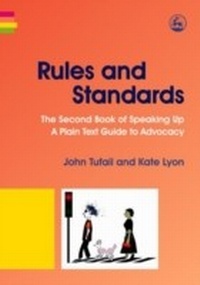
Rules and Standards
The Second Book of Speaking Up: A Plain Text Guide to Advocacy
1st Edition
Published on 15. February 2007
48 pages
978-1-84642-597-4 (ISBN)
Description

'The Four Books in this series; 'Introducing Advocacy', 'Rules and Standards', 'Listen Up!' and 'Advocacy in Action' are comprehensive, informative and quite simply a very good introduction for someone new to the world of advocacy.'
- Practice Links in Social Work
Advocacy for people with disabilities is widely practised, but what about self-advocacy? How often do parents or carers speak `for' you and prevent you being heard? Do you know your rights within advocacy law? The four books in the Speaking Up set were conceived and written specifically to promote self-advocacy to disabled individuals who want to learn how to speak up for themselves.
This second book in the series explores the idea of rules and standards for advocacy and looks at the advocacy charter. It covers issues such as whether an advocate should share a confidence if they are worried that their advocacy partner might self-harm.
All four books are illustrated throughout with colour drawings and case studies showing the positive results of self-advocacy on the individuals themselves, as well as on their families and carers.
This empowering training package encourages an equal partnership between the advocate and the user where the shared goal is to develop the life skills of the individual with learning difficulties. It is accessible to people with a wide range of literacy needs, including those with high learning needs and is designed for use in formal and informal learning situations, either unsupported or with a facilitator present.
- Practice Links in Social Work
Advocacy for people with disabilities is widely practised, but what about self-advocacy? How often do parents or carers speak `for' you and prevent you being heard? Do you know your rights within advocacy law? The four books in the Speaking Up set were conceived and written specifically to promote self-advocacy to disabled individuals who want to learn how to speak up for themselves.
This second book in the series explores the idea of rules and standards for advocacy and looks at the advocacy charter. It covers issues such as whether an advocate should share a confidence if they are worried that their advocacy partner might self-harm.
All four books are illustrated throughout with colour drawings and case studies showing the positive results of self-advocacy on the individuals themselves, as well as on their families and carers.
This empowering training package encourages an equal partnership between the advocate and the user where the shared goal is to develop the life skills of the individual with learning difficulties. It is accessible to people with a wide range of literacy needs, including those with high learning needs and is designed for use in formal and informal learning situations, either unsupported or with a facilitator present.
Reviews / Votes
'This second book in a four-volume training set gives people with disabilities and their advocacy partners backgrounds in the standard and accepted ethical practices of advocacy. Building from the information about types of disability advocacy in the first book, this covers the reasons why proper advocacy considers rules and standards, acceptable practices in confidentiality, duty of care and risk assessment and positive risk management. It concentrates on complex or delicate situations in which a person practicing self-advocacy or an advocate partner is faced with issues of disclosure (for example, when revealing a need may result in harm to the person with the need) or when making an issue public may result in more harm than good. whether short-term or long-term'. -- BookNews.comMore details
Language
English
Place of publication
London
United Kingdom
Target group
College/higher education
Professional and scholarly
Children/juvenile
ISBN-13
978-1-84642-597-4 (9781846425974)
Copyright in bibliographic data and cover images is held by Nielsen Book Services Limited or by the publishers or by their respective licensors: all rights reserved.
Schweitzer Classification
Other editions
Additional editions
Kate Lyon | John Tufail
Rules and Standards
The Second Book of Speaking Up: A Plain Text Guide to Advocacy
Book
02/2007
Jessica Kingsley Publishers
€32.00
Article not available at the moment
Persons
John Tufail and Kate Lyon are directors of People's Advocacy Network in Wellington, New Zealand. John Tufail has over 30 years' experience working in the disability sector, specialising in high communication needs. Since the 1980s, he has been increasingly involved in developing advocacy services. John has been lead investigator on a number of research projects into advocacy provision, both in the UK and internationally, and was central to the development of the UK's first university advocacy course at the University of East London. Kate Lyon is a self-employed graphic designer and web-page designer and the winner of four industry awards. She runs her own learning and design company, Merlin Design.
Content
1. Why We Need Rules and Standards. 2. Confidentiality. 3. Duty of Care and Risk Assessment. 4. Positive Risk Management.
