

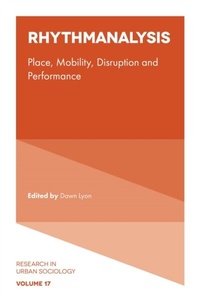
Rhythmanalysis
Place, Mobility, Disruption and Performance
1st Edition
Published on 26. November 2021
304 pages
978-1-83909-972-4 (ISBN)
Description

This collection brings together new and original research on the concept and practice of 'rhythmanalysis' in urban sociology as a means to analyse the relationship between the time and space of the city.
Originally proposed by French philosopher and urban scholar, Henri Lefebvre and his collaborator, Catherine Regulier, in the twentieth century, 'rhythmanalysis' continues to capture the attention of urban scholars today. Including in-depth analyses of the rhythms of place-making, this volume takes us from the City of London to the Caminito of Buenos Aires. Exploring the production of rhythm on the move - in cars and on the street - in relation to urban atmospheres and the implications of mobility for climate emergency, the chapters consider what happens when everyday urban rhythms are disrupted and reconfigured.
Delving into the mobilisation of the body, materials and technologies to make and detect rhythm, this collection sparks new interest in using rhythmanalysis as a mode of sensing and making sense of the complex entanglements of time and space at the heart of everyday urban life. It is an appealing read for scholars and students in urban sociology, social and cultural geography, mobilities studies, and the sociology and philosophy of time.
Originally proposed by French philosopher and urban scholar, Henri Lefebvre and his collaborator, Catherine Regulier, in the twentieth century, 'rhythmanalysis' continues to capture the attention of urban scholars today. Including in-depth analyses of the rhythms of place-making, this volume takes us from the City of London to the Caminito of Buenos Aires. Exploring the production of rhythm on the move - in cars and on the street - in relation to urban atmospheres and the implications of mobility for climate emergency, the chapters consider what happens when everyday urban rhythms are disrupted and reconfigured.
Delving into the mobilisation of the body, materials and technologies to make and detect rhythm, this collection sparks new interest in using rhythmanalysis as a mode of sensing and making sense of the complex entanglements of time and space at the heart of everyday urban life. It is an appealing read for scholars and students in urban sociology, social and cultural geography, mobilities studies, and the sociology and philosophy of time.
More details
Series
Language
English
Place of publication
Bingley
United Kingdom
Target group
Professional and scholarly
File size
12,26 MB
ISBN-13
978-1-83909-972-4 (9781839099724)
Copyright in bibliographic data and cover images is held by Nielsen Book Services Limited or by the publishers or by their respective licensors: all rights reserved.
Schweitzer Classification
Other editions
Additional editions
Book
11/2021
Emerald Publishing Limited
€141.60
Shipment within 3-4 weeks
Person
Dawn Lyon is Reader in Sociology in the School of Social Policy, Sociology and Social Research at the University of Kent, UK. She is author of What is Rhythmanalysis? (Bloomsbury, 2019).
Content
Introduction: Rhythm, Rhythmanalysis and urban life - Dawn Lyon
Chapter 1. From The Balcony to Caminito: An Ongoing Rhuthmanalysis; Salome Lopes Coelho;
Chapter 2. Eurhythmia and Arrythmia: Understanding Gendered Performances through Rhythm in the City of London; Louise Nash;
Chapter 3. Slow Motion Streets: Exploring Everyday Super-Diversity in a London Neighbourhood Through Video Rhythmanalysis; Katherine Stansfeld;
MOBILITY
Chapter 4. Rhythm as Energy in Space and Time: Engaging Rhythmanalysis With Climate Change and Urban Mobility Transitions; Gordon Walker;
Chapter 5. Street Rhythms in the 'Twilight zone': Crepuscular Urban Mobility Rhythms and Their Effects on the Atmospheres of Street Space; Jani Tartia;
Chapter 6. Rhythmanalysis in Taxicabs and Soft Cabs: A Report From Three North American cities; Donald Anderson;
Interlude: In Saint-Paul-de-Vence; Amy Sackville
DISRUPTION
Chapter 7. Recovering From a Disaster: A Rhythmanalytic Approach to Everyday Life in L'Aquila,Italy; Eirini Glynou Lefaki;
Chapter 8. Overtourism as a Worrying Tide: A Rhythmanalytic Experiment on Venetian Everyday Life; Guido Borelli;
Chapter 9. Persephonic Rhythms and The Seasonal Urbanization of Island Space: Tourism and Migration in Lesvos, Greece; Marina Karides;
PERFORMANCE
Chapter 10. Rhythmanalysis, Concrete Abstraction and the Quantified Self: Sonification and Performance Research as Remediation of Data; Harry Pitts, Eleanor Jean, and Yas Clarke;
Chapter 11. Fete or Pseudo-Fete? A Time-Lapse Rhythmanalysis of Outdoor Arts in the UK; James Macpherson;
Chapter 12. Counterpoint dancing: Towards a Rhythmanalysis of Interculturalism; Jessie Lauren Stein;
Afterword: Rhythmic Multiplicities: Seeking Order and Excitement; Tim Edensor
Chapter 1. From The Balcony to Caminito: An Ongoing Rhuthmanalysis; Salome Lopes Coelho;
Chapter 2. Eurhythmia and Arrythmia: Understanding Gendered Performances through Rhythm in the City of London; Louise Nash;
Chapter 3. Slow Motion Streets: Exploring Everyday Super-Diversity in a London Neighbourhood Through Video Rhythmanalysis; Katherine Stansfeld;
MOBILITY
Chapter 4. Rhythm as Energy in Space and Time: Engaging Rhythmanalysis With Climate Change and Urban Mobility Transitions; Gordon Walker;
Chapter 5. Street Rhythms in the 'Twilight zone': Crepuscular Urban Mobility Rhythms and Their Effects on the Atmospheres of Street Space; Jani Tartia;
Chapter 6. Rhythmanalysis in Taxicabs and Soft Cabs: A Report From Three North American cities; Donald Anderson;
Interlude: In Saint-Paul-de-Vence; Amy Sackville
DISRUPTION
Chapter 7. Recovering From a Disaster: A Rhythmanalytic Approach to Everyday Life in L'Aquila,Italy; Eirini Glynou Lefaki;
Chapter 8. Overtourism as a Worrying Tide: A Rhythmanalytic Experiment on Venetian Everyday Life; Guido Borelli;
Chapter 9. Persephonic Rhythms and The Seasonal Urbanization of Island Space: Tourism and Migration in Lesvos, Greece; Marina Karides;
PERFORMANCE
Chapter 10. Rhythmanalysis, Concrete Abstraction and the Quantified Self: Sonification and Performance Research as Remediation of Data; Harry Pitts, Eleanor Jean, and Yas Clarke;
Chapter 11. Fete or Pseudo-Fete? A Time-Lapse Rhythmanalysis of Outdoor Arts in the UK; James Macpherson;
Chapter 12. Counterpoint dancing: Towards a Rhythmanalysis of Interculturalism; Jessie Lauren Stein;
Afterword: Rhythmic Multiplicities: Seeking Order and Excitement; Tim Edensor
