

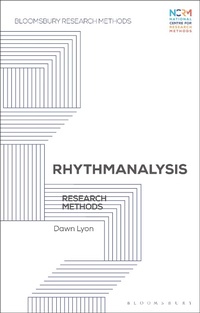
Rhythmanalysis
Research Methods
1st Edition
Published on 10. December 2020
144 pages
978-1-350-18892-1 (ISBN)
Description

First published Open Access under a Creative Commons license as What is Rhythmanalysis?, this title is now also available as part of the Bloomsbury Research Methods series.
In recent years, there has been growing interest in Henri Lefebvre's posthumously published volume, Rhythmanalysis. For Lefebvre and subsequent scholars, rhythmanalysis is a research strategy which offers a means of thinking space and time together in the study of everyday life, and this remains its strength and appeal.
This book addresses the task of how to do rhythmanalysis. It discusses the history and development of rhythmanalysis from Lefebvre to the present day in a range of fields including cultural history and studies of place, work and nature. For Lefebvre, it is necessary to be 'grasped by' a rhythm at a bodily level in order to grasp it. And yet we also need critical distance to fully understand it. Rhythmanalysis is therefore both corporeal and conceptual. This book considers how the body is directly deployed as a research tool in rhythmanalytical research as well as how audio-visual methods can get at rhythm beyond the capacity of the senses to perceive it. In particular, the book includes detailed discussion of research on different forms of mobility - from driving to dancing - and on the social life of markets - from finance to fish.
Dawn Lyon highlights the gains, limitations and lively potential of rhythmanalysis for spatially, temporally and sensually attuned practices of research. This engaging text will be of interest to students and researchers in sociology, criminology, socio-legal studies, geography, urban studies, architecture, anthropology, economics and cultural studies.
In recent years, there has been growing interest in Henri Lefebvre's posthumously published volume, Rhythmanalysis. For Lefebvre and subsequent scholars, rhythmanalysis is a research strategy which offers a means of thinking space and time together in the study of everyday life, and this remains its strength and appeal.
This book addresses the task of how to do rhythmanalysis. It discusses the history and development of rhythmanalysis from Lefebvre to the present day in a range of fields including cultural history and studies of place, work and nature. For Lefebvre, it is necessary to be 'grasped by' a rhythm at a bodily level in order to grasp it. And yet we also need critical distance to fully understand it. Rhythmanalysis is therefore both corporeal and conceptual. This book considers how the body is directly deployed as a research tool in rhythmanalytical research as well as how audio-visual methods can get at rhythm beyond the capacity of the senses to perceive it. In particular, the book includes detailed discussion of research on different forms of mobility - from driving to dancing - and on the social life of markets - from finance to fish.
Dawn Lyon highlights the gains, limitations and lively potential of rhythmanalysis for spatially, temporally and sensually attuned practices of research. This engaging text will be of interest to students and researchers in sociology, criminology, socio-legal studies, geography, urban studies, architecture, anthropology, economics and cultural studies.
More details
Series
Edition
1. Auflage
Language
English
Place of publication
London
United Kingdom
Publishing group
Bloomsbury Publishing PLC
Target group
College/higher education
ISBN-13
978-1-350-18892-1 (9781350188921)
Copyright in bibliographic data and cover images is held by Nielsen Book Services Limited or by the publishers or by their respective licensors: all rights reserved.
Schweitzer Classification
Other editions
Additional editions
Book
12/2020
Bloomsbury Academic
€81.70
Shipment within 15-20 days
Book
12/2020
Bloomsbury Academic
€25.00
Shipment within 15-20 days
Person
Content
Series Editor Foreword
1. Introduction to Rhythmanalysis
2. A Brief History of Rhythmanalysis
3. The Application of Rhythmanalysis
4. Gains and Limitations of Rhythmanalysis
5. Future Directions in Rhythmanalysis
6. Summary
Annotated Bibliography
Index
1. Introduction to Rhythmanalysis
2. A Brief History of Rhythmanalysis
3. The Application of Rhythmanalysis
4. Gains and Limitations of Rhythmanalysis
5. Future Directions in Rhythmanalysis
6. Summary
Annotated Bibliography
Index
