

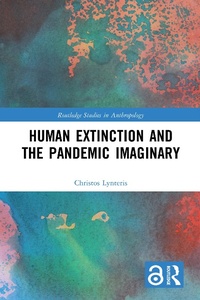
Human Extinction and the Pandemic Imaginary
1st Edition
Published on 19. September 2019
190 pages
978-1-000-69816-9 (ISBN)
Description

This book develops an examination and critique of human extinction as a result of the 'next pandemic' and turns attention towards the role of pandemic catastrophe in the renegotiation of what it means to be human. Nested in debates in anthropology, philosophy, social theory and global health, the book argues that fear of and fascination with the 'next pandemic' stem not so much from an anticipation of a biological extinction of the human species, as from an expectation of the loss of mastery over human/non-humanl relations. Christos Lynteris employs the notion of the 'pandemic imaginary' in order to understand the way in which pandemic-borne human extinction refashions our understanding of humanity and its place in the world. The book challenges us to think how cosmological, aesthetic, ontological and political aspects of pandemic catastrophe are intertwined. The chapters examine the vital entanglement of epidemiological studies, popular culture, modes of scientific visualisation, and pandemic preparedness campaigns. This volume will be relevant for scholars and advanced students of anthropology as well as global health, and for many others interested in catastrophe, the 'end of the world' and the (post)apocalyptic.
Reviews / Votes
"Lynteris' book shows clear connections between available narratives to experience biological emergencies and the measures at hand to handle a pandemic. By showing the wide span of the pandemic imaginary, and the way it is adopted and used by many different actors in western society, the book opens the door to continue exploring the significance of the apparently superfluous and its impact on our experienced reality. But ultimately, the book is at its most inspiring in its depiction of humanity's struggle to reinvent itself in relation to our environment. This is a struggle that we witness not only during pandemic times, but also more generally, as we face the environmental challenges resulting from the Anthropocene and its extractive relation to earth and nonhuman animals." --Jose A. Canada, Postdoctoral Researcher Faculty of Social Sciences University of HelsinkiMore details
Series
Edition
1. Auflage
Language
English
Place of publication
London
United Kingdom
Publishing group
Taylor & Francis Ltd
Target group
College/higher education
Illustrations
1 Tables, black and white; 1 Line drawings, black and white; 5 Halftones, black and white
File size
3,76 MB
ISBN-13
978-1-000-69816-9 (9781000698169)
Copyright in bibliographic data and cover images is held by Nielsen Book Services Limited or by the publishers or by their respective licensors: all rights reserved.
Schweitzer Classification
Other editions
Additional editions
Christos Lynteris
Human Extinction and the Pandemic Imaginary
Book
04/2021
1st Edition
Routledge
€69.00
Shipment within 15-20 days
Christos Lynteris
Human Extinction and the Pandemic Imaginary
Book
10/2019
Routledge
Unfortunately, price unknown
Available (delivery time upon request)
Christos Lynteris
Human Extinction and the Pandemic Imaginary
Book
09/2019
1st Edition
Routledge
€206.00
Shipment within 15-20 days
Person
Christos Lynteris is Senior Lecturer in Social Anthropology at the University of St Andrews, UK. His books for Routledge include Plague and the City (2018) and The Anthropology of Epidemics (2019).
Content
Introduction: the end of mastery
1.The end of the world as We Do Not Know It
2. Zoonotic transformations
3. Anthropogenesis reversed
4. The epidemiologist as culture hero
5. The post-pandemic condition
Conclusion: catastrophism beyond closure
Bibliography
1.The end of the world as We Do Not Know It
2. Zoonotic transformations
3. Anthropogenesis reversed
4. The epidemiologist as culture hero
5. The post-pandemic condition
Conclusion: catastrophism beyond closure
Bibliography
