

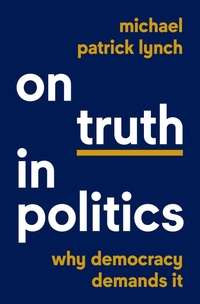
On Truth in Politics
Why Democracy Demands It
1st Edition
Published on 18. February 2025
264 pages
978-0-691-23194-5 (ISBN)
Description

The "philosopher of truth" (Jill Lepore, The New Yorker) shows why truth is an essential democratic value-and how it can be strengthened
Do any of us really care about truth when it comes to politics? Should we? In a world of big lies, denialism, and conspiracy theories, democracies are experiencing two interlocked crises: a loss of confidence in democracy itself and the growing sense among many that politics is only about power-not truth. In this book, Michael Patrick Lynch argues that truth not only can-but must-matter in politics. He shows why truth is an essential democratic value-a value we need to sustain our democratic way of life-and how it can be strengthened.
Despite evidence that people are rarely motivated by truth when it comes to politics, On Truth in Politics argues that this isn't inevitable. Accessibly written and rigorously argued, it draws on the American pragmatist tradition to develop an original theory of the nature and value of truth in the messy world of politics. Contrary to the belief of many, political beliefs can be true or false. But if democracy is to continue to be a space of reason and not just an arena of power, we must build a better infrastructure of knowledge, including stronger schools and media, and renew our commitment to science and history.
A vital and timely book, On Truth in Politics makes an original case for why democracy cannot survive without truth.
Do any of us really care about truth when it comes to politics? Should we? In a world of big lies, denialism, and conspiracy theories, democracies are experiencing two interlocked crises: a loss of confidence in democracy itself and the growing sense among many that politics is only about power-not truth. In this book, Michael Patrick Lynch argues that truth not only can-but must-matter in politics. He shows why truth is an essential democratic value-a value we need to sustain our democratic way of life-and how it can be strengthened.
Despite evidence that people are rarely motivated by truth when it comes to politics, On Truth in Politics argues that this isn't inevitable. Accessibly written and rigorously argued, it draws on the American pragmatist tradition to develop an original theory of the nature and value of truth in the messy world of politics. Contrary to the belief of many, political beliefs can be true or false. But if democracy is to continue to be a space of reason and not just an arena of power, we must build a better infrastructure of knowledge, including stronger schools and media, and renew our commitment to science and history.
A vital and timely book, On Truth in Politics makes an original case for why democracy cannot survive without truth.
More details
Other editions
Additional editions
Book
04/2025
Princeton University Press
€31.50
Shipment within 10-20 days
Person
Michael Patrick Lynch is Provost Professor of the Humanities and Board of Trustees Distinguished Professor of Philosophy at the University of Connecticut. His books include The Internet of Us: Knowing More and Understanding Less in the Age of Big Data and Know-It-All Society: Truth and Arrogance in Political Culture, winner of the Orwell Award for Distinguished Contribution to Honesty and Clarity in Public Language.
Content
- Cover
- Contents
- Preface and a Note to the Reader
- Introduction: "While Darkness Still Prevails
- Part I
- Chapter 1. Truth and the Twitbookians
- An Uncomfortable Thought
- Democracy as a Space of Reasons
- Political Meaning
- Truth and the Concept of the Political
- Chapter 2. The Many Uses of Political Judgment
- The Humean Attitude
- Belief, Commitment, and Why We Are Not (Always) Twitbookians
- Performative Politics
- Political Meaning and Political Forms of Life
- Chapter 3. Can Truth Be a Democratic Value
- Those Who Know
- Epistocracy and Political Meaning
- Is Truth Antidemocratic
- Truth as a Democratic Value
- Objections and Replies
- The Political Meaning of Falsity?
- PART II
- Chapter 4. Neither Made nor Found
- Found Political Truth
- Democratic Truth Without Foundations
- Habermas and Concordance
- Chapter 5. Truth as Normative: From Quietism to Pluralism
- Truth as a Logical Device
- The Twitbookians Strike Back
- Deflationary Explanations of Alethic Normativity
- From Quietism to Pluralism
- Chapter 6. Political Truth as Concordance
- Two Competing Ideas
- Superwarrant Redux
- Warrant for Belief and Political Inquiry
- Concordance
- Reasons, Public and Private
- Reasonable Pluralism and Political Forms of Life
- Appendix: Notes on Semantics and Logic
- Chapter 7. Epistemic Infrastructure and Democratic Hope
- Big Bald-Faced Lies
- Epistemic Disagreement
- Arrogance and Epistemic Colonization
- Epistemic Corruption and Democratic Hope
- Acknowledgments
- Notes
- Bibliography
- Index
