

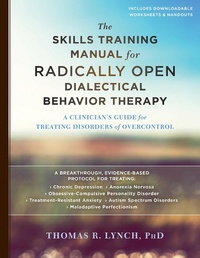
Skills Training Manual for Radically Open Dialectical Behavior Therapy
Description

Radically open dialectical behavior therapy (RO DBT) is a groundbreaking, transdiagnostic treatment model for clients with difficult-to-treat overcontrol (OC) disorders, such as anorexia nervosa, chronic depression, and obsessive-compulsive disorder (OCD). Written by the founder of RO DBT, Thomas Lynch, this is the first and only session-by-session training manual to help you implement this evidence-based therapy in your practice.
As a clinician, you're familiar with dialectical behavioral therapy (DBT) and its success in treating clients with emotion dysregulation disorders. But what about clients with overcontrol disorders? OC has been linked to social isolation, aloof and distant relationships, cognitive rigidity, risk aversion, a strong need for structure, inhibited emotional expression, and hyper-perfectionism. And yet-perhaps due to the high value our society places on the capacity to delay gratification and inhibit public displays of destructive emotions and impulses-problems linked with OC have received little attention or been misunderstood. Indeed, people with OC are often considered highly successful by others, even as they suffer silently and alone.
RO DBT is based on the premise that psychological well-being involves the confluence of three factors: receptivity, flexibility, and social-connectedness. RO DBT addresses each of these important factors, and is the first treatment in the world to prioritize social-signaling as the primary mechanism of change based on a transdiagnostic, neuroregulatory model linking the communicative function of human emotions to the establishment of social connectedness and well-being. As such, RO DBT is an invaluable resource for treating an array of disorders that center around overcontrol and a lack of social connectedness-such as anorexia nervosa, chronic depression, postpartum depression, treatment-resistant anxiety disorders, autism spectrum disorders, as well as personality disorders such as avoidant, dependent, obsessive-compulsive, and paranoid personality disorder.
In this training manual, you'll find an outline of RO DBT, including history, research, and how it differs from traditional DBT. You'll also find a session-by-session RO DBT outpatient treatment protocol, with sections that outline the weekly, one-hour individual therapy sessions and weekly two-and-a-half hour skills training classes that occur over a period of approximately thirty weeks. This includes instructor guidelines and user-friendly worksheets.
The feasibility, acceptability, and efficacy of RO DBT is evidence-based and informed by over twenty years of translational treatment development research. This important manual-along with its companion book, Radically Open Dialectical Behavior Therapy (available separately), distills the essential components of RO DBT into a workable program you can start using right away to improve treatment outcomes for clients suffering with OC.
More details
Other editions
Additional editions
Person
Thomas R. Lynch, PhD, FBPsS, is professor emeritus of clinical psychology at the University of Southampton school of psychology. Previously, he was director of the Duke Cognitive-Behavioral Research and Treatment Program at Duke University from 1998-2007. He relocated to Exeter University in the UK in 2007. Lynchs primary research interests include understanding and developing novel treatments for mood and personality disorders using a translational line of inquiry that combines basic neurobiobehavioral science with the most recent technological advances in intervention research. He is founder of radically open dialectical behavior therapy (RO DBT). Lynch has received numerous awards and special recognitions from organizations such as the National Institutes of Health-US (NIMH, NIDA), Medical Research Council-UK (MRC-EME), and the National Alliance for Research on Schizophrenia and Depression (NARSAD). His research has been recognized in the Science and Advances Section of the National Institutes of Health Congressional Justification Report; and he is a recipient of the John M. Rhoades Psychotherapy Research Endowment, and a Beck Institute Scholar.
Content
- Intro
- Chapter 1: Basic Principles, Treatment Overview, and Global Structure of Skills Training Classes
- Chapter 2: Dialectics, Radical Openness, and Self-Enquiry
- Chapter 3: Managing Problematic Behaviors in RO Skills Training Classes
- Chapter 4: Using the RO Skills Training Manual
- Chapter 5: The RO DBT Lesson Plans
- Lesson 1: Radical Openness
- Lesson 2: Understanding Emotions
- Lesson 3: Activating Social Safety
- Lesson 4: Enhancing Openness and Social Connection via Loving Kindness
- Lesson 5: Engaging in Novel Behavior
- Lesson 6: How Do Emotions Help Us?
- Lesson 7: Understanding Overcontrolled Coping
- Lesson 8: Tribe Matters
- Lesson 9: Social Signaling Matters!
- Lesson 10: Using Social Signaling to Live by Your Values
- Lesson 11: Mindfulness Training, Part 1
- Lesson 12: Mindfulness Training, Part 2
- Lesson 13: Mindfulness Training, Part 3
- Lesson 14: Mindfulness Training, Part 4
- Mindfulness Training, Part 4
- The "How" Skills
- Lesson 15: Interpersonal Integrity, Part 1
- Lesson 16: Interpersonal Integrity, Part 2
- Lesson 17: Interpersonal Effectiveness
- Lesson 18: Being Assertive with an Open Mind
- Lesson 19: Using Validation to Signal Social Inclusion
- Lesson 20: Enhancing Social Connectedness, Part 1
- Lesson 21: Enhancing Social Connectedness, Part 2
- Lesson 22: Learning from Corrective Feedback
- Lesson 23: Mindfulness Training, Part 1
- Lesson 24: Mindfulness Training, Part 2
- Lesson 25: Mindfulness Training, Part 3
- Lesson 26: Mindfulness Training, Part 4
- Lesson 27: Envy and Resentment
- Lesson 28: Cynicism, Bitterness, and Resignation
- Lesson 29: Learning to Forgive
- Lesson 30: RO Integration Week
- References
- Index
