

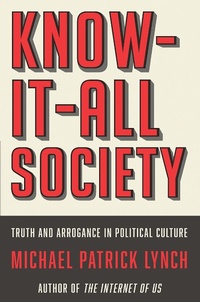
Know-It-All Society
Truth and Arrogance in Political Culture
Published on 13. August 2019
256 pages
978-1-63149-362-1 (ISBN)
Description

Winner • National Council of Teachers of English - George Orwell Award for Distinguished Contribution to Honesty and Clarity in Public Language
The "philosopher of truth” (Jill Lepore, The New Yorker) returns with a clear-eyed and timely critique of our culture's narcissistic obsession with thinking that "we” know and "they” don't.
Taking stock of our fragmented political landscape, Michael Patrick Lynch delivers a trenchant philosophical take on digital culture and its tendency to make us into dogmatic know-it-alls. The internet—where most shared news stories are not even read by the person posting them—has contributed to the rampant spread of "intellectual arrogance.” In this culture, we have come to think that we have nothing to learn from one another; we are rewarded for emotional outrage over reflective thought; and we glorify a defensive rejection of those different from us. Interweaving the works of classic philosophers such as Hannah Arendt and Bertrand Russell and imposing them on a cybernetic future they could not have possibly even imagined, Lynch delves deeply into three core ideas that explain how we've gotten to the way we are: • our natural tendency to be overconfident in our knowledge; • the tribal politics that feed off our tendency; • and the way the outrage factory of social media spreads those politics of arrogance and blind conviction. In addition to identifying an ascendant "know-it-all-ism” in our culture, Lynch offers practical solutions for how we might start reversing this dangerous trend—from rejecting the banality of emoticons that rarely reveal insight to embracing the tenets of Socrates, who exemplified the humility of admitting how little we often know about the world, to the importance of dialogue if we want to know more. With bracing and deeply original analysis, Lynch holds a mirror up to American culture to reveal that the sources of our fragmentation start with our attitudes toward truth. Ultimately, Know-It-All Society makes a powerful new argument for the indispensable value of truth and humility in democracy.More details
Other editions
Additional editions
Book
07/2020
Liveright Publishing Corporation
€17.50
Shipment within 3-4 weeks
Book
09/2019
Liveright Publishing Corporation
€45.99
Article exhausted; check different version
Person
Michael P. Lynch is Board of Trustees Distinguished Professor and director of the Humanities Institute at the University of Connecticut. His previous books include True to Life and The Internet of Us.
Content
- Intro
- Title
- Contents
- Preamble: No Ordinary Question
- 1. Montaigne's Warning
- Nothing More Wretched
- Like Ears of Corn
- A Very Social Attitude
- 2. The Outrage Factory
- Google Knows All
- Fake News and Information Pollution
- Sharing Emotions
- 3. Where the Spade Turns
- Why We Don't Change Our Minds
- What Kind of Person Are You?
- From Belief to Conviction
- 4. Ideologies of Arrogance and the American Right
- Roots of Authoritarianism
- Telling It Like It Is
- The Logic of Status Threat
- Arrogance, Ignorance, and Contempt
- 5. Liberalism and the Philosophy of Identity Politics
- Arrogant Liberals
- Misunderstanding the Politics of Identity
- The Rationality Brand
- The Politics of Contempt
- 6. Truth and Humility as Democratic Values
- Socratic Lessons
- Intellectual Humility
- A Space of Reasons
- Truth and Democracy
- Acknowledgments
- Notes
- References and Additional Sources
- Index
- Also by Michael Patrick Lynch
- Copyright
