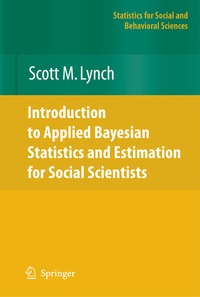
Introduction to Applied Bayesian Statistics and Estimation for Social Scientists
Description

"Introduction to Applied Bayesian Statistics and Estimation for Social Scientists" covers the complete process of Bayesian statistical analysis in great detail from the development of a model through the process of making statistical inference. The key feature of this book is that it covers models that are most commonly used in social science research - including the linear regression model, generalized linear models, hierarchical models, and multivariate regression models - and it thoroughly develops each real-data example in painstaking detail.
The first part of the book provides a detailed introduction to mathematical statistics and the Bayesian approach to statistics, as well as a thorough explanation of the rationale for using simulation methods to construct summaries of posterior distributions. Markov chain Monte Carlo (MCMC) methods - including the Gibbs sampler and the Metropolis-Hastings algorithm - are then introduced as general methods for simulating samples from distributions. Extensive discussion of programming MCMC algorithms, monitoring their performance, and improving them is provided before turning to the larger examples involving real social science models and data.
Reviews / Votes
From the reviews:"The book . contains a very detailed and comprehensive description of MCMC methods useful for applied researchers. . Undoubtedly the book is interesting . . The reader will gain an extensive knowledge of the issues covered . ." (Dimitris Karlis, Zentralblatt MATH, Vol. 1133 (11), 2008)"This new offering adds to our burgeoning Bayesian bookshelves a text directed at social scientists . . To summarize, this a very useful text for a tightly bounded semester-long introduction to Bayesian statistics in the social sciences. The text is distinguished by its hands-on practical orientation which many readers will find very appealing. . In addition, the book is handy for self-study . ." (Jeff Gill, Journal of the American Statistical Association, Vol. 103 (483), September, 2008)"This book introduces readers to the world of Bayesian analysis and MCMC methods through brief discussions of theory, examples, and programming computations for pplications. ...The potential users of the book are students or researchers in the social sciences, or anyone that is interested in learning Bayesian techniques and MCMC methods and applying them to their practice. The book is geared... towards practical applications. ... I recommended this book to anyone who is interested in learning about Bayesian inference and MCMC methods." (Journal of Educational Measurement . Summer 2010, Vol. 47, No 2, pp. 250-254)More details
Other editions
Additional editions